
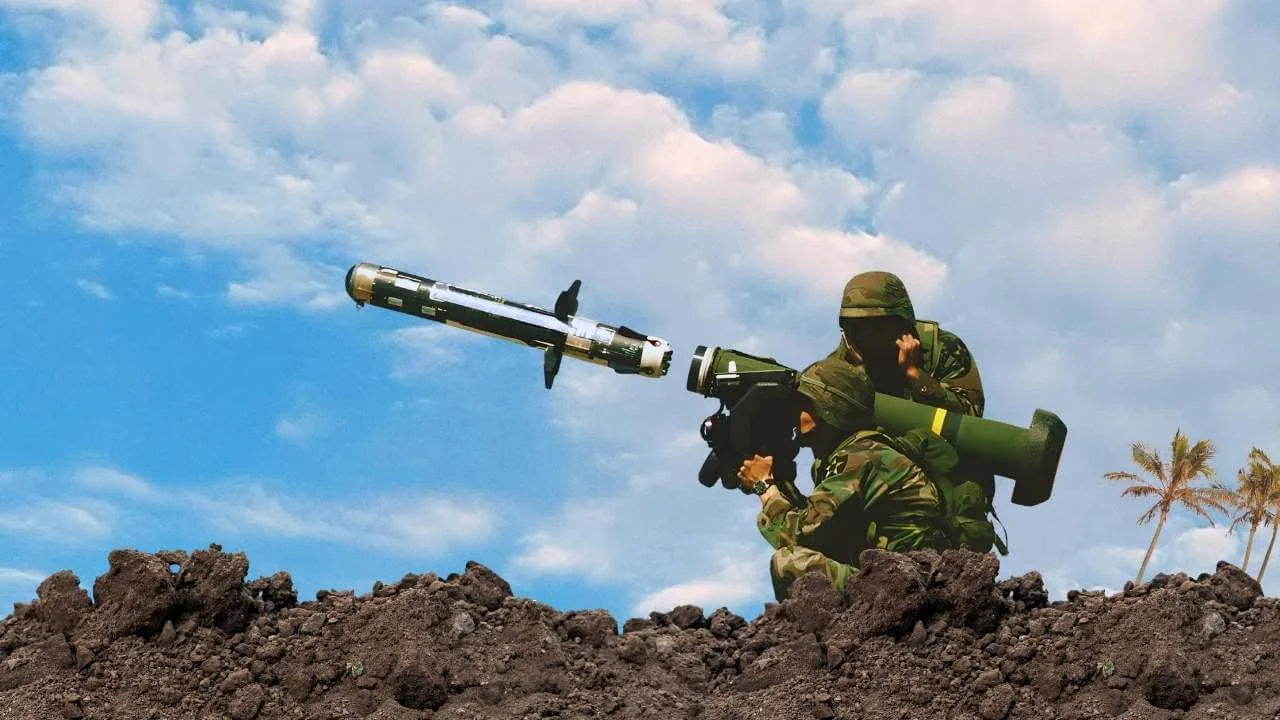
To explore the co-production of the American Javelin anti-tank missile system on Indian soil, an agreement has been signed between India and the United States. The development comes as a transformative step towards deeper defence cooperation between the two nations.
Tata Advanced Systems Limited (TASL) and the Javelin Joint Venture (JJV)—comprising Lockheed Martin and Raytheon—signed a Memorandum of Understanding to establish an Indian facility for the final assembly and integration of the Javelin All Up Round, alongside selected component production.
This follows India’s formal agreement to acquire Javelin systems via Foreign Military Sales. While initial procurement brings state-of-the-art weaponry, the Tata–Javelin accord grants Indian industry a larger, structural role in the supply chain, marking a mature evolution in bilateral defence ties.
What the Javelin Brings to India’s Military Arsenal
The Javelin is a man-portable, fire-and-forget anti-tank guided missile designed to destroy armoured vehicles and fortified positions. Its lightweight portability allows infantry units to deploy advanced anti-armour capability without relying entirely on heavier vehicle-mounted platforms. For the Indian Army, the Javelin significantly upgrades its anti-armour capabilities and modernises its land forces for challenging border environments.
Scope and Boundaries
The agreement does not mean the entire missile will immediately be manufactured in India. Instead, TASL and the JJV will establish a facility for final assembly and integration of the Javelin All Up Round, alongside targeted sub-component production. The framework preserves core American elements: Lockheed Martin will produce sub-assembly kits in Troy, Alabama, while Raytheon manufactures guidance electronics in Tucson, Arizona. These components will be supplied to India for final assembly and rigorous testing by TASL.
Fuelling India’s Defence Manufacturing Goals
The agreement aligns directly with India’s Make in India and Atmanirbhar Bharat frameworks, which seek to reduce import dependence and expand domestic defence exports. As a major private-sector participant, TASL’s leadership role in the Javelin programme will catalyse its engineering capabilities and integrate private firms more deeply into sophisticated defence production. Furthermore, the venture creates lucrative opportunities for secondary domestic suppliers and micro, small, and medium enterprises (MSMEs). This localised participation cultivates specialised engineering talent and world-class quality-assurance capabilities applicable across other defence platforms.
Deepening the Broader India–US Strategic Partnership
The Javelin agreement reflects a multi-dimensional transformation in India–US cooperation over the past two decades, expanding from basic procurement into joint exercises, technology sharing, and strategic coordination. US Ambassador to India Sergio Gor lauded the MoU as a “major step forward,” noting it creates commercial opportunities for American firms while supporting India’s resilient domestic industrial base. Geopolitically, as a cornerstone US partner in the Indo-Pacific, India’s integration into advanced supply chains contributes to regional stability and deterrence. This industrial alignment insulates the bilateral relationship against external shocks and anchors it in mutual security interests.
Strategic Significance and the Road Ahead
The TASL and Javelin Joint Venture agreement marks a watershed moment in contemporary India–US defence cooperation. Although it stops short of immediate standalone greenfield production, it builds a robust framework for final assembly and component manufacturing within India. By advancing self-reliance while embedding Indian industry into international supply chains, this partnership serves as a win-win template. If executed smoothly, the Javelin collaboration will pave the way for future co-development initiatives, cementing a lasting legacy of technological synergy and strategic trust.

