
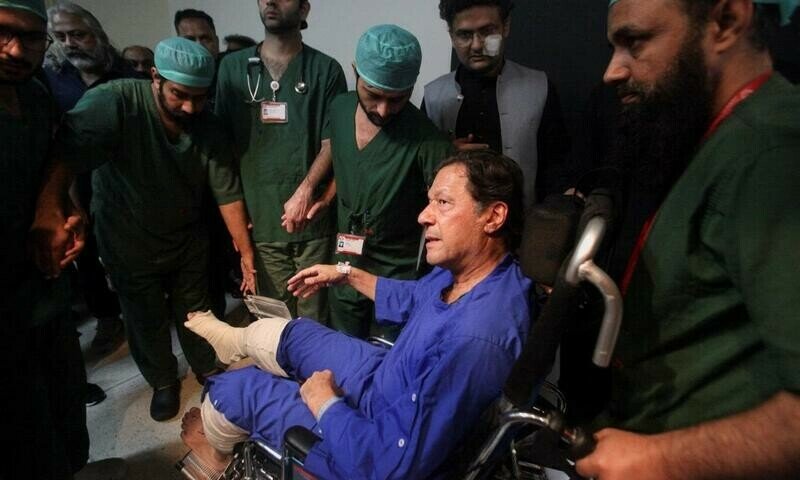
In Pakistan’s perennial contest between formal institutions and informal power, the recent episode surrounding incarcerated former Prime Minister Imran Khan’s court-ordered medical examination and treatment offers a useful case study in selective compliance, competing narratives, and the limits of judicial intervention when security concerns and political calculations collide. For an Indian audience accustomed to observing Pakistan’s institutional turbulence from across the border, it illustrates yet again how Pakistan’s contemporaneous hybrid system prioritises control and optics over consistent rule of law.
On August 18, 2026, a three-judge Supreme Court bench headed by Justice Shahid Waheed, and comprising Justices Naeem Akhter Afghan and Ishtiaq Ibrahim, issued an interim order directing the federal government to transfer the incarcerated former premier from Adiala Jail in Rawalpindi to Shifa International Hospital, a private facility in Islamabad, within 48 hours. The court mandated the constitution of a multidisciplinary medical board – including a physician, general surgeon, internal medicine specialist, ophthalmologist, and cardiologist – with Khan’s personal physician, Dr Faisal Sultan, and his sister Dr Uzma Khan also permitted by the court to “remain associated” with the examination and treatment.
Khan was to remain at the hospital until the next hearing scheduled for September 16. The order also instructed the government to facilitate weekly family meetings as well as twice-weekly telephone calls between Khan and his sons in the United Kingdom. Crucially, it barred family members, PTI workers, and lawyers from publicly disclosing Khan’s health condition or medical reports until the next hearing, while emphasising that the state must safeguard the life, health, dignity, and security of persons in custody.
The timeline of implementation quickly diverged from the letter of the order. Overnight between August 20 and 21, Khan was moved under tight security: not to Shifa, but to the government-run Pakistan Institute of Medical Sciences (PIMS). A medical team – including an ophthalmologist, cardiologist, and physician – examined him; authorities stated that doctors from Shifa were present and that his sister Dr Uzma also attended. He was declared medically fit and returned to Adiala Jail by approximately 5 a.m. on August 21. Dr Faisal Sultan waited for hours at Shifa but never saw him that night. Government spokesmen cited security risks from PTI gatherings near the private hospital as the reason for the change of venue.
Khan’s family, particularly his sisters, and PTI leadership initially treated the Supreme Court order as meaningful relief after prolonged restrictions on access and documented health concerns, including earlier reports of vision impairment due to central retinal vein occlusion, and more recent reports of anxiety and blood-pressure fluctuations linked to prolonged isolation.
Dr Uzma Khan, the former premier’s sister who is reported to be a qualified surgeon, was present in court on August 18. After the hearing, she and Khan’s other sisters were smiling outside the court, and while responding to inquisitive journalists, they said they were just grateful that Imran Khan would get the medical attention he needs. The more detailed public response came after the PIMS episode. On August 21, Dr Uzma and Dr Faisal Sultan held a press conference describing a night of contradictory instructions, an incomplete examination in their view, and Khan’s alleged complaints of sustained isolation amounting to mental torture. PTI framed the episode as deliberate non-compliance and an insult to the entire justice system.
The government’s early reaction was cautious and legalistic, but soon turned adversarial. Law Minister Azam Nazeer Tarar stated that the private-hospital directive sat uneasily with Pakistan Prison Rules (particularly Rule 197) and that convict treatment normally occurs in jail hospitals or at public facilities. Information Minister Attaullah Tarar and Minister of State for Interior Talal Chaudhry defended the decision to seek review, challenging the order on legal and equality grounds and asking whether every prisoner in state custody would be entitled to private facilities. When the transfer occurred at PIMS instead of Shifa, the government cited security concerns arising from PTI supporters gathering near or en route to the private hospital. Officials insisted the examination at PIMS fulfilled the spirit of the court order and met the substantive requirement of examination under controlled conditions; that the decision to go to PIMS rather than Shifa was operational, not political.
Meanwhile, the Islamabad Chief Commissioner filed a review petition under Article 188 characterising the order as discriminatory and beyond jurisdiction. The petition was returned for procedural defects – the Supreme Court registrar objected that the contents of the affidavit and facts were not properly represented, and that one of the paper books of the review petition was incomplete – and later refiled in amended form.
Both sides have since levelled contempt accusations. Dr Uzma Khan filed a petition seeking proceedings against the incumbent Prime Minister Shehbaz Sharif, ministers and officials for failing to implement the court order mandating Imran Khan’s transfer to Shifa and the full board arrangements. The government countered that the family and PTI breached the non-disclosure clause through public statements about Khan’s health, and that unauthorised gatherings created the very security problems that necessitated the venue change. As of the filing of this report, the Supreme Court has not ruled on either set of claims. The interim order of August 18 remains operative and in force pending any review outcome.
Analytically, the clearest divergence from the text of the Supreme Court order lies in the failure to transfer Khan to the specifically named private hospital and to keep him there under the stipulated medical board until September 16. The government’s security rationale and partial examination at PIMS may constitute substantial compliance in its view, even though it does not conform to the explicit directives contained in the order. On the family side, the non-disclosure restriction was binding; public statements after the PIMS visit invited the government’s counter-accusation. Liability for contempt ultimately rests with the court, which alone can determine whether any breach was wilful and contumacious. What is evident is that neither side fully escaped the shadow of the order’s constraints, and the only thing that emerged unfiltered from this entire episode is the selective character of institutional compliance when high-stakes political actors are involved.
Beyond the legal contest lies a more speculative political reading, which interprets the limited judicial relief and subsequent constrained implementation as signaling within Pakistan’s current power configurations. The incumbent coalition’s working relationship with the military establishment has always been transactional: of mutual dependence rather than uncomplicated alliance. Controlled humanitarian optics around Khan can function as a reminder of residual popular support that still circumambulates around him, potentially pressuring the civilian leadership on difficult political issues or legislative agendas – such as getting national security bills rapidly approved by Parliament, or ‘convincing’ them on longer-running discussions on governance structures and creating smaller and more manageable administrative units from existing provinces, or increasing federal oversight of and control over certain urban centres and provincial capitals. Whether such signaling is intentional or incidental, the episode underscores once again that civilian governments in Pakistan rarely operate free from the broader institutional calculations of the establishment.
Pakistan remains trapped in a conundrum that is all too familiar across the Global South and especially in our region: institutional incoherence, elite bargains that systematically exclude the broader public interest, chronic economic fragility and underperformance, and most dangerously, an entire generation represented by a fast-growing, increasingly disillusioned cohort of young citizens who see little evidence that the state prioritises service delivery, opportunity, predictable justice, or even basic dignity. Protest cycles and securitised responses continue to erode public trust: government apathy toward everyday hardships – inflation, unemployment, corruption, service delivery failures – feeds a cycle of dissent and repression that further frays the already tattered social fabric.
There is no shortcut. Sustainable progress requires coherently synced public policies that treat human security in tandem with socioeconomic development as core rather than residual concerns, inward-oriented rational economic policies that prioritise broad-based growth for all rather than further entrenching elite capture by individuals and organisations, credible accountability processes that apply across institutional lines and beyond formal or informal immunities, and most importantly, a political settlement that not only reduces the zero-sum character of elite competition, but also ensures genuine civilian supremacy under a constitutional framework that all major players accept and abide by. Only when the incentives of power begin to align with the needs of ordinary Pakistanis – rather than the perpetual management of internal rivals – can the country hope to restore political stability, societal harmony, and a development path that benefits more than a narrow circle of elites.
Pakistan’s current hybrid system is more capable of managing conflict than resolving the underlying deficits of governance and development. The Khan hospital episode is a symptom, not the disease. The deeper illness remains the unresolved contest over who truly governs, and for whose benefit.
(The author – Shemrez Nauman Afzal is a research analyst and holds a Ph.D. from the School of Government, UIBE Beijing. He serves as a senior associate at the UK-based Midstone Centre for International Affairs, and also contributes to The Friday Times. He tweets at @shemrez)

