
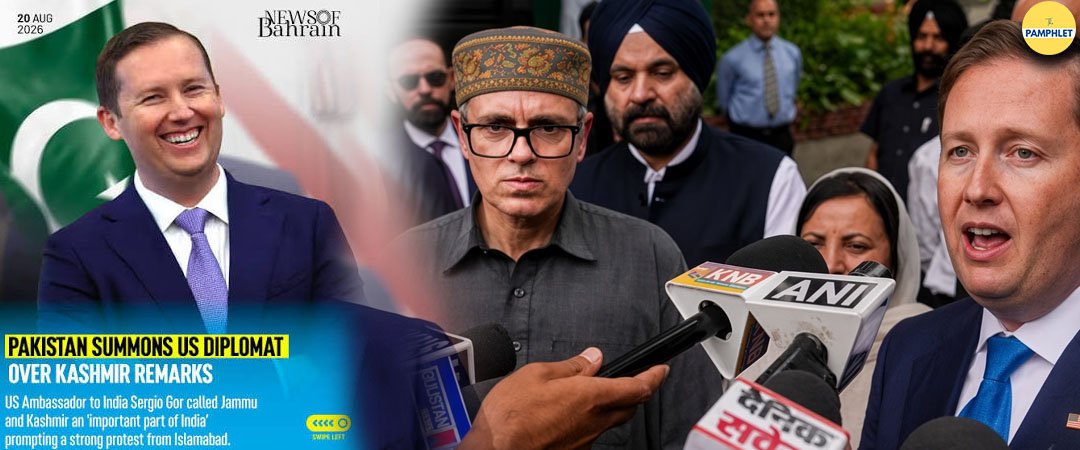
The US Ambassador to India and US President Donald Trump’s Special Envoy for South and Central Asia, Sergio Gor, during his visit to Kashmir administered by India, called Kashmir an “integral part of India” and praised the activities of the regional administration.
Sergio Gor’s two-day visit to Kashmir and Ladakh was considered especially significant due to his special status. However, after meeting with the Chief Minister of Jammu and Kashmir, Omar Abdullah, he took a cautious and nearly neutral stance in brief remarks to journalists.
He said: “I am very happy to have come to Kashmir, it is a very beautiful region.” He said that his meeting with Omar Abdullah took place in a friendly atmosphere and they discussed various important topics. He added, “More discussions on the topics of these talks still need to take place in Washington and New Delhi, and we still have further rounds of meetings ahead.”
In the same context, Omar Abdullah described the meeting as satisfactory and said, “Naturally, there are some old and inherited problems that will be worked on to resolve in the future. But these discussions will continue not only between Sergio Gor and Washington, but also between me and New Delhi. We hope that in the coming years, relations between the US and Jammu and Kashmir will become broader and deeper.”
When Sergio Gor was asked about the travel restrictions placed on American citizens for Kashmir, he said that these restrictions are reviewed from time to time.
He said, “This is a very beautiful valley. New Delhi and the local administration have done significant work to improve the security situation and to make this region safer. I do not have any major announcement regarding this, but my personal opinion is that the travel restrictions related to Kashmir should be eased.”
It is worth noting that the nuclear-armed neighbors India and Pakistan have fought two wars and one limited conflict over Kashmir. Pakistan summoned the US Chargé d’Affaires to the Ministry of Foreign Affairs to protest the US ambassador’s remarks.
On the other hand, Pakistan has strongly objected to the US ambassador’s statements in India regarding Jammu and Kashmir, and has summoned the US Chargé d’Affaires to the Ministry of Foreign Affairs in Islamabad.
In a statement issued on Wednesday, Pakistan’s Ministry of Foreign Affairs said that it has formally registered its protest against the US ambassador’s remarks in which, during his visit to Indian-administered Kashmir, he called Jammu and Kashmir an “integral part” of India.
Pakistan condemned and rejected these remarks by the US ambassador. Islamabad emphasized that Jammu and Kashmir is internationally recognized as a disputed territory, and the final decision on this region has not yet been made in accordance with the relevant resolutions of the United Nations Security Council and the wishes of the Kashmiri people.
According to Pakistan’s Ministry of Foreign Affairs, the protest notes delivered to the US Chargé d’Affaires stated that the US ambassador’s remarks do not align with the United States’ long-standing and documented position on the Kashmir issue. Pakistan also said that this stance contradicts America’s declared commitments to the supremacy of international law and the United Nations Charter.
The statement says that Pakistan welcomed President Donald Trump’s offer of mediation in which he proposed to play the role of mediator between Pakistan and India on the Kashmir issue. However, Pakistan emphasized that American officials should ensure that their public statements are consistent with the disputed status of Jammu and Kashmir.
The US ambassador went to Kashmir on a two-day visit. There has been tension between Pakistan and India over Jammu and Kashmir for a long time. Meanwhile, the US Ambassador Sergio Gor’s visit to Srinagar and his remarks in which he called Jammu and Kashmir a part of India has sparked new debates.
In recent months, an impression of improving relations between the US and Pakistan had emerged, but some analysts believe that the US ambassador’s visit to Srinagar and his statements could be considered a diplomatic blow to Pakistan.
International affairs expert and founder of “Indo Pacific Solutions”, Derek J. Grossman, while sharing a post by Jammu and Kashmir Chief Minister Omar Abdullah on X, wrote: “Ambassador Sergio Gor’s visit to Jammu and Kashmir is an important and hopeful message for India, although the problem is that his boss has a different view regarding Pakistan.”
American journalist Caitlin Doranbus said on X regarding the US ambassador’s remarks that the official US policy should not be equated with an individual ambassador’s statements. According to her, Washington still considers the status of Kashmir to be an unresolved issue.
Masood Khan, former president of Pakistan-administered Kashmir, wrote in his reaction, “Ambassador Gor’s remarks in Srinagar reflect a lack of sufficient knowledge about the history and current situation of Jammu and Kashmir. Before his visit, he should have been briefed on America’s own policy regarding Kashmir and the binding resolutions of the UN Security Council related to this conflict.”
He added, “Jammu and Kashmir is not a part of India, and this issue is still included on the active agenda of the United Nations Security Council. The United Nations Military Observer Group in India and Pakistan (UNMOGIP) is still operating there. The decision about the future of Jammu and Kashmir will be made by the people of this region in accordance with the resolutions of the United Nations Security Council.”
Diplomatic affairs reporter Kamran Yousaf wrote on X that, as expected, Pakistan summoned the US Chargé d’Affaires in Islamabad and formally lodged a strong protest against US Ambassador Sergio Gor’s remarks in which he called Jammu and Kashmir a “part of India.”
According to Kamran Yousaf, this development is significant because the formal summoning of a senior American diplomat by Pakistan regarding remarks attributed to Washington is relatively rare. He said that this step reflects Islamabad’s sensitivity and firm stance against any perceived change in the US position on the Kashmir dispute, especially at a time when President Trump has repeatedly offered to mediate between India and Pakistan.
Kamran Yousaf also wrote that this matter shows that Pakistan, despite having close ties with the Trump administration, is not prepared to overlook such contentious statements. On the other hand, Austrian-Bulgarian geopolitical expert Velina Tchakarova assessed this development in light of the broader political environment of the region.
She wrote on X that Pakistan feels relatively confident due to its mediation role in Iran and defense cooperation with Saudi Arabia and Turkey, but in the larger geopolitical game the decisive role lies in the hands of the major international powers.
According to her, “In this case, it appears that the US is standing alongside India in light of new alliances and the changing geopolitical landscape of the region.”
Kashmir is an ethnically and culturally diverse region, famous for its beautiful lakes, green meadows, and snow-covered mountains. Even before India and Pakistan gained independence from Britain in August 1947, there were intense disputes and rivalries over this region.
Under the Indian Independence Act, the Partition plan gave Kashmir, whose majority of residents were Muslims, the choice to either join India or join Pakistan. The Maharaja (local ruler) of Kashmir, Hari Singh, initially wanted Kashmir to remain an independent country. But in October 1947 he decided to accede to India, and in return received Indian military assistance against the tribal armed incursion from Pakistan. A war broke out and India asked the United Nations to intervene.
The United Nations recommended that a decision be made through a plebiscite on whether the state would join India or Pakistan.
But both countries were unable to reach an agreement on the demilitarization of the region before the plebiscite could be held. In July 1949, India and Pakistan signed an agreement, under the UN’s recommendation, to establish the Ceasefire Line, and after that the region was divided into two parts.

