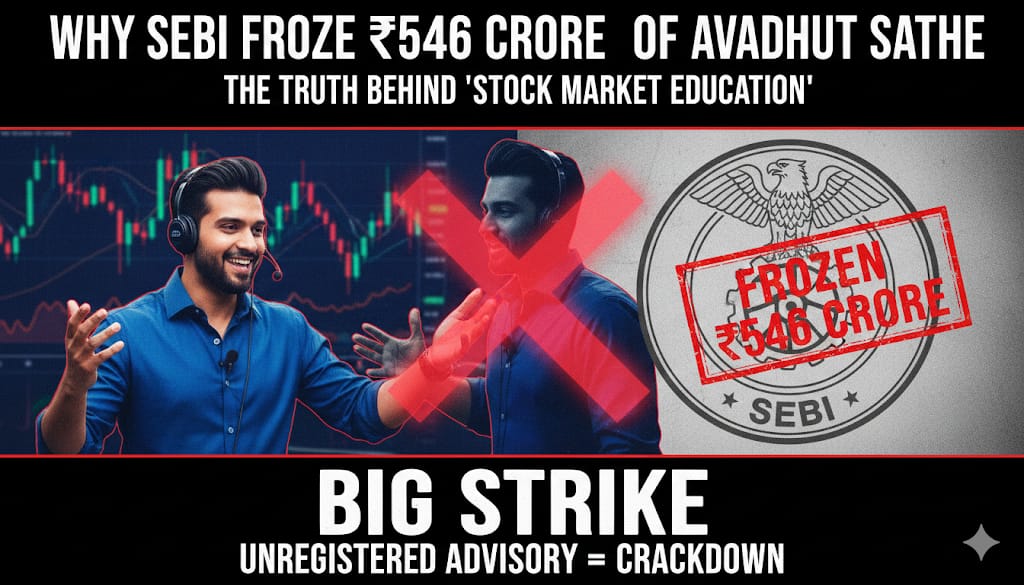
Why did SEBI move so aggressively against a well-known “stock market educator” like Avadhut Sathe? Why did the regulator not only impound ₹546.16 crore but also ban him from accessing the securities market?
To understand this, the story has to be told from the point where “education” quietly crossed the line into “illegal investment advisory.” On paper, Avadhut Sathe Trading Academy Pvt Ltd (ASTAPL) was just another stock market learning platform, selling courses, conducting sessions and promising to make ordinary people smarter with money. But SEBI’s order reveals a very different picture: one where live market sessions, specific stock tips and profit screenshots were used to influence people to trade in a particular way, all without the mandatory SEBI registration that any investment adviser or research analyst must obtain.
The first big question is: what exactly is this ₹546.16 crore that SEBI has impounded? Is it a fine, a penalty or something else? SEBI calls it “unlawful gains” – money that, according to the regulator, was earned through activities that violated the law. Between July 25, 2015 and October 9, 2025, ASTAPL collected about ₹601.37 crore in course fees. Did SEBI say all of this was illegal? No. The regulator zoomed in on eight specific courses that were run between January 1, 2020 and October 9, 2025. For these eight courses, SEBI found clear evidence that Sathe was not just teaching theory but was effectively running unregistered advisory and research services under the cover of education. The fees linked to these eight programmes add up to ₹546.16 crore – and that is the exact amount SEBI has frozen.
What made SEBI conclude that this was not genuine education but disguised advisory? The order describes how Sathe used live market data during sessions and gave buy and sell recommendations on specific securities, for a fee, while participants traded based on his directions. Can a person claim to be only an educator if he is telling paying participants which exact stock to buy and when to sell it? SEBI’s answer is a clear no. The moment someone gives specific investment advice or stock recommendations for consideration, they step into a regulated territory. At that point, they must be registered as an investment adviser or research analyst. Sathe and ASTAPL were not. That non-compliance alone is serious, but the story does not end there.
Another key question is: were investors simply learning and taking their own independent decisions, or were they being actively misled? SEBI’s investigation into FY 2023–24 activities found that ASTAPL and Sathe published only selective profitable trades of participants and claimed that their students “consistently earn” and that their trainers are market experts. Were these claims backed by actual performance data? SEBI’s analysis showed the opposite: those trainers and participants were in net losses overall. So what does that mean? It indicates deliberate cherry-picking of winning trades to build a dream, while hiding the far more common losing outcomes. To make things worse, SEBI had already issued an administrative warning on March 1, 2024, asking them to stop misrepresentation and selective disclosures. Did they correct course after this warning? According to SEBI, they did not; instead, they continued pushing misleading content and videos.
Why did SEBI’s tone turn from cautionary to punitive? Because complaints began to pile up from people who had subscribed to various programmes, lured by the promise of extraordinary returns. Many of them said they suffered substantial losses despite following the strategy and narrative sold to them. Are these just emotional reactions from losing traders, or was there a pattern? SEBI went beyond mere allegations and examined session recordings and supporting documents. The regulator concluded that Sathe had devised a scheme: courses were not just neutral learning modules, they were a pipeline through which people were nudged, influenced and directed to trade in specific stocks, while being shown unrealistic success stories and aspirational outcomes.
Another layer to this is the power of social media. Why is SEBI so concerned about finfluencers in particular? Because people like Sathe have significant presence on YouTube, Instagram, X and Telegram. Does that popularity create risk? Yes, SEBI points out that “gullible investors” can be easily swayed by follower counts, viral videos and slick marketing. When such a person runs unregistered advisory activity wrapped in motivational “stock market education,” the scale of potential damage multiplies. That is why SEBI did not stop at impounding the money. The order also restrains Sathe and ASTAPL from accessing the securities market, and prohibits them from buying, selling or dealing in securities until further notice. This is not just about punishing past conduct; it is also about preventing future harm.
So what is the deeper message behind this crackdown? SEBI is effectively telling the entire finfluencer ecosystem: you cannot hide behind the word “education” while doing everything that an investment adviser or research analyst does, especially when you charge money and promise life-changing returns. Investors, too, are being quietly asked an uncomfortable question: before paying for any course or joining any premium group, do you first check if the person is SEBI-registered, or do you just trust the thumbnails, testimonials and high-energy claims? The Avadhut Sathe case is a cautionary tale of how the line between learning and lobbying can blur dangerously. SEBI’s action – impounding ₹546.16 crore and imposing a market ban – is a strong reminder that in the world of money, influence without regulation is a risk the system will no longer tolerate.