Confusion is a potent weapon in politics. Politicians wield and exploit it. People consume it. The confused propagate it. Harry S Truman’s tone had an air of confidence when he said, “If you can’t convince them, confuse them.”
John Steinbeck, on the other hand, seems sure about the power of confusion in the context of people. “I know now why confusion in government is not only tolerated but encouraged. I have learned. A confused people can make no clear demands.”
Indian politicians have known the art of seeding and harvesting confusion since Partition. Independent India’s political contours have been marked by a series of events that suggest how hard people have tried to make decisions that have mattered to the sovereignty of Bharat. Some politicians of Kashmir have used confusion as a wand of exercising control and manipulation.
Defeating manufactured duplicity using culture
In October, the government of Jammu and Kashmir issued an official order by the Under Secretary, department of culture. The order mentioned directives from the Ministry of Home Affairs and Ministry of Culture and mandates an action plan for November which involves cultural performances across schools in Jammu and Kashmir, to ensure participation of students in the celebration of Vande Mataram and its 150th year. Just as Vande Mataram, the order, became a matter of debate in the union territory. Among people opposing it was chief minister of Jammu and Kashmir Omar Abdullah himself. Yet, calls to boycott the celebration of Vande Mataram and manufactured duplicity failed. People celebrated Vande Mataram. They made J&K outshine.
Planting fear in the furrows of deep ambiguity and duplicity to keep people distanced from the idea of freedom and independence according to the Indian ideals is normalised. And in doing so, they have truncated the meaning of freedom — restricting sharply the idea of freedom to separatism and secessionism. They have tried to keep Kashmiris away from the electoral process while talking about Kashmiriyat and the democratization of power in Kashmir. At the same time some of them have made efforts to manipulate people’s reactions and endorsement of the abrogation of Article 370. They have tried to keep people away from celebrations of Indianness through political rhetoric. They have made efforts to widen cultural gaps by objecting to the celebration of Vande Mataram. But now, confusion created in the minds of people is seen chipping, thinning and eroding.
This process has not taken place overnight. It is beginning to show results after years of toil. It has people in governance and politics who understand cultural transformation in Kashmir’s contexts, working tirelessly through administrative efficiency. PM Modi, home minister Amit Shah, LG Manoj Sinha and several people in Kashmir’s administrative machinery are making every effort to connect the people of Jammu and Kashmir with heritage that belongs to them but was distanced from them prior to the abrogation of Article 370.
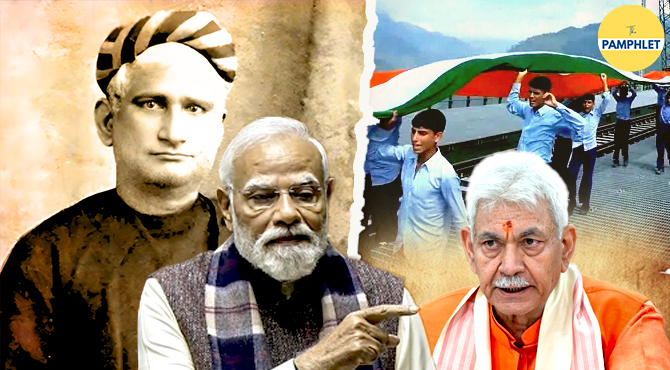
Efforts to delegitimize Vande Mataram and its celebrations were dressed in neat political lexicon, but people of Jammu and Kashmir courageously displayed which administrative language they prefer to respond to and side with, when it came to representing the evolving cultural consciousness in Kashmir. In the presence of LG Sinha at the valedictory ceremony at a stadium, more than 20,000 children gathered — tricolour in their hands, to celebrate Vande Mataram. Each frame of this occasion tells the story of how and why MP Sudha Murthy’s belief and view, that Vande Mataram should be made compulsory at schools and colleges, holds ground and reason in Jammu and Kashmir, other union territories and states. Jammu and Kashmir under the leadership of LG Sinha has boosted the chances of bringing transformation to cultural policy using Vande Mataram as a catalyst across India. The thought – ‘that if it can happen in Jammu and Kashmir, it can infuse education and cultural policy across India’, is quick to arrive.
Something unusual happened in Jammu and Kashmir with Vande Mataram working as a cultural catalyst. Sections of people in the local media termed this unusual “unprecedented”. The 150th anniversary celebration of Vande Mataram in Jammu and Kashmir turned out to be an evidence of the quiet transformation taking place. The moment appeared like the spring sun, which sets rows and rows of tulips spurting and blooming in the neat frosty furrows. The only difference, from visuals and numbers that point to celebrations of Vande Mataram in the state, is that the rows are of children and people of Kashmir, instead of tulips. In spite of the negative remarks of chief minister Omar Abdullah surrounding the celebrations of Vande Mataram involving school-going children, people from all sections, including children and youth, turned out in big numbers to mark the occasion.
J&K – where people turned the tide for ‘Vande Mataram’
Outside this sole event, Jammu and Kashmir stuns the entire nation by topping the statewise table in the celebration of Jammu and Kashmir. For a UT set in the lap of lofty snow-covered mountains, rivers and valleys, the numbers are encouraging and point to the public’s willingness to join a song of unity, freedom and resurgence in oneness. And that’s the profound message that naysayers on Vande Mataram must note. Visuals of the cultural event are noteworthy for the quality and harmony in presentation which was attended by people who represent administration, education, public life and social diversities of the union territory.
Jammu and Kashmir topped the national table in the celebration of Vande Mataram. It organised 31,232 events, with event participation standing at 12,250,730 (as per the last update checked). The event reached 5,525 schools and 216 colleges covering 20 districts. The participation count in Anantnag stood at 2,33,513, in Baramulla 1,604,984, Budgam 95,009. Ganderbal 1,77,005, Kishtwar: 3,506,044, Kulgam: 3,60,349, Kupwara: 240172, Shopian 119,829 Srinagar. 1,53,779, among districts. Total renditions of Vande Mataram stand at 1,41,420 (as per the last update checked) in the rendition count out of which Jammu and Kashmir rendition count stood at 20971, second to Uttar Pradesh. These numbers are impressive considering the nature of politics in parts of Jammu and Kashmir and opposition to ideas that LG Sinha is trying to build space for – particularly in Kashmir.
There are moments in politics when history knocks the hardest to be let in, to witness how events of the present have walked out its shadows. The meeting of history and its defiance in corrections of the past, is unprecedented, – Jammu and Kashmir has shown.
The debate on Vande Mataram – when history faces a resurgent present
History remains enclosed in its dark shells or fortresses, right next to the warmth of oil lamps, rituals, light and colours, reclamation and regeneration, and the luminous celebration of the turn history itself has taken. It happened in 2020, when PM Modi participated in the historic bhoomipujan of the Ram Mandir at Ram Janmabhoomi in Ayodhya. History, at that moment in 2020, was 500 year old – ghostly-dull, stubbornly entitled, haggard, painful, sorrowful. Yet it stood right there, boldly, waiting to be understood. Separated by the fine line of feisty action for dharma, but dominant and wanting to be recognised for the way it brought a vast period of cultural slavery and courage clouded by a sense of shame.
History revisits itself in evolving consciousness reflected in events and symbols of change aligning together, slowly but assuredly. History interacts with the ancient and modern expressions of “janmabhoomi” – the idea of the greatness of the land of birth. It pulls them together. The living evidence of this pattern is the Dharmadhwaja flying at the shikhara of Ram Mandir, during the 150th year of Vande Mataram.
PM Modi’s mention of Ram and Ramayana in his speech to mark the 150 years of Vande Mataram in the Parliament debate, is the evidence of the alignment of the different elements of Bharat’s evolving consciousness shaped and witnessed by history. Invoking “Janani Janmabhoomishcha Swargadapi Gariyasi” – the words spoken by Shri Ram in Ramayana, PM Modi remarked that it was this thought that echoed in Vande Mataram — making it a modern embodiment of a great cultural tradition.
This year, as India under Modi celebrates 150 years of Vande Mataram, history stands courageously, to be scrutinised, to be understood, to reveal how it was and has been violated, and to make the pain of those violations felt, known and heard. It finds fluidity and locates a narrator and narrative for itself. Its narrator, currently, is PM Modi. He said in his speech during the debate on 150 years of Vande Mataram: “when ‘Vande Mataram’ completed 50 years, the nation was compelled to live under Colonial rule, when it reached 100 years, the country was shackled by the chains of Emergency… and the Constitution of India was throttled, and those who lived and died for patriotism were imprisoned behind bars… unfortunately coincided with a dark chapter in our history, when democracy itself was under severe strain.”
At other times, history is 70 years too young. As in 2019, when the PM Modi-led government revoked the special status — autonomy — to Jammu and Kashmir which was granted under Article 370 of the Indian Constitution. At such moments, history tunes itself to the idea of being discussed with the idea of freedom and autonomy — something not unusual for India and Indians. In such instances, it prepares to come in conflict with newer disagreements between sovereignty and ‘azadi’, between circumstance and consequence, between the constricted-‘before’ and the transforming-‘after’. Yet history never disappoints. It stands to be understood in the light of the present. Its courage to keep standing, to be constantly available for scrutiny, gets rewarded by people, India’s citizens, who dissolve political and religious flashpoints in response to a shift in cultural policy, as evident in the Kashmir Valley, in the lap of Chenab.
Redefining loyalty – through ‘Vande Mataram‘ and for it
We live in an India where the vigour of our prime minister to reclaim the symbols of Bharat’s resilience, culture, and tradition, are met with acerbic political push back. More than seven decades after Independence, the foresight of our freedom fighters to create, shape, propagate, and celebrate lasting heritage is being continuously challenged by a section of Indian politicians. The Left-dominated politics of the Congress and other political parties, is seen posing angry reactions to PM Modi’s corrective actions. After capturing the energies of India’s leadership with ideas and ideals foreign and flimsy in nature and construct for decades in Independent India, they have created a narrative that treats any effort to celebrate the diverse cultural wealth of a great civilisation, with contempt, neglect, disdain or indifference. The main evidence of ideological impediments to the idea of independence, this week, have been three. First, negative reactions from some MPs to Modi’s debate on the 150 years of the Vande Mataram add nothing to their own perspective on the truncated version of Vande Mataram.
Second, their reactions to the truncated version of Vande Mataram – an unfortunate event during the freedom struggle – should have mattered even more after PM Modi raised the vital aspect of the fragmentation of ‘Vande Mataram’ – followed by the fragmentation of India. Yet, they have missed a wide opportunity. Third, they have been unable to address, and respond to PM Modi’s insights and futuristic tone and tenor on the importance of surging ahead — towards 2047 — with ‘Vande Mataram’ – its original and complete version.
The strain of accommodating movements within movements for civilisational continuity is PM Modi’s, but the abject inability of Left politics to understand the depth of the matter in PM Modi’s bent towards Swadeshi ideals amid the transforming global order, is a discomforting image of loyalties of lesser denominations – localised, constricted, stunted and small. Freedom fighters such as Khudiram Bose, Ramkrishna Biswas, Ram Prasad Bismil, Ashfaqulla Khan, Roshan Singh, Madanlal Dhingra, Rajendranath Lahiri, rose above these lesser aspects that define loyalty. It’s a pity that leaders of today are showing lack of courage in redefining loyalty for a common cause.
Understanding lyrical heritage for shaping cultural policy
Below the enthusiastic flush of democratic debate on the 150 years of Vande Mataram is the increasingly problematic aspect of the missing voice on finding a solution to making Vande Mataram relevant to India’s cultural policy. While Asaduddin Owaisi’s conviction to his own values and beliefs, is fair and expected, it is the pertinent event of his debate with non-BJP MPs such as Sudha Murty or Milind Deora, which should have taken place in an ideal and impactful space for discussing cultural transformation, taking religious diversities into account, but is missing.
Vande Mataram‘s potency in strengthening foundations of a democracy through Amrutkaal should be understood from the point of view of India’s freedom fighters and their belief in keeping the flame of Vande Mataram burning during the cultural onslaught of the British.
The creation of the rebirth of ‘Bande Mataram’ — the newspaper started by Sri Aurobindo Ghosh, was a process of rejuvenation achieved by the feminine empowering the freedom movement. The role of women in replanting the seed of Vande Mataram in cultural policy, in policy making that involves and connects schools and colleges with the singing and understanding of Vande Mataram, should be identified and made a participant.
The historic celebration of Vande Mataram in Kashmir reflects the sense of determination to secure integrity in the social and cultural fibre of India through Vande Mataram. It not only proves naysayers of democracy wrong, the critics of the abrogation of Article 370, wrong. It renders cynics, who try to push the social intent of people and their efforts and willingness to connect with the “mainstream”, ineffective. It exposes their disconnection with truth.
Vande Mataram‘s celebration in Jammu and Kashmir has exhibited the efficacy of a beginning made towards breaking political and social stereotypes. The debate on 150 years of Vande Mataram would have stumbled upon learnings of governance value in discussing local-nuances of the celebration of Vande Mataram under the leadership of LG Manoj Sinha in the complex context of Jammu and Kashmir. It has all ingredients that define courage – that would involve taking the celebration of 100 years of India’s Independence as a cultural challenge as the celebration of India’s freedom of 140 crore Indians.
Two speeches that hold the key to future
One of the valued utterances during the debate on Vande Mataram to come from home minister Amit Shah is on the expression of ‘rashtrabhakti’ in Vande Mataram and its essentiality today — being the same as it was during the times when Vande Mataram was written. The instilling of the essence of Vande Mataram in India’s cultural policy should be used in restructuring the absorption of tradition and culture — during Swadeshi 2.0 through reclamation from this view point. Modi and Shah are looking at creating a flow of awareness of the essence of Vande Mataram — from Sansad to the youth of India, teens and perhaps a generation that India’s breakers are looking at with greed. Breaking India forces are eyeing the involvement of this generation. Perhaps they are drawing some pleasure and encouragement from the violent political stirs in Bangladesh and Nepal.
Vande Mataram has the power to build a helix of protection against such intentions, provided it is filtered through a structured programme to reach schools and colleges. From India’s freedom struggles to the free frontiers of India, Vande Mataram has accompanied the bravest of the brave to become the leitmotif of victory, defence and protection. Its enduring profundity has elbowed out colonial prejudice, cultural subjugation and ideological objections. A beginning has to be made to let the youth of India develop an ear for it, a mindful absorption of the song, a sense of ownership for this eternal hymn of heritage.
The interaction with each line will open up the young Indian mind to the connection past and present, between the sacred and geographical, local and national, in the age of the Internet. It will help them explore the need for cultural nationalism, even as they aspire to become “global citizens.” Teens and youth of India should be able to ask the question: “What was the pressing need to spill details on the truncated version of Vande Mataram during its 150th anniversary?” They should be enabled to question how the fracturing of a song emboldened the fracturing of India into parts. They should be able to figure out how constructing distance from Vande Mataram leads to cultural “disjointedness”.
The speeches of Modi and Shah have enhanced the importance of connecting the youth and teens with the importance of Vande Mataram in nation building. Their speeches have made it clear that cultural nationalism — during the 150th year of Vande Mataram — is a national project. Shah is not known for mincing words. He, instead, wields the voice of clarity. He has used the word “Bhaktigaan” for the singing of Vande Mataram. “Bhaktigaan ki abhivyakti” – the expression of the singing of the sacred — with devotion. This establishes and cements the nature of political interventions in reshaping culture and society, that the Modi era is swiftly rewriting in the period it is celebrating as Amritkaal – the period up to the centenary of India’s Independence. 2047 is slated to be the defining year for the Modi’s government’s dreams and ideals of Viksit Bharat.
Culture as a unifier – identifying a national project
The Indic belief and concept of the nation as motherland, and motherland as the manifestation of the divine feminine, took a hit in education and the absorption of culture in education, political narratives, and popular culture, during previous governments for several decades. While Jinnah is easily and quickly blamed for compelling the leaders of this nation to cleanse Vande Mataram of the sacred – the Devi, Congress and the communist parties should be equally credited for successfully managing to distance education and governance from cultural nationalism and the invocation of the Devi in Vande Mataram, or the celebration of the cleansed version of Vande Mataram in public and political life, art, culture, and education.
The speeches of PM Modi and HM Shah indicate a bridge between the concept and execution of concepts in the reshaping of culture through politics and policy. The manifestation of the Devi as the bestower of the gifts of nature, life and prosperity, and her celebration in Vande Mataram, surpasses the mere activity of singing the song written by Bankim Chandra Chatterjee. The instilling of Vande Mataram and the study of its essence for learners from all walks of life and disciplines will provide a sensitive guide that helps internalise the meanings of freedom and Independence.
As seen and heard during the debate on Vande Mataram in Parliament, certain politicians would be tempted to try to restrict and fix Vande Mataram to the region and sensibilities of its origin. This arc of their narrative should be used to educate the youth and teens of India on the power of expression, creativity, courage, conscience and thought process of Bankim Chandra Chatterjee and his view of the land of his birth. The aperture of this lyrical and poetic genius was Bengal but the landscape to cover was the vastness of Bharat.
In the Modi-era, Bankim Chandra Chatterjee is receiving the recognition for strengthening, shaping and moulding the concept and thought of cultural nationalism during India’s freedom struggle. Critical and substantial is this moment in the continuous process of formulation of India’s cultural policy during the Modi era because the name and essence of Bankim Chandra Chatterjee and Vande Mataram — the composition — unsevered and whole — in form has infused a realisation in Parliament debate, national narrative, and speeches of national importance. The realisation that culture alone is the unifier of the nation. Culture plays a seminal role in preserving unity and sovereignty of the nation. Cultural nationalism forms the warm cast – establishing the movement of reinvigorating the nation with the spirit of unity and integration, of which Jammu and Kashmir has offered a rich glimpse in the celebration of Vande Mataram.
Parliament has witnessed history. Jammu and Kashmir has witnessed history. Vande Mataram is stirring and compelling a shift in India’s rethinking of culture. And this was a moment eagerly awaited. The 150th year of Vande Mataram – an opportunity to make it immortal, and to make it reach the younger generation, and evoke awareness of its role in India’s freedom struggle, should be studied as that chapter in history of the civilisation state when people rallied behind those who have upheld its celebration, today.
Home Minister Amit Shah spoke about the need to make Vande Mataram “amarkriti” (the eternal composition) towards the dedication and surrender to Ma Bharati. Rallying behind this idea should be the view that it would be shortsightedness to attach Vande Mataram to a particular state. It was and is seamless. Shah also pointed out that people of the era witnessed the importance of the song and noted that its value surpassed its literary finesse — to become an expression of patriotism. It went on to strengthen the path to freedom. Home Minister Amit Shah reiterated that the land of Vande Mataram‘s origin suffered repeated Islamic transgression for centuries. One of the emerging prominent deliberations in the speeches of PM Modi and home minister Amit Shah is that the land from which Vande Mataram emerged, was subjected to a series of aggressions and attacks on people, traditions and culture. The oppressors, including the ruling British, ensured that the history and culture of the land were destroyed and ripped. The attempts of the British to slap and overlay their own culture on the people and traditions of Bharat.
It was amid these brazen attempts to desecrate the culture of the great land that Bankim Chandra Chatterjee created and composed Vande Mataram. The essence of cultural nationalism, the core Indic values, were under attack. Screaming was the absence of freedom under which children, youth, women and men were subjected to harsh punishments for singing Vande Mataram and raising it as a slogan. Vande Mataram strengthened the Bharatiya-resolve to stay resilient under cultural oppression in the absence of freedom and freedom of expression.
A significant point in Amit Shah’s speech in Parliament was the mention of the destruction of centres of culture and tradition, such as temples, libraries, education system, and agricultural practices, under British rule. In such times, Vande Mataram helped in the unification of cultural expression. Shah highlighted another crucial characteristic in India’s uniqueness as a civilisation state. He said that while there are nations that came into existence after wars, or as a result of treaties after wars, or acts, India’s boundaries were not decided under an act, but were defined by culture.
The space for confusion created by a section of politicians is rapidly reducing. It is this utterance from Shah that unstoppably rushes to meet the energy in the acceptance of silent cultural transformation that has taken place in response to the celebration of Vande Mataram in Jammu and Kashmir, thanks to the determination of LG Manoj Sinha to reconnect the soil with the fragrance truth and clarity. Winter is setting in in the Kashmir Valley, but the warmth of a renewed-connection with Indian history and aspirations set in the present, have made the most valiant cultural referendum set in J&K, give an asserting direction to a pan-India embracing of ‘Vande Mataram.’ It’s a short story that the children and youth of Jammu and Kashmir have written for themselves and rewritten for Bankim Chandra Chatterjee. This story should be read and sung across India with Vande Mataram. The Left must stop trolling her and try to begin to understand India. Vande Mataram.