The long genesis of a movement in the quest for identity, cultural and economic strength, evolved in a series of events in people’s determination for Bodoland in Assam for decades after Independence. Language, literature, culture, music and dance, and above all, rituals and people’s spiritual connection with land and nature, secured the consciousness of identity and dignity during these times.
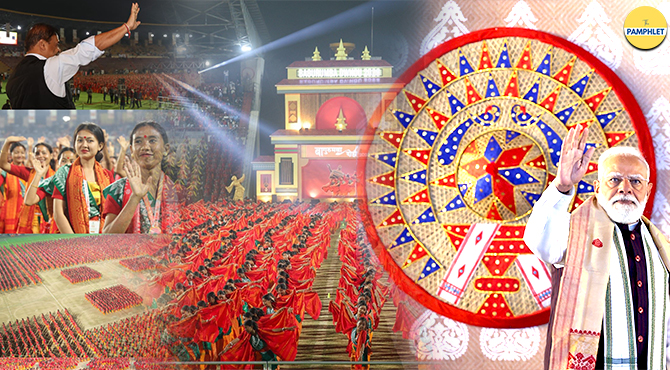
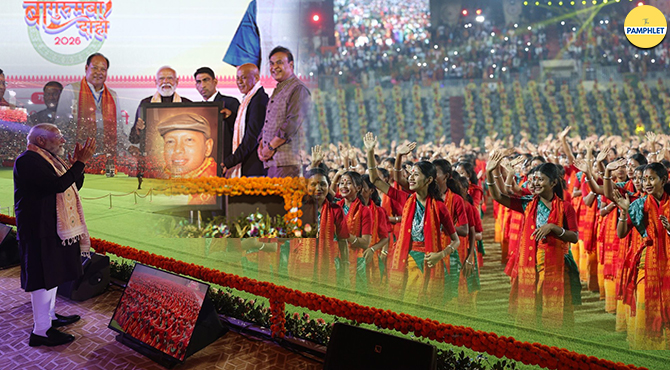
The healing of political scars required political and administrative sincerity, discernment, and decision making in New Delhi – a seat distant from the North East, but saddled with responsibility it must be wired into — at all times. Prime Minister Narendra Modi-led government at the Centre understood the profundity of the Bodoland movement. January 2020 brought the political shift in Bodo history. On January 17, as 10,000 dancers erupted in the expression of joy and Bagurumba in Guwahati, Assam, PM Modi’s consistency in securing the Bodo emotion within the sacred geography of Assam, witnessed a massive symbol of healing that’s not superficial, but is clasped in the retrieval and restoration of a culture from the pages of strife-ridden history. The rich Bodo heritage announced its vibrant demeanour to the world — in the duality of the sounds of music and dance.
The performance of more than 10,000 Bodo artistes was organised by the Assam Government in partnership with the Bodoland Territorial Council and Bodo community organisations. This collaborative effort to draw participation and representation from different parts of Assam, between the government, a council and the community, for a magnificent display of Bodo culture, is exemplary for how it embellishes the local heritage for national and global perspective on Indic culture.
Move over “Beijing”, this is Bodo scale and precision
Political leaders might be of the belief that the event has given Bagurumba the “recognition globally”, but I believe that the performative aspect of a dance form that connects a gendered-panorama of human expression of oneness with nature, inner prosperity and fertility, makes it remarkably universal. The world has found Bagurumba through this event. The Indic deep connection with fauna, a distinct facet of forest life, finds movement in Bagurumba, that emulates the flutter of butterflies, reflects the intricacy of the movement of birds, through the unseen but fleetingly- felt element of the wind. The butterfly wings find representation in the exquisitely woven, loose, richly-red garment worn by the women. It is controlled by their arm and hand gestures. The cloth is stretched and flapped, and at other times, held in a dainty grip of fingers, for the pleats to form, so that the fabric can emulate the flight-ready structure of wings.
Bagurumba, as musical as its name, is a tradition preserved by the women, thriving in the Bodo women’s cultural steadfastness, faith and nurturing of a generational bond with the echoes of nature, seasons, and festivities of Bwisagu, the Bodo New Year. On January 17, when the 10,000 participants performed before PM Modi, they made a nationwide offering of oneness to fellow Bharatiyas.
Rhythm-guided movements and formations worked with precision unfolded with ease, as the dancers — women from the different walks of life from across Assam – presented a feminine personification of faunal heritage, agility and adeptness, in a space and arena several times larger than rural intimate spaces for celebration it might have emerged from. The masculine play of rhythm, the kham as its instrumental medium, accentuates the sound of the Bodo cultural identity. Wood and animal skin, the harvest of the forest, echoes in the unity of percussion and movement, impersonating life in the Bodoland cradles of nature. The chiming of the cymbal marks the opening of this massive altering of Assam’s cultural history, stimulating the ensemble of flutes, and the ensemble of kham — musical territories guarded and upheld by men. My own fascination for the Bodo “serja” — a version of the traditional bow and string, has multiplied after watching recordings of this performance.
It’s a pity that Indians habitually look at foreign events at benchmarks for own achievements, cultural breakthroughs and ambitions. That is unfair to the creative courage of those people who have been able to generate and present Bodo art on this scale. This is the Indic scale of celebrations. Imagine the cultural and geometric potency of a traditional form of dance, passed down for generations, replicating the human expression of faunal heritage on a canvas multiple times larger than the domesticated spaces it has thrived in, distinctly, for doing in movement and music what the people of Indus Valley Civilisation did on the seal-amulet, in terracotta, in the static and visual representation of life around them.
From an Indian perspective, it is understandable that the performance reminded many people on social media of the precision and finesse in performances displayed during the opening ceremony of the Beijing Olympics (2008). Misplaced, however, is our ability to own Indic as Indic. India’s North East has its own rich reserves of community dance and music ensembles and celebrations. If an Olympic games ceremony was dedicated to solely the music and dance ensembles of the North East, organisers would be busy for not four but eight years to accommodate the vastness, vigour, valour, colour, rhythm, martial-rigour, music, musicality, geometry, form, and above all — aesthetic, the gentleness motion and movement, and the flow of weaves, textile, costume and ornamentation.
Peace, prosperity, development – the basis for cultural expression
In Assam, the “cultural” becomes assiduously political. PM Modi said in his speech at the Bagurumba Dwhou that the Bodo youth was cut off from the mainstream due to the politics of Congress which took advantage of the challenges faced by Assam after Independence. PM Modi accused the Congress of using the situation to create instability in Assam for political benefits, and for pushing Assam into violence. He said, “Trust was the need of the hour, but Congress encouraged divisiveness, dialogue was the need of the hour but Congress chose neglect, it blocked the paths for dialogue. The voice of the people of Bodoland was never heard properly. When the need of the hour was healing the wounds of its own people, when the need of the hour was serving the people of Assam, Congress opened the doors of Assam to infiltrators, and remained engrossed in their hospitality.”
In January 2020, a Memorandum of Settlement (MoS) was signed with factions of the National Democratic Front of Bodoland, All Bodo Students Union to boost the “scope and power of Bodoland Territorial Council and to streamline its functioning”. Promotion and protection of “Bodo social, cultural, linguistic and ethnic identities” and giving legislative protection to tribals’ land rights was covered under it. This would also notify Bodo as the “associate official language” in Assam and establish a directorate in Assam for Bodo medium schools. PM Modi mentioned these developments in his speech during the Bagurumba Dwhou.
Last year, home minister Amit Shah said in a speech in Kokrajhar that the opposition was mocking the signing of the Bodoland Territorial Region (BTR) peace agreement. Shah’s speech expressed the commitment of the Modi-led government to fulfil conditions of the agreement with the aim to fulfil all the promises “in the next two years”. With the centre’s own efforts, the message filters out that the government is working with the approach of achieving “lasting peace” and not just peace.
PM Modi and home minister Amit Shah have repeatedly hailed Bodo culture, tradition, visionaries and youth from the community. Shah has paid his tributes to Bodofa Upendra Nath Brahma in Assam and in Delhi. A prominent road in Delhi has been named after him. In March last year, Union Home Minister Shri Amit Shah addressed the 57th annual conference of All Bodo Students’ Union (ABSU) in Kokrajhar, Assam. Shah was speaking as chief guest. Shah hailed the role of ABSU in the Bodo Accord. He said that it would not have been possible without the crucial role played by the students’ union in establishing peace in Bodoland. Shah informed that it was due to the efforts of ABSU that students were able to complete their school education by taking exams in Bodo language. This was important for the recognition of Bodo by cementing it in speaking, academics and younger generations for its longevity.
PM Modi stated on January 17 that the Bagurumba event sends a strong message of the peace established in Bodoland. The Modi-led government aims at completing 100 per cent implementation of the peace agreement, while focussing on facets such as welfare, education, development, and industry, that would play a role in confining separatism, unrest, and chaos in Bodoland to the past. There have been efforts to make the youth of Bodoland participate in the development and progress of Assam. The message from the government, repeatedly, has been for shaping the role of Bodo youth as nation builders, to fulfil the dreams of Bodofa Upendra Nath Brahma. A beginning was made last year when 400 Bodo youths were recruited into the Assam Commando Battalion.
Removal of the Armed Forces (Special Powers) Act (AFSPA) from the entire Bodoland Territorial Region in April 2022 was a significant develepment. Efforts have been made since the signing of the accord to celebrate and preserve the symbols and living heritage of Bodoland, and recognising the different aspects of Bodo identity.
In December last year, the Assam Cabinet approved the releasing of Rs 250 crore to the Bodoland Territorial Council under “the State-Owned Priority Development Fund (Rural)” for ensuring the acceleration of development in the Bodoland Territorial region. This step was seen as instrumental in sustaining the efforts towards peace, development, progress and growth in the region — strengthening progress at the grassroots of development aspects and delivery of promises in the rural pockets of the region. With its focus on speeding progress in the region, and encouraging local economy, the Centre is also looking at boosting railways in Bodoland with new projects, new rail lines, the modernisation of stations and wagon workshops.
Sections of the media have covered the growth in the tourism sector in Bodoland owing to the reaping of government-efforts to establish peace and stability, including the forest areas. Identifying the mushroom from Korajhar as the “Mushroom from Bodoland” under the ‘One District, One Product’ (ODOP) and making it reach fine menus in New Delhi might seem small, but it has seen fruition due to the establishing of peace in Bodoland. Creating space for sporting talent in Bodoland, securing the Geographical Indication (GI) Tag for more than a dozen products from Bodoland, and providing Bodo culture and traditions a global platform within the state of Assam, as a solid representative of India on the world stage, are some of the softer aspects of the government’s work in the region. A separate Welfare Department, Bodoland Administrative Staff College, the commitment for the Bishmuri-Saralpara road project connecting Kokrajhar with the Bhutan border, and the proposed rail project from Kokrajhar to Gelephu in Bhutan are important steps for accelerating trade and tourism.
Cultural is political: internalising sensibility and sensitivity
Multiple visits of PM Modi to Assam during his ongoing tenure in New Delhi, creating the inflow of mammoth-scale display of folk performing arts of Assam in New Delhi under the leadership of CM Sarma; making the celebration of Bagurumba, Jhumair Binodini, Bihu on massive scale of participation part of cultural policy of Assam; curating a grand spectacle designed and conceived for the global stage; giving Delhi the Bodoland Festival, were all unthinkable 11 years ago. Today, these are part of PM Modi’s cultural achievements dedicated to Assam and Bharat. The centre and state governments have also pursued the cause of the upliftment of Bathou religion and traditions, including a holiday for the Bathou Puja. Modi and Shah have internalised their cultural sensibility and sensitivity in the North East.
PM Modi’s outlook for ‘Bagurumba Dahou’ and the magnification of its scale is a zealous initiative meant for honouring Bodo tradition. It perhaps is the first time since independence that visionaries and icons from Assam and Bodo history, such as Bodofa Upendranath Brahma, Satish Chandra Basumatary, Moradam Brahma, Rupnath Brahma, Gurudev Kalicharan Brahma, and Kankeshwar Narzary, have been credited for instilling the cultural Assam with reform and rejuvenation, by the prime minister. It is a conscious communication of gratitude and respect to the cultural and political visionaries of the community. Paying respect to the luminaries of the Bodo society during an event of national scale as the one held on January 17, is the minimum that was expected from central leaders responsible not just for Assam’s stability, but also India’s sovereignty, over the decades. Expectations were not fulfilled in the commotion of internal strife and the alleged and perceived political disconnect before Modi-era.
The gradual but definite rise of the performing arts of Assam during Modi rule, with help from the BJP-led government in Assam, should not be looked at as symbols of Assam being given national recognition, but as national heritage being meaningfully-enriched and upgraded by cultural facets that define Assam. Assam is mainstream. The North East is mainstream.
In 2024, the Charaideo Moidams – which are the mound-burial system of the Ahom Dynasty, were included in the UNESCO World Heritage – becoming the first site in the North East to be inscribed in the list and the 43rd World Heritage site of India listed under UNESCO. This would not be possible without the efforts of the Modi-led centre.
A master in using metaphors to establish the difference in the chaotic past and the creative present, PM Modi mentioned the contrasting sounds of the echo of bullets — that signify political disturbance involving the youth of Bodoland and Assam as the larger reference, and the music of the kham and sifung. Music and the celebration of Assam’s indigenous musicality against the silence of curfew — as dissimilarity and distinction are meant for celebration. Bodoland and Assam as the larger abode of Assamese cultural sensibilities have been able to synthesise cultural spectacles on grand scale because peace and stability, progress and development, reclamation of physical space for cultural restoration, have percolated into day to day lives of ordinary people. Peace is the creation of the youth and people of Assam. The 2020 Bodo Peace Accord is its manifestation as an event.
Synchronisation in cultural policy, people and leaders
Each and every outcome of the continuing political, social and cultural upsurge in Assam can be credited to the determination of the people for ending conflict and preparing the soil for restoration and rehabilitation. The synchronisation visible in Bagurumba Dwhou is not of music, dance, percussion, participation, and folk art and indigenous sensibilities, but also of policy and governance – of which the youth of Bodoland are a section of recipients.
How can the celebration of Sanatan Dharma, Indic classical, folk music, art, and folk culture energize a state’s internal security or national integration? How can they contribute to a state’s progress and the protection of India’s sovereignty? These questions might be of value to us today. While several political leaders and chief ministers invest a lot of time in doubting and questioning the potency of art and culture without putting in any thought or work to the celebration of the state’s heritage, Assam CM Himanta Biswa Sarma is introducing the art of reclamation of Hindu spaces through politics on unprecedented scales. He has answered these questions through several stunning initiatives.
Have you seen or heard about folk song and dance workshops being held for children in schools during summer vacations in your state? In Assam, Sattriya culture, music, and dance workshops were organized in 2024. The message was very simple: to encourage children towards the preservation of culture, making them capable and empowered. I spoke to a member of the Marwari community in Assam who contributed to the initiative. Weaving people and community effort’s into the state’s rejuvenation initiatives is commendable.
Assam—the land of the Brahmaputra and the cradle of its grandeur. A sacred geography adorned by the Maa Kamakhya Shaktipeeth. A border state where demographic transition – an outcome of political neglect in the past has left adverse effects on the ground. Sarma has turned the heritage and culture of Assam into an instrument for altering the clockwork of internal security and protection of Assam. The inherent power and collective memory of the people of Assam is backing each initiative – with resilience and performative prowess.
Timelessness of art, bounties of nature, vastness of flora and fauna, the voice of the Brahmaputra, India’s only male river, radiating from the spiritual inwardness of the heritage in the prolific expanse of Sudhakanta Dr. Bhupen Hazarika’s singing. Assam. One of the seven sisters standing robustly, in cultural might, against the aggressor and expansionist, in the past and present. In September last year, when Assam began the birth centenary celebrations of Dr. Bhupen Hazarika, 1000 finest singers from the state — poured out the superlative musical renditions in a tribute.
Last year, Sarma announced that with year-long celebrations beginning September 2025 across Assam and Bharat. PM Modi attended the celebrations. National transformation through the celebration of Dr Hazarika’s voice and vision should be a national outcome. In this video, I have covered the importance of these celebrations. Assam’s strategic and cultural importance and weight to the preservation and protection of the North East is so huge that each effort in sustaining and safeguarding indigenous culture against external threats to India, would simultaneously nourish a layered shield of India’s cultural sovereignty. When polity and politicians exhibit preparedness to honour the tradition of courage defining history and courage, the message of resistance in the current and present context gets established effectively.
The strength of numbers and scale: essential antidote
Numerical strength—whether linked to demographic transition or forged and refined by its fires as indigenous people unite in resistance—carries optimum cultural fortitude when embodied in local singers, instrumentalists, artists, and groups. I am of the view that the power inherent in these local and indigenous creative communities is taken lightly across India.
Taking it lightly is organised happenstance. This is because civilizational battles have historically been fought with swords and shields and people tend to think that culture, dance and music are soft aspects that are of little use in fighting battles. ‘After all, which invader was ever deterred or defeated by the flute, the mridangam, the khol, the morsing, the gogona, or the sutuli?’ Is that what you are thinking? History and the present compel us to form such a perception; for if it were otherwise, some European nations, today, would not be building walls at international borders, but would instead be drawing boundaries of flamenco, accordion, and flute performances. Those who come for cultural or aggressive expansion, come to defeat the targeted civilization, not to enjoy its arts, culture and heritage. Their operating system is one. Envy. Culture cements the wall. It defines and marks territory. It solidifies deterrence. It is an essential antidote to diversionary cultural and political tactics threatening the land and its people.
Sanatan culture and its grandeur, its openness to gendered participation, is the subject of the iconoclast’s envy. I have recently written in detail about Bharat’s determined fight against the iconoclasts who destroyed Somnath in this article and in this article. These battles have lasted centuries. Bharatiyas who protected the Somnath temple centuries ago, and through the centuries across the span of a 1,000 years, witnessed and noticed that the attacks were the iconoclast’s blow against the cultural grandeur and heritage, history and belief, embedded and protected in Somnath and the worship of Somnath. The iconoclast, today, is no more an outsider. He doesn’t have to come riding on the camel with water reserves loaded on the camel’s hump, from the West. He is sitting in the East, or squatting on Bharat’s land as a subsidiary of the iconoclast in the West or East.
Sarma seems to have understood that culture, heritage, their celebration and reclamation – serve as unifying binders of the people of the state. They are the shield that aids India’s protection of borders and sovereignty. The grandeur of scale in Assam’s celebrations is not restricted to the North East. It has left its imprints in Delhi – to give a message of centrality, to give a message that “tyranny of distance” is a weapon in the hands of those who want India and Indians to forsake and lose what is their own.
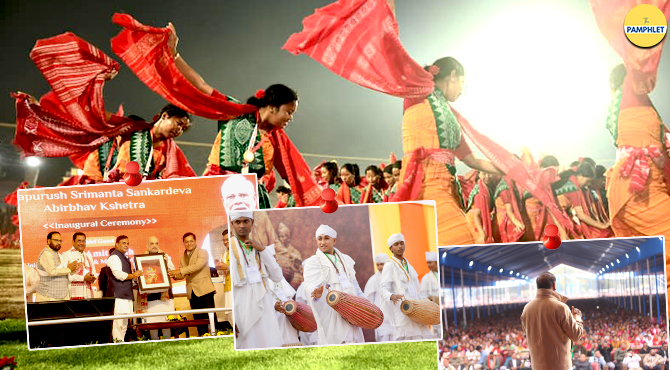
Last year, the first Bodoland Festival was organized in Delhi, where the traditional Bodo dances, ‘Bagurumba’ and ‘Ran-sandhari’, were performed. Numerical strength—whether it stems from demographic transition or is forged and refined through its challenges as people unite in resistance—holds great significance when manifested in local and indigenous singers, instrumentalists, artists, and cultural groups.
Earlier this year, Assam set a world record with a grand Jhumur dance performance featuring 8888 dancers from the tea growing community. In 2023, Assam created history — unveiled a performance by 11,298 Bihu dance participants at a single venue. Not just this, the encouragement given by Sarma to children and youth practicing music in Uriamghat, preserving Satra culture, and continuously celebrating Bihu, is so dominant on social media that he seems to be shaping a positive struggle against the speed of time as Assam’s son.
The rhythm of ‘double engine’, the dance of collaborative politics
The interesting bit here is that CM Himanta Biswa Sarma was present virtually to attend this significant cultural watermark, while PM Modi attended it with dignitaries from the state. Also worth noting here is that a significant historical moment was unfolding through the expression of the celebration of life in this festival, etching the tradition of victory on the battlefield from Assam onto the nation’s capital. To showcase this, it was not the Chief Minister’s formal rush to Delhi from his busy schedule in Assam, but rather his remote yet pivotal leadership that was on display—and that, in truth, was both sufficient and necessary.
The partnership of the ‘Double Engine’ is working, and has successfully worked, to ensure this festival gains visibility on both national and international stages – that seemed the message. In 2026, the attendance would be reversed. PM Modi watched Bagurumba being performed by thousands of dancers in Assam.
For many of us who grew up listening to the word “Bodo” in news bulletins regularly, for the reasons of strife and struggle, have realised that something drastic has shifted in the polity surrounding the issue of deep cultural, political and regional sensitivity. The drastic shift was the healing – through political change and the celebration of the healing itself. Bodo youth – women and men – themselves have been seen celebrating life and joy in performance. They have celebrated themselves and Assam.
There are other steps Sarma has taken in the state to uphold culture. Thinking of Assam’s role in transforming Bharat, the CM made attempts to spread awareness nationally on the history and legacy associated with Lachit Borphukan. Celebrating the Ahom General’s 400th birth anniversary, he urged state governments across India to include a chapter on him in school and college syllabus. Next, from commemorating 17th century heritage to restoring 18th century heritage. The Dimasa Kachari kingdom.
In 2018, organisations dedicated to the cultural preservation and protection of Dimasa community heritage in Assam demanded the restoration and preservation of the remains of the last Dimasa kingdom, and structural facets of the architectural heritage. Sarma announced that the government’s Department of Indigenous Faith and Culture will initiate the preservation of the process of preservation of heritage of the Dimasa Kachari kingdom.
Under Sarma, the Assam government is constructing a memorial dedicated to ten thousand Ahom soldiers at the Alaboi Hills in North Guwahati. This history traces back to a 17th-century chapter of the Mughal era, where Ahom soldiers sacrificed their lives while thwarting Mughal expansion through their strength, wisdom, and valor. The significance of Saraighat and Alaboi in present-day Assam may not be a roar in the popular narrative, but its footsteps are certainly being heard in the hearts of people and in their absorption of their evolving present.
In the continuing and intensifying anti drug drive, seizure of drugs, the value of which runs into scores of crores each seizure, each time, has become the new normal in Assam. Drug bust operations in Cachar, Saptagram, Karbi Anglong, Kokrajhar and Golaghat districts have propped up massive and major catches of consignments. Assam’s efforts have been lauded by home minister Amit Shah in the state’s contribution to the acceleration of Modi govt’s march to building drug-free Bharat.
Singing praises and celebrating a golden past and history has meaning and consequence only when the society in the present has an appropriate and conducive environment, foundation, and originality in creation, firmly established on the ground. Vile problems like drug addiction— that lead to the hollowing of youth and society, and destroy culture—are against the internal prosperity of any state. If the youth are steeped in intoxication, the glorification of ancient warriors becomes meaningless in the current context. Civilisational courage needs valiant takers, not intoxicated escapists. Keeping the future of Assam drug-free, weakening and failing the heinous and terrifying system of drugs by striking at its roots, keeping the youth and children of Assam safe and away from the narcotic threat, seizing drugs worth thousands of crores and implementing this into an anti-drug operational style is playing a crucial role in cultural reformation, and defining new goals.
CM Sarma’s shield of culture – the protector of ‘pahad’ and ‘bhumi’
The conjoining of celebrations dedicated to Dr Hazarika and the Srimanta Sankaradeva Kalakshetra, keeping central the tribute to cultural transformers of Assam, who worked with “Sudhakanta” marked 2025. The preservation of his belongings, as carefully as preserving the tangible memory of his creation, is safeguarding the cultural memory of the people of Assam. The special relationship between the Bard of Brahmaputra and the Kalakshetra, a physical space where the people of Assam can revisit symbols of history and culture, is a unique point reflecting keen attention to detail.
The CM’s Srimata Sankaradev legacy – weaving of Gunamala, shlokas from Namghosha, portrait of Srimata Sankaradev on local weaves, Magalacharan of the Bhagwad Geeta (in Assamese), his commitment to preserving the iconic heritage of the Ahom rulers, construction of new Bathaou mandirs, protecting Bathao mandirs and thans, efforts to negate the influence of outsiders on the Bathao people, their traditions and culture, helping mitigate and stop conversions in Bathao followers, strengthen the religious and cultural outreach and awareness by strengthening Bathao traditions and temple life is happening behind the larger and the more prominent picture — of the ongoing forest evictions.
Assam’s handloom industry is precious to India’s soft power and the fibre of Left’s cultural identity. With 94 handloom training centre and 240 handloom demonstration centres, the state is now aiming to build a strong appeal for the weaving industry for youth in the state for the propagation and prospering of Muga silk and Eri yarn as pride pivots.
Sarma stated last year that that twenty-six hectares of land—equivalent to sixty-five football fields—have been cleared of encroachers. Sarma is busy readjusting and rewiring the sense of entitlement in the state, by resetting the emotion for pahad and bhumi, forests, lands, satras, agricultural fields, the responsibility of preserving which, and safeguarding it with sensitivity, is, an expression of honouring the state. He is bound to face opposition in areas and parts of the state where the undermining of the state’s economy and culture is currently underway — owing to illegal migrants. Assam’s culture and cultural heritage will protect his efforts. It is a shield he must never loosen his grip on.