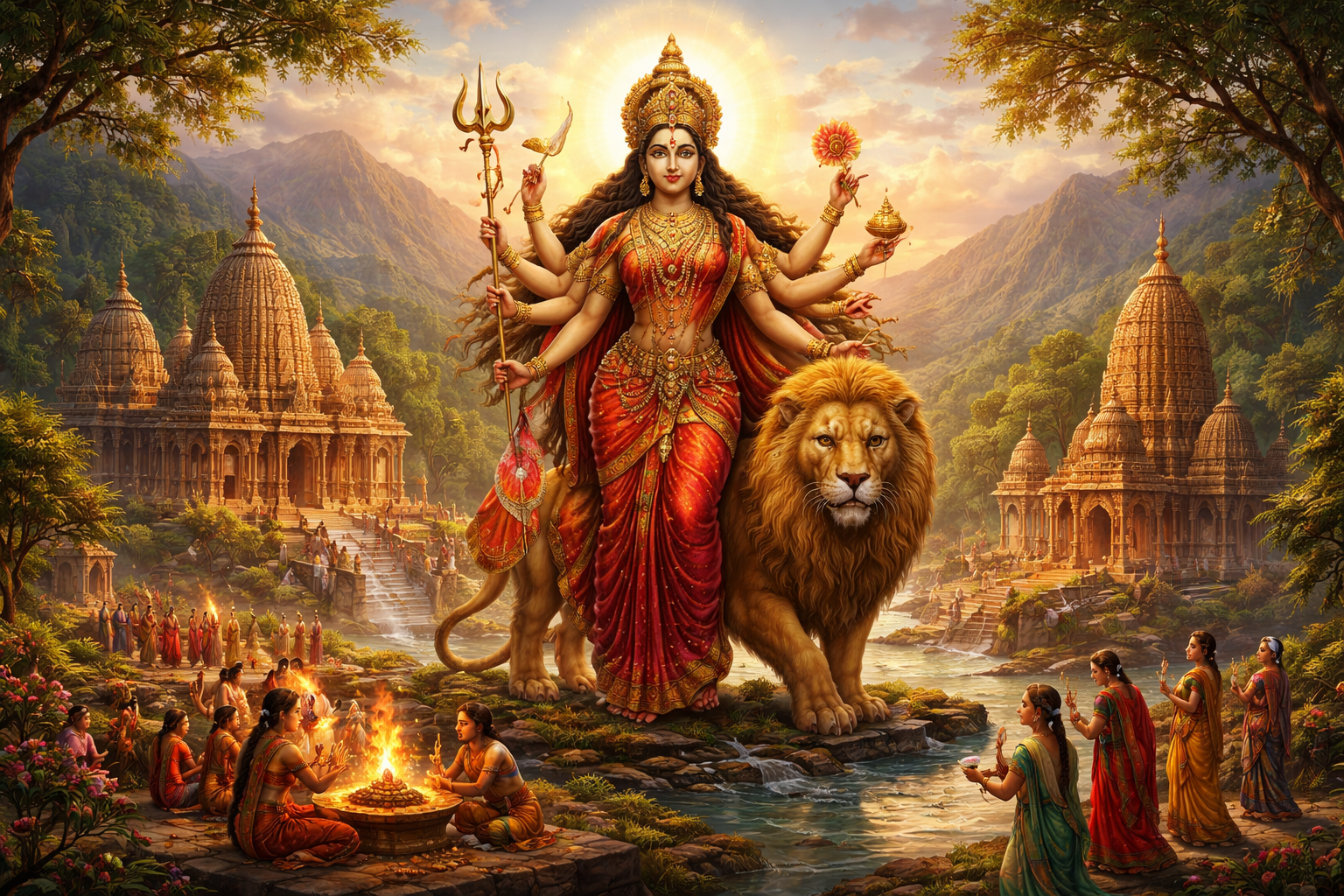
For generations, Hindu women have invoked Shakti not as a slogan in textbooks, but as living spiritual power – the mother who protects, the goddess who sustains, the cosmic force that dignifies every woman’s strength. For Hindu women, Shakti is not a theory, not a metaphor, not a political construct – it is a living faith. From childhood, they grow up in homes where Devi is worshipped as mother, protector, and cosmic force.
The sound of aarti, the fragrance of incense, the rhythm of Navratri fasting, and the quiet strength drawn from Durga, Lakshmi, and Saraswati are woven into daily life. Devi Aradhana is not an abstract idea in Hindu civilisation – it is an intimate spiritual anchor, especially for women who see divine feminine energy as dignity, resilience, and inner power.
This sacred understanding of Shakti has survived centuries of invasion, colonialism, and social change. It has guided families, shaped ethics, and given generations of women a spiritual language of strength.
But today, that sacred vision of Shakti – rooted in devotion, lived experience, and millennia-old practice – is increasingly being distilled into theoretical frameworks that many Hindus find alienating. When philosophical symbols that belong to a civilisation become tools in niche academic discourses, they stop being bridges to tradition and start sounding like cultural critique dressed as scholarship.
Across certain streams of contemporary cultural and literary research, traditional Hindu symbols and frameworks are being re-read through activist and identity-driven theories. Concepts like Prakriti, Purusha, and Shakti are no longer treated as sacred philosophical categories but are reframed primarily as instruments for modern ideological arguments. For believers, this does not feel like neutral scholarship – it feels like the extraction and repackaging of faith traditions to suit preset theoretical positions.
The IIT Patna Controversy: When Theory Contradicts Faith
This cultural fault line erupted sharply when a research paper co-authored by Dr Priyanka Tripathi and another scholar associated with IIT Patna drew intense public backlash for its interpretation of Hindu spiritual concepts. The paper, published in an international journal, reframed traditional notions like Prakriti and Shakti through the lens of contemporary identity and eco-theory – concepts like lesbian subjectivity and queer ecofeminism.
The academic framing crossed far beyond neutral scholarship. Rather than exploring Hindu philosophy on its own terms, the paper positioned sacred concepts as evidence for ideological arguments that Hindus find unrelated – or even antithetical – to the lived faith that millions uphold.
The paper explains Hindu ideas like Prakriti and Shakti using modern queer and ecofeminist theory instead of traditional Devi worship or spiritual meaning. It says Prakriti can be used to support lesbian identity and treats Shakti as a form of power outside the usual male-female (Purusha-Prakriti) framework.
It claims Shakti can help challenge heterosexual norms and says seeing lesbians “as Prakriti” gives them Shakti. Critics argue that this turns a sacred, worshipped concept of divine feminine power into a modern ideological tool, removing its devotional and religious significance.
What sparked particular ire was that a revered spiritual tradition was being repackaged without context, not as cultural interpretation but as theoretical appropriation. For believers, this is less like analysis and more like a reduction of spiritual heritage to fit niche academic agendas – at the expense of reverence for the beliefs of millions.
Who Is Priyanka Tripathi
Priyanka Tripathi, who earned her PhD from IIT Kharagpur, is an Associate Professor of English at IIT Patna and previously served as Head of the Department of Humanities and Social Sciences.
According to her institutional profile, she serves as Associate Editor for Journal of Graphic Novels and Comics and Global South Literary Studies (Taylor & Francis). She has received fellowships including the Charles Wallace India Trust Visiting Fellowship (2024-25) at the University of Leeds and a Visiting Research Fellowship at the University of Edinburgh’s IASH.
Her published work focuses on gender studies, medical humanities, South Asian fiction, and cultural criticism. Her monograph with Bloomsbury examines feminist ethnographic narratives of the 1971 Bangladesh war, and another forthcoming work engages with Indian art, culture, and heritage themes.
Why Her Work Has Drawn Criticism
Several of Tripathi’s papers and co-authored works interpreting Hindu texts, symbols, and social traditions through feminist and critical theory frameworks have triggered strong objections from sections of the Hindu community. Her readings of Hindu marriage, patriarchy, Shivling symbolism, Manusmriti references, and kotha culture portray Hindu society in a sharply negative frame and detach sacred concepts from a devotional context.
Her academic associations with major international publishers such as Taylor & Francis have also been highlighted, as some journals under such platforms frequently publish work critical of Hindutva, Indian policy positions, and traditional religious structures. This is global critical scholarship; opponents see it as an ideologically loaded interpretation.
Why This Matters: Beyond One Paper
The debate isn’t simply about a single article. It reflects a broader concern among Hindu communities about how religious and philosophical symbols are presented in elite academic spaces:
- When Shakti – a central force in Hindu worship and spiritual psychology – is primarily discussed through frameworks that detach it from devotion, many believers feel their lived tradition is being overwritten by theory.
- When sacred Sanskrit concepts like Prakriti and Purusha are reframed mainly in contemporary ideological vocabularies, young minds encountering them first in such contexts may never see their original philosophical depth.
- When academic authority is used to project interpretations that sharply contradict devotional sensibilities, it breeds alienation rather than understanding.
For many Hindu parents and cultural commentators, the fear is not academic debate itself – it’s who sets the terms of the debate. When elite institutions produce work that feels dismissive of faith, it sends a message to students that cherished spiritual traditions are expendable footnotes in modern theory.
The Cost to Young Minds and Cultural Continuity
Hindu civilisation has always been comfortable with questioning, discussion, and reinterpretation – that is the strength of its intellectual tradition. But there is a difference between critical engagement and dismissive repurposing. When students are exposed only to ideological critiques of their religious heritage, they lose not just knowledge, but emotional connection to their roots.
Shakti, in the Hindu worldview, is not an academic category to be contested – she is the embodied power of every woman, the pulsating source of life and inner force. When that sacred recognition is lost in translation from devotion to theory, it impoverishes not just scholarship but cultural continuity.
This controversy at IIT Patna has stirred deeper reflection across India: Can academic freedom coexist with cultural sensitivity? Can institutions nurture critical thinking without severing the spiritual roots that give meaning to generations of Hindus?
The larger question is not about banning research or silencing disagreement. It is about intellectual fairness and cultural responsibility. Civilisations endure when they are engaged with integrity, not only interrogated through suspicion.
For believers, Shakti is not a construct to be repurposed – she is शक्ति itself – the source of strength that has sustained Hindu women and Hindu society across ages.