
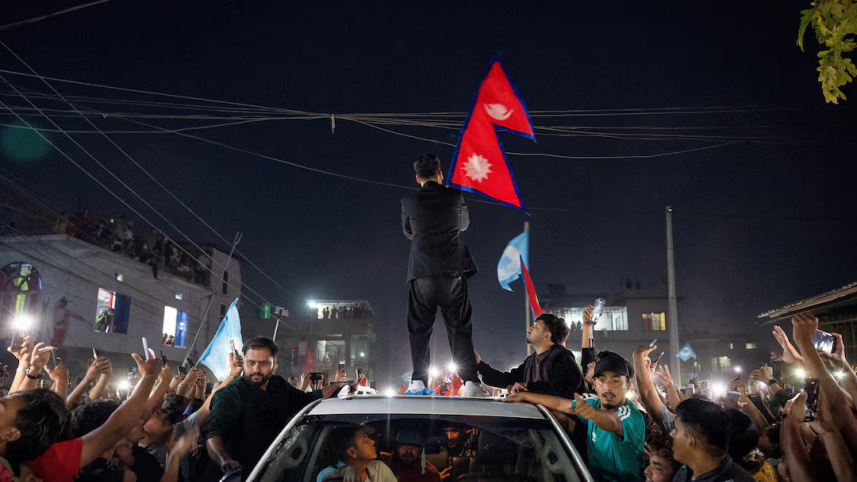
On April 22, 2026, Nepal’s Home Minister Sudhan Gurung resigned amid mounting criticism over alleged financial links and share transactions with controversial intermediaries. At the centre of the controversy is Dipak Bhatta, a power broker facing investigation for money laundering and alleged influence over government contracts, particularly during the tenure of former Prime Minister K.P. Sharma Oli. Gurung framed his resignation in moral terms, asserting that public office must remain clean and accountable, and that “there is no power greater than public trust.”
Gurung’s resignation foregrounds a persistent feature of Nepal’s political culture: the reliance on “moral capital” as a substitute for institutional accountability. Political legitimacy is frequently articulated through ethical claims, even as mechanisms of oversight remain weak, inconsistent, or selectively enforced. In such a context, appeals to morality often serve to manage political fallout rather than resolve underlying governance deficits.
Gurung stepped down within a month of assuming office on March 27, 2026, following media reports linking him to shareholdings in several companies and alleged proximity to Bhatta. His resignation, submitted to Prime Minister Balendra Shah, was presented as an effort to ensure a fair inquiry and avoid conflict of interest. Such gestures are not uncommon in Nepal’s political practice; however, their long-term impact on accountability remains limited.
More significantly, the episode exposes a structural deficit: the growing reliance on personal morality at the expense of transparent and enforceable institutional processes. In Nepal, resignations are frequently deployed as symbolic acts of responsibility, yet they rarely lead to conclusive investigations or systemic reform. The absence of strong regulatory frameworks governing political finance, asset disclosure, and conflict of interest allows such episodes to recur with little deterrent effect. As a result, moral assertions risk becoming performative rather than substantive.
Gurung’s own political journey underscores this contradiction. Emerging as a prominent figure in the youth-led “Gen Z” anti-corruption protests of September 2025, he represented a generational shift in Nepalese politics. These protests were violently suppressed during Oli’s tenure, resulting in significant casualties and deepening public distrust in state institutions. Gurung’s transition from protest leader to Home Minister had raised expectations of reform and cleaner governance. However, his brief tenure was marked not only by financial controversy but also by reported interference in police functioning, including direct involvement in operational matters. Such actions created friction within the security establishment and highlighted the blurred boundaries between political authority and institutional autonomy.
These developments raise critical questions about whether governance patterns in Nepal have meaningfully changed since the Oli era. While leadership has shifted, there is little evidence of a structural transformation in how power is exercised. The transition from Oli to Shah reflects a shift in leadership style, but not in the underlying architecture of power. Informal networks, opaque business-political linkages, and the influence of unelected intermediaries continue to shape policy decisions. The prominence of figures like Bhatta illustrates the persistence of shadow governance structures that operate alongside, and often within, formal institutions.
Prime Minister Shah’s leadership style – characterized by relative restraint in public engagement – differs from the more assertive approach of his predecessor, but this distinction appears largely stylistic rather than structural. The early exit of two ministers within weeks of the government’s formation, including Gurung and Minister for Labour, Employment and Social Security, Deepak Kumar Sah, removed over allegations of nepotism, points to systemic weaknesses in political vetting and governance stability. While these resignations may signal a degree of responsiveness, they do not necessarily indicate deeper institutional reform.
In this context, the durability of public trust remains highly uncertain. Trust in Nepal’s political system has become increasingly episodic, often rising during moments of political mobilization and declining rapidly in the face of scandal. The cycle of protest, political incorporation, controversy, and resignation has contributed to a growing sense of disillusionment, particularly among younger citizens who initially supported anti-corruption movements. Gurung’s emphasis on morality reflects an attempt to reclaim that trust, but without credible institutional backing, such efforts are unlikely to have lasting impact.
The role of media in exposing the current controversy highlights both its importance and the limitations of existing oversight mechanisms. Investigative reporting has been instrumental in bringing allegations to light, yet formal institutions responsible for monitoring financial conduct remain reactive rather than proactive. This imbalance allows political actors to frame accountability as a matter of personal choice rather than institutional obligation and enforcement.
Ultimately, Gurung’s resignation is symptomatic of a broader governance challenge. The emphasis on moral capital, while politically expedient, cannot substitute for the rule of law and institutional integrity. Unless Nepal undertakes substantive reforms to strengthen transparency, regulate political finance, and limit the influence of informal power networks, the cycle of scandal and symbolic accountability is likely to persist.
Author: Deepak Kumar Nayak- Research Associate, Institute for Conflict Management

