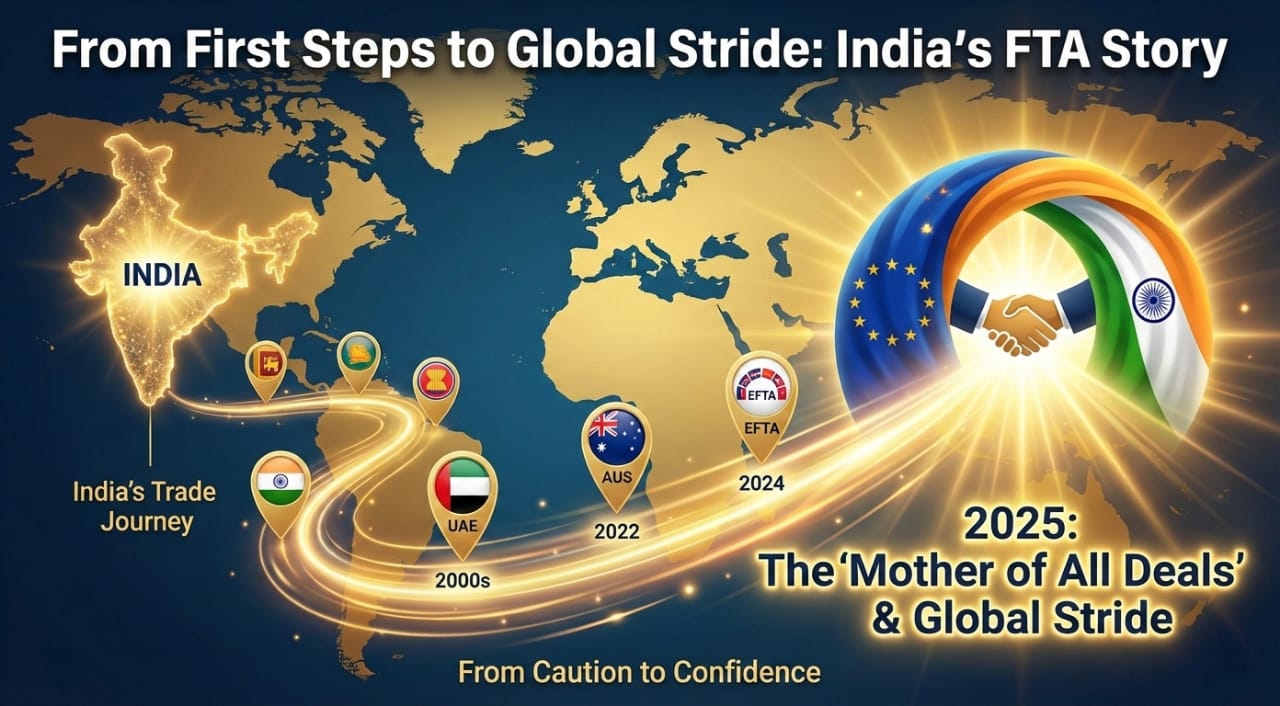
When Piyush Goyal called the proposed India–European Union free-trade agreement the “mother of all deals,” it did not sound like a line crafted only for headlines. It sounded more like the conclusion of a long conversation India has been having with the world—and with itself.
Standing on the sidelines of a Startup India event, the Commerce and Industry Minister was speaking with the confidence of someone who knows that this deal did not appear overnight. It is the result of years of steady, sometimes quiet, trade diplomacy under Prime Minister Narendra Modi, built deal by deal with partners who were chosen carefully.
Over the last few years, India has been telling the world a clear story through its trade agreements. The Comprehensive Economic Partnership Agreement with the United Arab Emirates, signed in 2022, was one of the first signs of this new tone. It was fast, ambitious and practical, aimed at helping Indian exporters, service providers and entrepreneurs plug directly into global supply chains. For many businesses, it was the moment they realised that trade policy was no longer abstract—it was becoming usable, immediate and growth-oriented.
Then came Australia. The Economic Cooperation and Trade Agreement with Canberra was not just about lowering tariffs; it was about trust. It opened doors for Indian students and professionals, secured access to critical minerals and energy, and strengthened India’s position in the Indo-Pacific. Together, the UAE and Australia deals showed that India was serious about engaging developed economies on equal terms, not as a junior partner but as a confident negotiator.
In 2024, the Trade and Economic Partnership Agreement with the European Free Trade Association quietly raised the bar even higher. Switzerland, Norway, Iceland and Liechtenstein are not mass-market economies, but they are standard-setters. The EFTA deal came with strong investment commitments and an emphasis on innovation and skills, reinforcing the idea that India was ready to match ambition with responsibility. For those tracking the India–EU negotiations, it felt like a rehearsal for something bigger.
At the same time, India kept multiple conversations alive. Trade talks with the United Kingdom regained momentum, reflecting the deep people-to-people and services-led relationship between the two countries. Engagements with New Zealand and Oman signalled India’s intent to widen its trade map, especially in areas such as agriculture, food products and logistics. None of these efforts felt rushed. They felt deliberate, almost patient.
This patience explains why the India–EU free-trade agreement carries such weight. The European Union is already India’s largest trading partner, with goods trade exceeding $136 billion in 2024–25, according to the Department of Commerce. Leaders like European Commission President Ursula von der Leyen and European Council President António Luís Santos da Costa have invested personal and political capital in the relationship. They see India not just as a market, but as a strategic counterweight in a world increasingly defined by uncertainty.
Goyal’s insistence that there will be no compromise on sensitive issues such as dairy or carbon taxes reflects another shift. This is not India negotiating from fear or urgency. Unlike earlier phases, when agreements like RCEP would have tied India into competition with China, today’s approach is selective. Every deal is meant to support domestic manufacturing, farmers and small businesses, aligning closely with Make in India and Atmanirbhar Bharat
There is also something deeply cultural in this moment. India’s leaders often speak of trade as being in the country’s genes, shaped by centuries of maritime routes and exchange. The current trade push is not about chasing headlines or reacting to US tariffs alone; it is about reclaiming that instinct and adapting it to a modern economy with a massive population and growing domestic consumption.
Seen this way, the India–EU FTA is less a sudden breakthrough and more a long-awaited arrival. The deals with the UAE, Australia and EFTA, the ongoing talks with the UK and others, and the conscious decision to avoid damaging agreements have all prepared the ground. That is why calling it the “mother of all deals” feels natural. It is not just the biggest agreement on paper—it is the one that finally brings together India’s experience, confidence and belief in trade as a pillar of its economic future.