
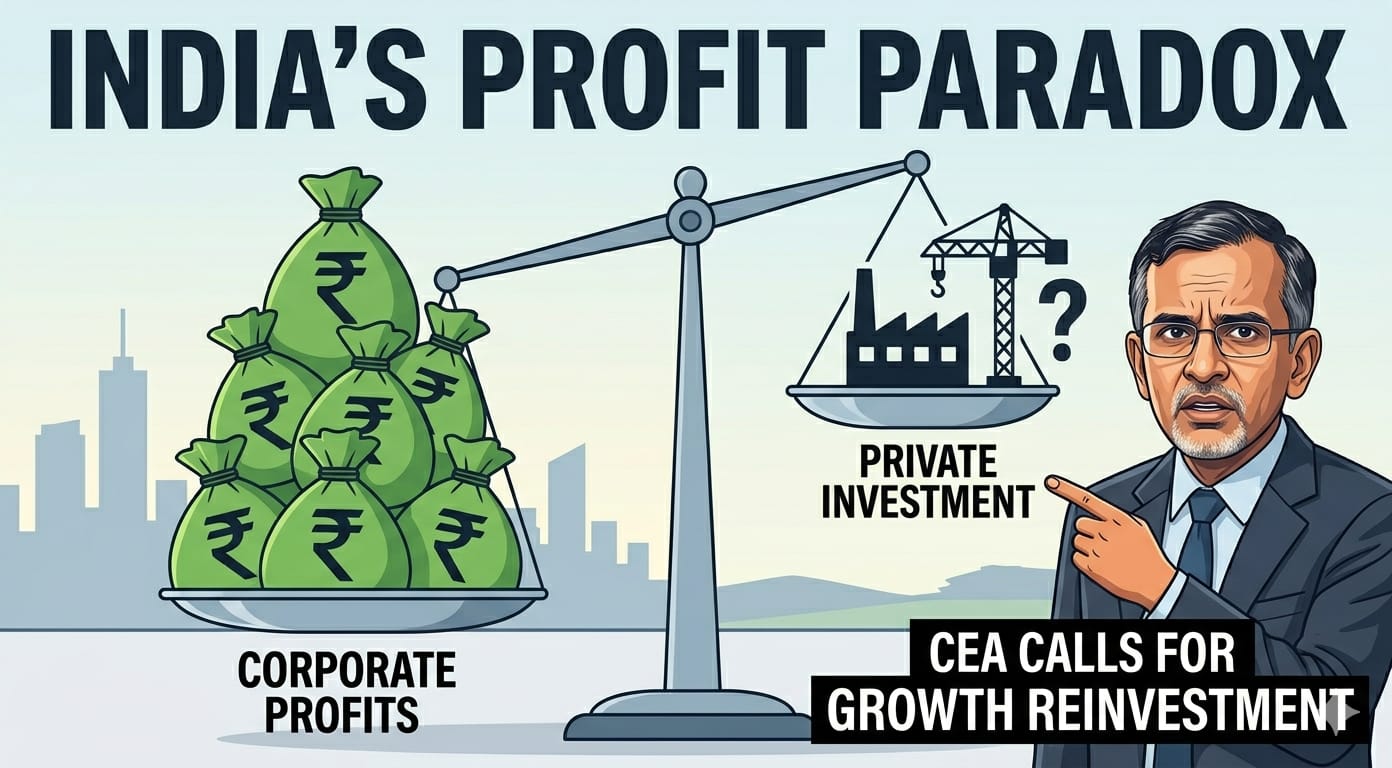
Imagine a business that is making more money than ever before sales are up, revenues are climbing, profits are breaking records and yet, when it comes to putting that money back into the economy, building factories, creating jobs, or expanding operations, the doors stay firmly shut. That, in essence, is the story of India’s corporate sector right now, and it has caught the sharp attention of the country’s Chief Economic Advisor, V Anantha Nageswaran.
Speaking at the second annual Isaac Centre for Public Policy Growth Conference organised by Ashoka University, Nageswaran laid out a striking paradox. Companies listed on the BSE 500 and NSE 500 India’s top 500 firms by market value recorded a staggering 30.8% annual profit growth in the years following the Covid-19 pandemic. By any measure, that is an extraordinary performance. Businesses recovered, revenues bounced back, and corporate balance sheets looked healthier than they had in years. And yet, despite all this financial muscle, the rate of capital formation from the private sector has been, in the CEA’s own words, “disappointing.”
The question that Nageswaran posed is both simple and deeply uncomfortable: if companies are earning so much, where exactly is the money going? His answer pointed to a troubling trend. Rather than reinvesting those profits into real assets, new plants, infrastructure, research, or expansion, many entrepreneurs, particularly those from the second and third generation of established business families, have chosen a different path. They have been parking their wealth in family offices, often set up abroad, rather than channeling it into productive investments on Indian soil. This is not just a missed opportunity for businesses themselves; it represents a significant drag on the broader Indian economy, which depends on private investment to generate employment, build capacity, and sustain long-term growth.
What makes this even harder to justify, according to the CEA, is that the conditions for investment have genuinely been improving. The regulatory environment, both at the central and state level, has been getting better at the margin. India has signed several Free Trade Agreements that open up foreign markets for Indian goods. And crucially, the gap between the Indian rupee and the Chinese yuan’s Real Effective Exchange Rate is narrowing, which effectively makes Indian exports more competitive and imports from China more expensive. All of these factors together create what the CEA described as “a good reason to invest.” Yet the private sector remains hesitant.
Nageswaran was direct in his message to industry. It is easy, he noted, to point fingers at the government when growth falls short. But the gaze must sometimes turn inward. In developed economies, nation-building was never just a government project; industry played a central role by aligning its private interests with broader national interests. That spirit, the CEA suggested, needs to be rekindled in India.
Beyond the domestic investment puzzle, the CEA also flagged a rapidly changing global environment that India cannot afford to ignore. China has recently issued two sweeping decrees that effectively prevent foreign companies from relocating their supply chains away from China, even under pressure from their home governments. Nageswaran colourfully likened it to the famous Hotel California line you can neither check out nor leave. In response, he argued that India urgently needs its own institutional frameworks: a supply chain security policy, a body similar to the American CFIUS to screen foreign investments, and a sharper strategy to use its massive domestic market as a lever to attract global companies.
The message from India’s top economist is clear. The profits are there. The opportunity is real. What is missing is the will to invest and that is a conversation India’s corporate sector needs to have with itself, honestly and without delay.

