In just a few years, India’s “instant delivery” moment has turned into an “instant transformation” story. What began as a promise to deliver groceries in 10–20 minutes has quietly pushed India into the global big league. According to Statista projections, India is now the third-largest quick commerce market in the world by revenue — behind only China and the United States, and ahead of traditional heavyweights like Japan, South Korea, the UK and key European Union economies.
But the real twist lies not just in the size of the market, but in the speed of its growth.
Between 2025 and 2030, India’s quick commerce sector is projected to grow at a blistering compound annual rate of 15.5%. Compare that with 6.72% in the US and 7.9% in China, and a clear picture emerges: When it comes to the next phase of digital consumption, India is not just catching up, it is pulling away.
This explosive q‑commerce story sits on top of an even bigger narrative: India’s macroeconomic outperformance in the post-Covid world.
In a striking comparative chart shared on X (formerly Twitter), Harvard economist Jason Furman mapped how major economies are performing relative to their pre-pandemic trends. The graph tracks real GDP as a percentage of pre-Covid trend for the US, Euro Area, China, Russia and India from 2019 to Q3 2025. One line stands out: India’s.
All five economies hit a sharp downturn in 2020. The Euro Area fell the hardest, close to –25%, while China declined about –10%. Russia dropped around –8%, and both the US and India slid roughly –5%. That year marked their common bottom, but the rebound that came afterward diverged across countries.
The US bounced back with massive fiscal firepower like the American Rescue Plan, managing to climb close to $2 above its pre-Covid trend by 2025. Europe, weighed down by energy shocks, inflation and geopolitical uncertainty, still hovers near $$-3\%$$. Russia remains stuck around $$-8\%$$, under the shadow of sanctions. China, battling prolonged zero-Covid policies and a deep real estate crisis, lingers near $$-5\%$$, far below its once-unstoppable reputation.
India’s line on the chart looks very different. From the 2020 dip, India pushes past its pre-Covid trend by 2022, reaches about $$+3\%$$ in 2024, and is projected to hit roughly $$+5\%$$ above trend by Q3 2025. For a country of India’s size, that kind of overperformance is not a bounce; it is a structural shift.
Furman underlines this point. India, he notes, has managed to foster domestic consumption and investment despite global headwinds. The backbone: rapidly scaling digital infrastructure, investment-friendly reforms, and a relatively stable macroeconomic environment. In simple terms, India has been quietly laying tracks — UPI, Aadhaar, ONDC, GST, PLI schemes — and the growth train is starting to run at full speed.
Quick commerce is one of the most visible coaches on that train.
The same digital rails that enable instant payments and paperless KYC are driving hyperlocal logistics, dark stores and last-mile delivery networks deep into Indian cities. Millions of young consumers, a rising middle class, and a smartphone-first culture are turning “15–20 minute delivery” from a novelty into a habit. That habit, multiplied by 1.4 billion people, becomes a macro story.
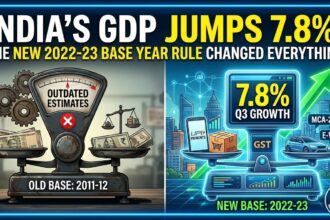
Global agencies are also taking note. ICRA expects India’s GDP growth to remain strong at 7% in Q2 FY26, after 7.8% in Q1 FY26, with gross value added (GVA) around 7.1%. Any cooling in services and agriculture is projected to be offset by an industrial upswing, with industry growth seen hitting a five-quarter high of 7.8%. Moody’s Ratings, meanwhile, calls India the growth leader in the Asia-Pacific region (excluding Greater China), projecting 7% GDP growth in 2025 and 6.4% in 2026, even as the rest of APAC settles near 3.4%.
By putting it simpler we can say that while much of the world is still trying to claw back lost ground, India is starting to build a new one.
Economists increasingly cite India as a template for other developing countries: combine robust digital public infrastructure with manufacturing incentives, a young workforce, strong services exports and cautious macro management — and you get a rare thing in today’s world: a large economy growing at 7–8% with momentum on its side.
From the hyperlocal lane of quick commerce to the global highway of GDP rankings, India’s growth story is no longer just about potential. It is about performance — visible in delivery apps on the phone, and in growth charts on a Harvard economist’s screen.