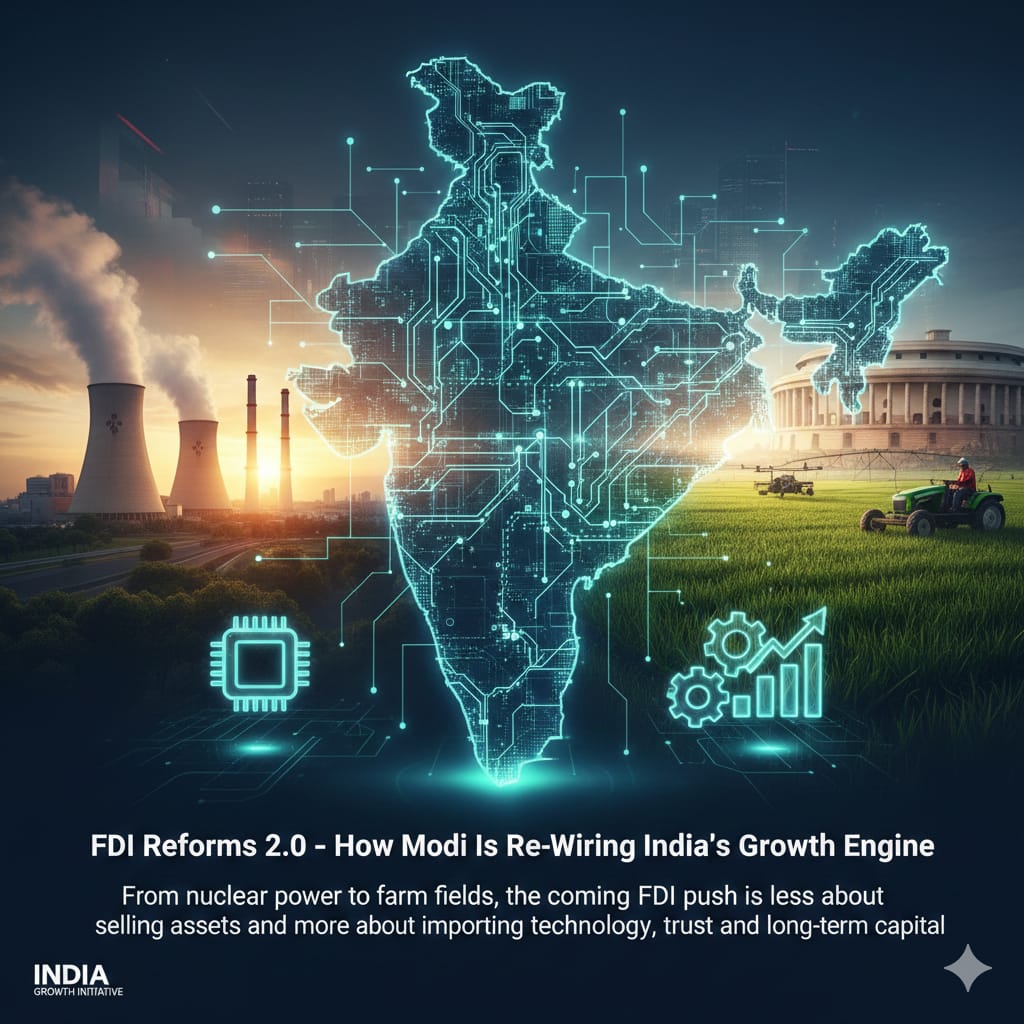
When a government touches “sensitive” sectors like nuclear energy, defence, insurance and agriculture, the first instinct is to ask: is this about control or about confidence?
In the Modi era, the answer increasingly tilts towards confidence, because the emerging FDI reforms are designed not to dilute India’s sovereignty but to deepen its capabilities with foreign capital, cutting‑edge technology and global best practices while keeping the strategic steering wheel firmly in Indian hands.
This is why the latest reform package lined up for the winter session of Parliament deserves to be seen as the next chapter of economic nationalism—one that builds strength by inviting the world in, on India’s terms.
Take nuclear energy, long treated as a forbidden city for private and foreign investment. For years, policy‑makers complained that state monopolies and strict rules were blocking modernisation, advanced reactor technology and the massive funds needed for capital‑intensive plants.
The proposed Atomic Energy Bill, 2025, changes the question from “should private and foreign players enter?” to “how can they enter without compromising security?” by allowing FDI through a tightly supervised government route, potentially in phases up to around 49%.
At a time when India aims to ramp nuclear capacity to about 40 GW by 2035 for clean baseload power, refusing foreign technology and capital would actually weaken energy security; smartly structured FDI, with ownership caps and regulatory firewalls, does the opposite by accelerating projects, localising manufacturing and reducing dependence on imported fossil fuels.
Defence is another sector where emotional reactions often drown out economic logic: doesn’t more FDI mean foreign domination of our arms industry? Yet the experience since the cap was raised to 74% under the automatic route and up to 100% with government approval shows a different story—India has already crossed 1 trillion dollars in cumulative FDI and defence is emerging as a magnet for technology‑rich partnerships, not takeovers.
The proposed easing of conditions that currently tie higher FDI to vague “modern technology” clauses, and the plan to allow up to 74% automatically for licensed defence manufacturers, simply recognises that global defence majors will only move core R&D and high‑value production to India if they can truly integrate their global value chains here. For a country targeting record defence exports and Atmanirbhar Bharat in weapons platforms, deeper FDI is not a surrender; it is a strategic shortcut to get Indian engineers, MSME suppliers and start‑ups working inside the world’s most advanced military ecosystems.
If nuclear and defence are about hard power, insurance reforms are about the soft power of financial security. Earlier, FDI liberalisation took the sector from 49% to 74%, and studies on India’s insurance market have linked higher foreign participation with stronger capital buffers, better risk management and more product innovation. Now the proposal to lift the cap to 100%—with the elegant condition that companies reinvest all their collected premium inside India—turns a potential political flashpoint into a development instrument, because it guarantees that foreign money deepens domestic capital markets instead of draining them. In a country where insurance penetration and density still lag global averages, asking whether full foreign ownership is “too much” misses a sharper question: can India expand health, life and crop coverage at scale without global capital and actuarial expertise flowing freely into the sector, especially when annual FDI inflows already hover around 80 billion dollars and the regulatory architecture is far stronger than in the 1990s?
Agriculture and plantation reforms might look modest next to missiles and reactors, but politically they are perhaps the boldest. The government is considering 100% FDI under the automatic route in more plantation crops—such as sandalwood, cocoa, bananas, spices and bamboo—alongside existing openness in tea, coffee, rubber and several high‑value horticulture segments. Critics fear this could mean foreign control of India’s farms, yet the actual policy architecture channels FDI mainly into processing, plantations under defined conditions, cold‑chain logistics and contract‑linked value chains, all of which are precisely where Indian farmers lose the most value today. When global investors bring in climate‑smart farming techniques, storage infrastructure and assured export markets, the real question becomes: why should the Indian kisaan be denied access to that ecosystem, especially when domestic capital has under‑invested in agri‑logistics for decades and farm incomes depend on moving up the value chain rather than endlessly raising MSPs?
What ties these sectoral moves together is a broader FDI strategy that has been steadily maturing through the Modi years: from 2014 to 2025, India has liberalised caps in core areas like defence, space, financial services and infrastructure, helping push annual FDI inflows above 80 billion dollars and cumulative inflows past the 1‑trillion‑dollar mark. The latest idea of a high‑powered committee of secretaries to fast‑track government‑route approvals, along with a National Manufacturing Mission tasked to court the world’s top 100 companies, shows that the reforms are not just about allowing more FDI on paper but about cutting friction and signalling reliability to long‑term investors. In that sense, the coming winter‑session bills are less an isolated burst of liberalisation and more the logical next step in a decade‑long experiment: can a confident India use foreign capital as a force multiplier for national ambition, while laws, regulators and Parliament ensure that the final word—on security, on workers, on farmers—always remains Indian?