
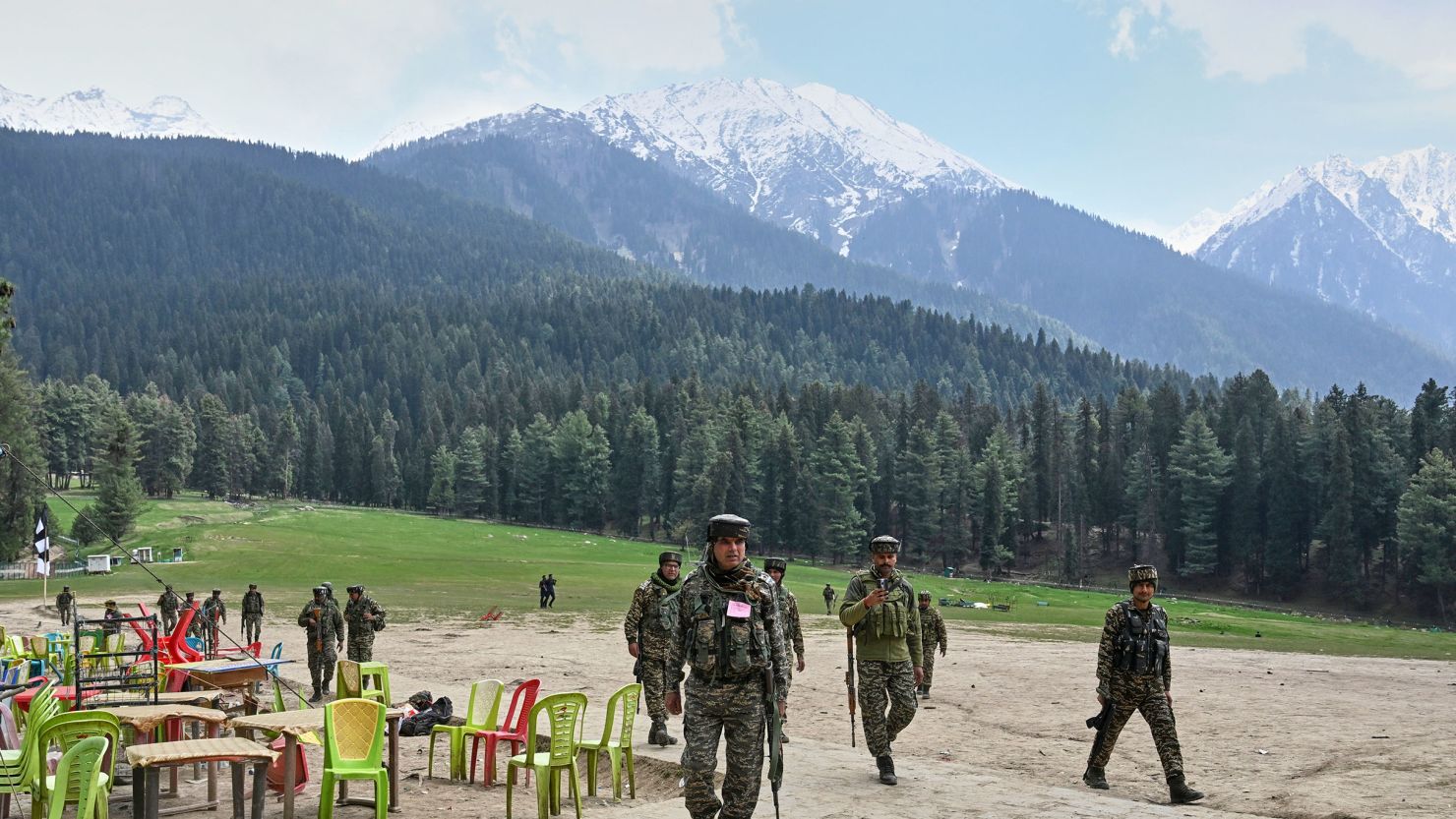
The majestic Chinar trees of the Kashmir Valley have witnessed centuries of shifting seasons, their crimson leaves falling like silent tears upon a land that has known more sorrow than spring. Beneath the breathtaking canopy of the Himalayas, a shadow war has been waged not merely for the territorial soil, but for the very soul and cognition of the Kashmiri people.
For over seven decades, a relentless and invisible tempest has swept through these mountains, meticulously designed to fundamentally alter the psychological landscape of entire generations. When one observes the profound depth, the unwavering continuity and the terrifying success of the mental conditioning deployed by Pakistan to shape what the Kashmiris believe, a chilling realisation takes root. It becomes painfully evident that from where Pakistan is standing in Kashmir, we have not even begun.
This is not a battle fought solely with kinetic weapons, but an insidious invasion of the mind that has successfully engineered a population to embrace a manufactured reality.
The genesis of this cognitive dominion capitalised on geographical isolation and infrastructural vulnerability to plant the very first seeds of alienation in the Kashmiri consciousness. Immediately following the partition in 1947, the Pakistani establishment swiftly weaponised the invisible ether, blanketing remote border villages with high frequency radio transmissions. While terrestrial broadcasting from the Indian side struggled to cross the formidable mountain passes, the adversary maintained a continuous feedback loop of ideological conditioning.
These broadcasts were intricately laced with cultural familiarity, utilising shared linguistic dialects and religious recitations to forge deep psychological bonds. It was a masterclass in exploiting an infrastructural vacuum, tethering the daily lived experiences of remote Kashmiri communities to a rhythm dictated entirely from across the border. Through this relentless auditory dominance, the Kashmiri populace was slowly conditioned to believe in the two nation theory, internalising the engineered narrative that their survival and identity were irreconcilable with a secular society.
This psychological subversion seamlessly transitioned into a profound educational and theological indoctrination that seeped into the very foundation of Kashmiri societal learning. The most devastating psychological pivot occurred during the late 1980s with the orchestration of Operation Topac, which actively sought to dismantle the indigenous pluralistic Sufi traditions of the valley.
Fanatical clerics were deployed into communities to reframe the political dispute as a sacred duty, systematically conditioning the youth to reject the syncretic practices of their ancestors. The Kashmiri mind was forcefully reprogrammed with a rigid theology, glorifying political violence as an absolute divine mandate. The slogan dictating that Kashmir will become Pakistan was drilled into the impressionable minds of the youth.
To further sanctify this proxy war, the psychological apparatus weaponised eschatological doctrines, convincing radicalised Kashmiri youth that their militancy was a prophesied cosmic battle. This theological conditioning successfully neutralised any cognitive dissonance, making the youth genuinely believe that taking up arms was a righteous path to salvation.
To sustain this multigenerational conflict, the strategic communicators perfected the dark art of romanticising militancy and weaponising the profound trauma of the Kashmiri populace. The youth, grappling with severe socio economic fragility and pervasive unemployment, found their immense psychological distress deliberately funnelled into an antagonism drive against the state.
The psychological warfare machinery transformed neutralised insurgents into revered cultural icons, offering an intoxicating illusion of absolute empowerment to a disenfranchised generation. Funerals of militants were strategically manipulated into radicalisation incubators, cementing a binary moral framework in the Kashmiri mind where the militant represents divine truth and the state represents irredeemable oppression.
This created a tragic closed loop of engineered trauma breeding radicalisation, where the Kashmiri youth are conditioned to attribute every facet of their suffering to a singular external source, completely absolving the proxy handlers who perpetuate their misery.
The absolute zenith of this psychological bombardment and the most terrifying testament to the success of this mental conditioning, is painfully visible when we examine the aftermath of the Pahalgam massacre. Over a year has passed since 26, innocent people were brutally gunned down by terrorists on the 22nd of April 2025.
The Indian security forces launched Operation Mahadev and successfully neutralised the three Pakistani perpetrators responsible for the heinous act. Furthermore, the National Investigation Agency conducted an exhaustive investigation and filed a detailed 1500 page chargesheet presenting irrefutable evidence of a cross border conspiracy orchestrated by handlers situated in Pakistan.
Despite this overwhelming mountain of concrete evidence detailing state sponsored terrorism, the cognitive conditioning of the Kashmiri populace remains so absolute and deeply entrenched that they actively reject the truth. Even today, a significant segment of the local populace genuinely believes and vehemently parrots the engineered narrative that the massacre was an Indian false flag operation.
This enduring denial highlights a terrifying reality where the Kashmiri mind has been so thoroughly indoctrinated that factual evidence is entirely eclipsed by manufactured conspiracies. This massacre is not an isolated event perceived as a state sponsored conspiracy. The same cognitive conditioning successfully framed the Ganga hijacking, the Mumbai attacks, the Pathankot assault and the Pulwama bombing as domestic illusions. Consequently, when India launched Operation Sindoor to dismantle terror infrastructure, the indoctrinated populace immediately started parroting the Pakistani version. They genuinely believed the retaliatory strikes were merely a fabricated spectacle.
The widespread trauma within the valley is the direct outcome of an adversary that has weaponised the very fabric of human cognition. The true tragedy lies in how thoroughly the Kashmiri people have been conditioned to embrace the narratives that ensure their perpetual suffering.
Acknowledging the monumental scale of this cognitive hegemony is the most crucial step towards true healing and reconciliation. We cannot hope to dismantle a fortress of the mind with only the tools of the physical realm. Addressing this profound asymmetry requires a compassionate and systematic deconstruction of the radical narratives that have hijacked the Kashmiri consciousness.
The ancient trees will inevitably shed their leaves again to brave the harsh winter, yet they always hold the silent promise of a vibrant spring. If we are to secure that spring for the generations yet to come, we must awaken to the reality of the invisible war waged in the shadows. We must finally, with unwavering resolve and boundless empathy, begin the arduous journey of healing the conditioned soul of the mountains.
The Author Ajmal shah is an advocate practicing before the High Court of Jammu & Kashmir and Ladakh, at Srinagar.

