
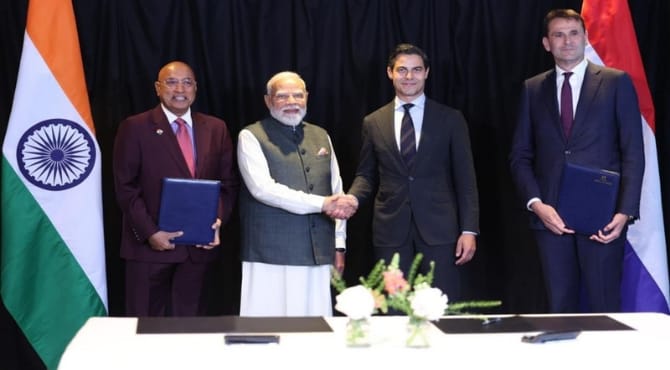
India’s semiconductor journey just took a serious step forward, and this time, it’s not just talk it’s execution. Tata Electronics has partnered with Dutch giant ASML, the world leader in chip-making equipment, to power India’s first commercial 300mm semiconductor fab in Dholera, Gujarat. The agreement, signed in the presence of Prime Minister Narendra Modi and Netherlands Prime Minister Rob Jetten, signals more than a business deal—it reflects India’s growing position in the global tech manufacturing race.
To understand why this matters, think of semiconductors as the “brain” inside everything—from your smartphone to electric vehicles and even defense systems. For decades, India has been a major consumer of chips but not a producer. That gap is what this partnership aims to close. With a planned investment of around $11 billion, Tata’s Dholera facility is not just another factory; it’s India’s entry ticket into a highly strategic and competitive global industry.
Now here’s where ASML becomes crucial. If semiconductor manufacturing is like baking a cake, ASML provides the oven—the most advanced and critical part of the process. Its lithography machines are used to print extremely tiny circuits onto silicon wafers, a step so complex that only a handful of companies globally can do it. By bringing ASML’s technology into Dholera, Tata Electronics is ensuring that India doesn’t just assemble chips, but actually manufactures them at scale with global standards.
But this partnership goes beyond machines. Both companies have committed to building a full ecosystem around the fab. This includes developing local talent, strengthening supply chains, and pushing research collaborations. In simple terms, it’s not just about one factory—it’s about creating an entire semiconductor ecosystem in India. This is critical because chip manufacturing depends on a deep network of suppliers, engineers, and research institutions.
Interestingly, this move also strengthens India’s strategic ties with the Netherlands, a country that plays a key role in global semiconductor supply chains. Alongside the Tata-ASML deal, academic collaborations have also been announced between top Indian institutes like IITs and IISc and leading Dutch universities. This “brain bridge” is designed to ensure that India has the skilled workforce needed to sustain and grow this industry in the long run.
From a business perspective, Tata Electronics is not starting from scratch. It has already partnered with Taiwan’s Powerchip Semiconductor Manufacturing Corporation (PSMC), gaining access to a wide range of technologies including 28nm to 110nm nodes. These are widely used in automotive, consumer electronics, and industrial applications—segments where demand is strong and growing. This means the Dholera fab will be commercially relevant from day one, rather than chasing cutting-edge nodes that require even higher investments and complexity.
For India, the timing couldn’t be better. Global supply chains are shifting, and countries are actively looking to reduce dependence on a few regions for critical technologies. This opens up a window for India to position itself as a reliable alternative. With government support, strategic partnerships, and now access to world-class technology, the foundation is being laid for long-term success.
At the ground level, the impact could be massive. The project is expected to generate high-skilled jobs, boost local industries, and attract further investments into Gujarat, which is quickly emerging as a semiconductor hub. More importantly, it gives Indian youth a new frontier to explore—one that goes beyond software and into deep-tech manufacturing.
So when you look at this MoU, it’s not just another headline. It’s a signal that India is moving from ambition to action in one of the most critical industries of the future. The real test will be execution, but for now, the direction is clear—and it’s a big one.

