
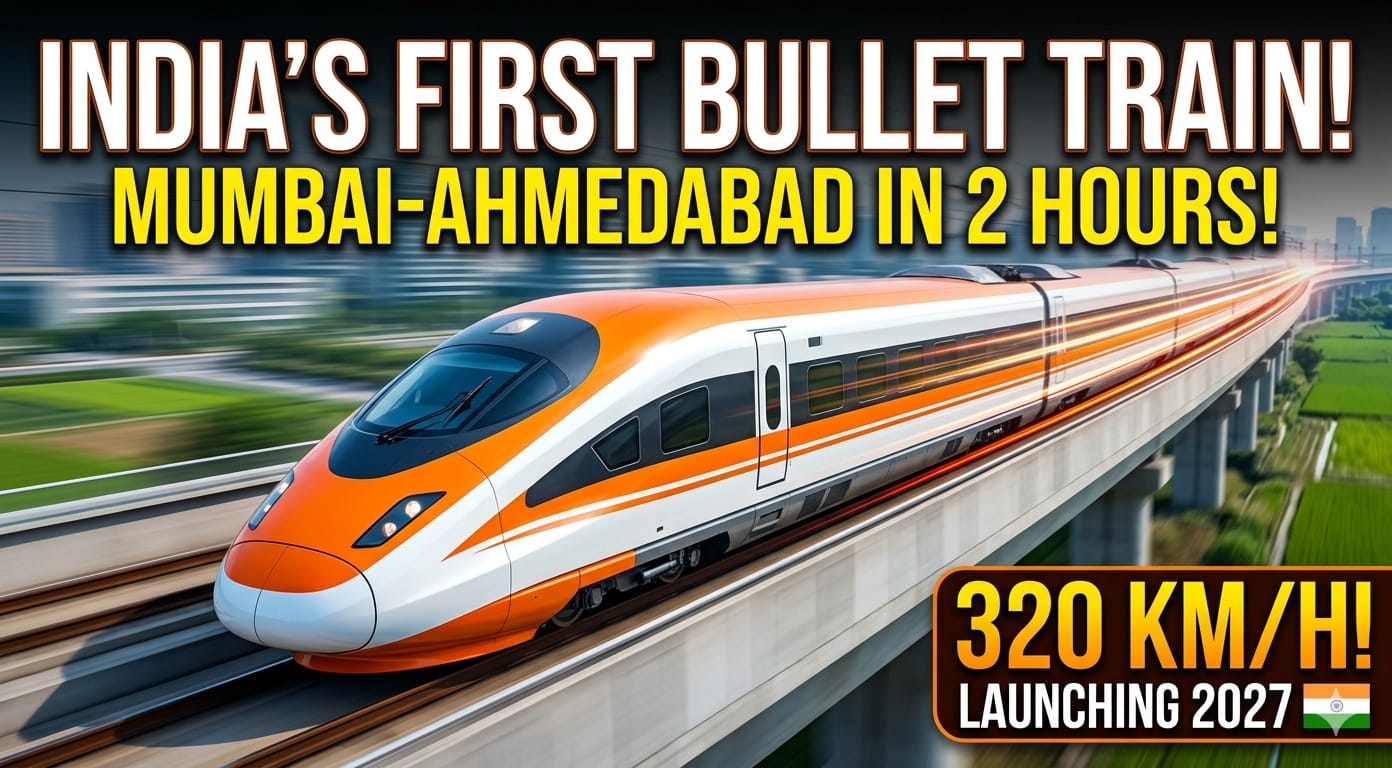
The government has finally offered its citizens a first visual glimpse of something long imagined but never seen before a bullet train that could redefine how Indians travel between cities. The Ministry of Railways recently showcased the official design of the Mumbai-Ahmedabad High-Speed Rail (MAHSR) train at its New Delhi office, giving people a preview of what the country’s fastest train will look like. Shared widely on social media, the image has sparked curiosity, excitement, and a sense that India’s infrastructure ambitions are steadily turning into reality.
At the heart of this development lies the 508-kilometre Mumbai-Ahmedabad corridor, India’s first dedicated high-speed rail project. Once operational, this train is expected to run at speeds of up to 320 km per hour, drastically cutting travel time between two of India’s most important economic hubs. Imagine covering the distance between Mumbai’s Bandra Kurla Complex and Ahmedabad’s Sabarmati in just about 2 hours. For anyone used to long train journeys or flight delays, this shift feels almost transformational.
But this project is not just about speed. It’s about connectivity and economic integration. The route will pass through key cities like Thane, Virar, Boisar, Vapi, Surat, Bharuch, Vadodara, and Anandregions that are already industrial powerhouses or emerging growth centres. By linking these cities through high-speed transit, the project is expected to boost business efficiency, reduce logistics friction, and create new economic opportunities across western India. Smaller towns like Boisar and Ankleshwar, often overlooked in national infrastructure conversations, stand to gain significantly from this enhanced connectivity.
The train’s design itself reflects a blend of modern aesthetics and familiarity. The orange colour scheme, reminiscent of the Vande Bharat Express, suggests a conscious effort to create a visual identity that feels both futuristic and distinctly Indian. While the current display is only a conceptual glimpse, it signals that India is not just importing technology but adapting it to its own narrative of growth.
Behind the scenes, the engineering work is equally impressive. The National High Speed Rail Corporation Limited (NHSRCL), which is spearheading the project, has already made substantial progress. One of the most complex componentsthe underground tunnel in Mumbaiis now underway. Recently, a massive 13.6-metre diameter Tunnel Boring Machine cutterhead weighing around 350 tonnes was lowered at Vikhroli. This is part of a much larger effort involving machines that weigh over 3,000 tonnes, working to carve out a 16-kilometre underground stretch, including India’s first undersea rail tunnel beneath Thane Creek.
If you think about it, this isn’t just a train project; it’s a technological leap. From advanced tunnelling to precision engineering and high-speed rail systems, India is building capabilities that could shape future infrastructure projects across the country.
The timeline is equally ambitious. The government is targeting 15 August 2027 for the launch of this corridor, aligning it symbolically with India’s Independence Day. While delays and cost concerns have been part of the conversation around the project, the visible progress suggests that momentum is building steadily.
For everyday travellers, the real question is simple: what changes? The answer lies in time saved, comfort improved, and predictability ensured. Business travellers could attend meetings in another city and return the same day. Families could rethink how they plan intercity trips. Even the competitive landscape between rail and air travel might shift, especially for short-haul routes.
In many ways, this bullet train represents more than just faster travel. It reflects India’s broader push towards world-class infrastructure, where speed, efficiency, and innovation come together. As the project inches closer to completion, the image unveiled at the Railway Ministry is not just a design, it’s a preview of a future that feels closer than ever.

