
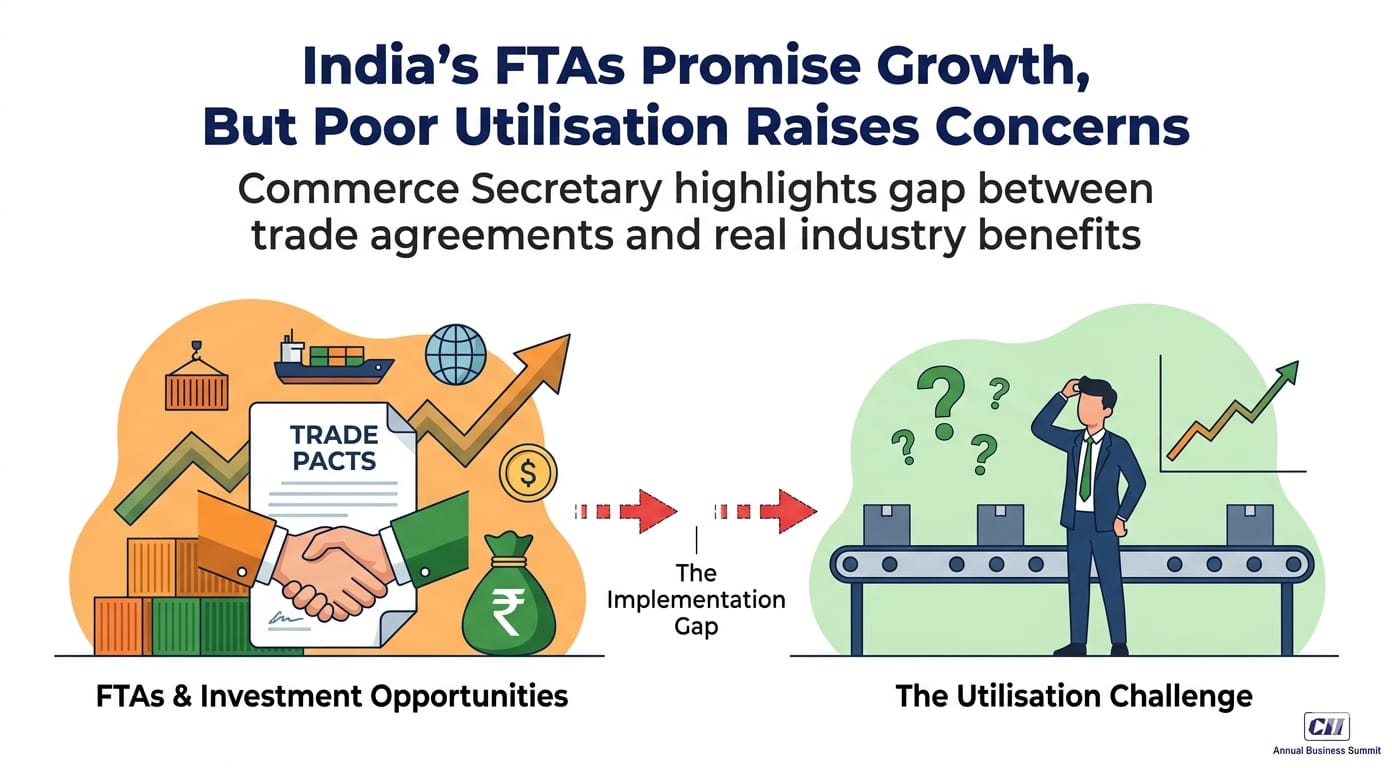
The government is expanding a network of free trade agreements (FTAs) and is opening new doors for trade and investment, yet their actual impact remains limited due to weak utilisation by domestic industries.
This concern was clearly highlighted by Commerce Secretary Rajesh Agrawal during the Confederation of Indian Industry (CII) Annual Business Summit 2026, where he pointed out that despite multiple agreements, India has not fully capitalised on their potential benefits.
His remarks underline a critical gap between policy creation and real-world execution, raising questions about how effectively Indian businesses are engaging with global trade frameworks.
Agrawal acknowledged that while FTAs have contributed to an increase in overall trade volumes, the growth pattern has been uneven. Imports have risen faster than exports, which has led to concerns about trade imbalances. However, he offered a nuanced explanation for this trend, suggesting that India’s rapidly expanding economy and rising domestic consumption could be a major factor.
As one of the fastest-growing major economies in the world, India’s internal demand is surging, which may reduce the immediate pressure to generate export surpluses. This perspective shifts the narrative slightly, indicating that the issue may not be entirely structural but also linked to the country’s growth trajectory.
At the same time, the Commerce Secretary did not shy away from pointing out the core problem—India’s track record in FTA utilisation is “not great.” This means that many businesses either lack awareness, face procedural hurdles, or are unable to meet the standards required to take advantage of these agreements. In practical terms, FTAs reduce tariffs and open market access, but if industries do not actively use these provisions, the agreements fail to deliver their intended economic value.
For example, a textile exporter may have duty-free access to a developed market under an FTA, but without proper compliance or market linkage, that opportunity remains untapped.
A key shift in India’s trade strategy is the move towards what Agrawal described as “modern FTAs.” Unlike traditional agreements that primarily focus on reducing tariffs, these newer pacts go much further.
They include provisions related to investment, services, digital trade, intellectual property, and regulatory cooperation. India’s recent and ongoing negotiations with countries and regions such as Mauritius, Australia, the European Union, the United Kingdom, and New Zealand reflect this broader approach. These partners are largely developed economies, which makes them complementary to India’s strengths, particularly in terms of capital, technology, and high-value markets.
This evolution in trade agreements presents a significant opportunity for India to attract foreign investment and integrate more deeply into global value chains. Developed countries bring not only demand for Indian goods but also investment in sectors such as manufacturing, infrastructure, and services.
However, the success of these agreements depends heavily on how well Indian industries adapt to higher standards, improve competitiveness, and align with global market requirements. Without this adjustment, even the most advanced FTAs may not translate into tangible gains.
Agrawal emphasised that the responsibility does not lie solely with the government. While policymakers can negotiate favourable agreements and create enabling frameworks, it is ultimately up to industries to leverage these opportunities.
This calls for greater awareness, capacity building, and strategic planning within the private sector. Businesses need to understand specific provisions of each FTA, identify target markets, and invest in quality, compliance, and logistics to fully benefit from reduced trade barriers.
The broader message from the summit is clear: India’s FTA strategy is evolving in the right direction, but execution remains the weak link. Bridging this gap requires coordinated efforts between government and industry, along with a mindset shift among businesses to actively explore global opportunities.
If utilisation improves, these agreements could play a transformative role in boosting exports, attracting investment, and strengthening India’s position in the global economy.

