
Just as Hitler’s hatred for Jewish people has been well documented, Nazi Germany’s alliance – political as well as ideological – with Fascist Mussolini of Italy, to fight the allied powers in the second World War is also a much known fact.
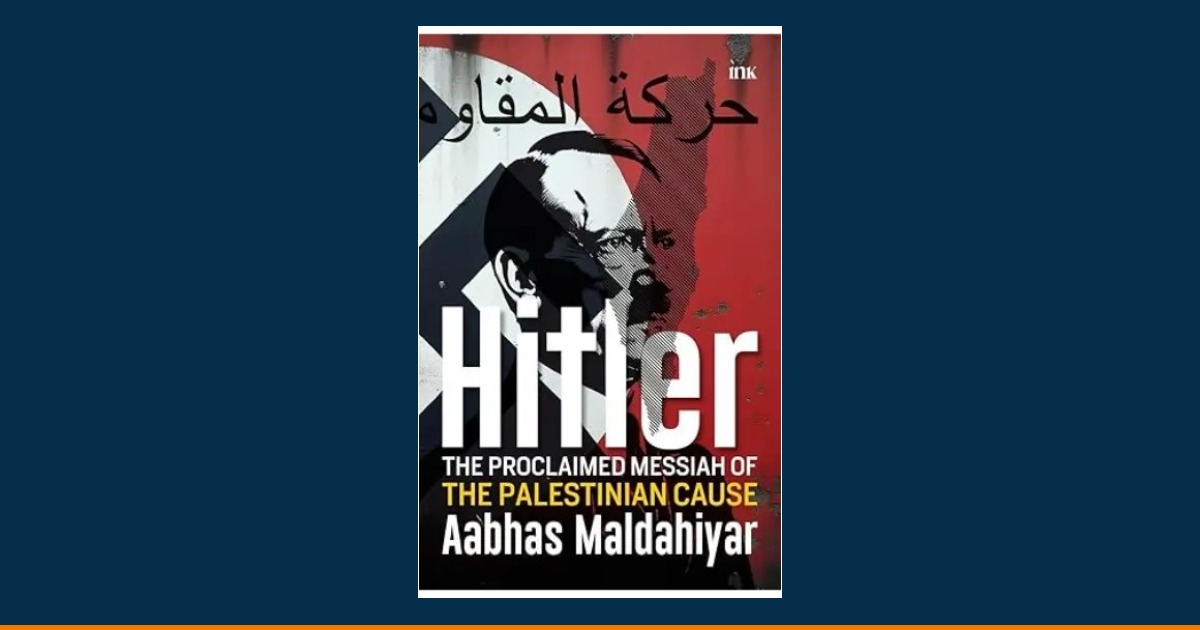
However, little known, or perhaps just ‘less talked-about’ despite being known to many, is Hitler’s profound inspiration he drew from Islam as a religion and Nazi Germany’s exemplary bonhomie with Arab Muslims throughout its reign. In his book Hitler – The Proclaimed Messiah of the Palestinian Cause, Aabhas Maldahiyar takes it upon himself to talk-about the ‘taboo’ that most people today dare not do to avoid being labelled ‘islamophobic’.
With a long and detailed prologue, Aabhas sets a much-necessitated premise for readers in the chapters that are about to be unfolded. The prologue details Hitler’s personal fascination with Islam, considering it to be a religion of ‘strong men’. This context helps readers understand that Hitler’s alliance with Arab Muslims was not merely a by-product of their common hatred for jews, but also his deep affection for the Islamic ideology, strengthening their alliance not just with political cause, but also with ideological backing.
In the very beginning of the book, Aabhas mentions Veer Savarkar: an Indian freedom fighter and the stalwart of Hindutva, and does not shy away from calling out the irony of ‘fascism’, by contrasting the labeling of Hindu nationalists like Savarkar as fascist with the historical record of the Arab world’s alignment with Fascist Mussolini and Hitler. He notes that Savarkar was one of those who recognised Israel much before, while the Arab world continued to negate its existence. With this, Aabhas sets a much needed unapologetic tone to his writing which helps the reader understand the historical context without any dilution and subversion of facts.
The chapterisation of the book gives a flow to the story telling. It begins with giving a historical background of what is today the state of Israel, and delves into details of the exodus of Jews from their holy land – the count, the reasons, the forces behind it and the discrimination and persecution thereafter. Where the world is more polarised than ever and it has become highly controversial to even debate on issues with Islamic theology, Aabhas does not hesitate to mention and quote Islamic scriptures, as an exhibit of intrinsic hatred that Islamic theology preaches against non-Muslims, and especially Jews.
The book notes down multiple instances of history that continue to be relevant even today. They help us understand the complexity of 21st century problems by giving us context of how the predicaments at hand today are just an enhanced form of similarly existing issues in the past. For instance, the book gives instances of how the common hatred of both Arab Muslims and Nazi Germany against the Jewish people helped them get closer to each other and how Nazi Germany under Hitler had influenced the Arab Muslim with his hatred for Jewish people, making Hitler a heroic figure for them. The instances of radicalisation and hatred penetrating into places like schools in the Arab world, that Aabhas notes, are not just historically isolated phenomena but are equally relevant even today. It helps us understand that the emergence of what is now called ‘white-collar’ terrorism is nothing new, but has a deep rooted historical context to it.
Aabhas also delves into the geopolitical context of the times, where the British Kingdom was at the center of conflict between Palestinians and Israelites, while also being in direct conflict with the Nazi Germany, who was hailed by Arab Muslims as a messiah of the Palestinian cause. The book details the events that unfolded in the struggle of Nazi Germany and Italy’s fascist ruler with the British to establish their dominance in West Asia. The geo-political strategies made by the insecure Mussolini with the mighty Hitler, with the help of Arab Muslims and how the Jewish people were made the scapegoats in the quest of the Nazi-Mussolini-Arab triad for political power in the regions of West Asia, find its documentation in the book. These historically noted patterns help us understand some present day issues at hand, for instance: the August 2024 coup in Bangladesh where the Islamists’ takeover of the Sheikh Hasina government ended up in multiple pogroms against the Hindu minority groups that continue unabated till this date.
One of the promising factors that leads one to rely upon the veracity of the book is the detailed citation of the facts. There is no arguable fact mentioned in the book without a reliable primary source cited to back it truthfulness. Where authors detailing historical events often give into the want to opining their own versions of history, Aabhas has tried to be as objective as possible with the facts that he presents, detailing source of claims in every four lines. The appendices following the ‘postscript’ of the book, containing the copies of historical documents, upon which Aabhas relies, make the reading more interesting and intriguing. The book is a must read for not just academic understanding of Nazism and Fascism and the present geopolitical conflicts in West Asia, but also for understanding the genesis of Islamist Terrorism that has caused insurmountable destruction to mankind.
(Author Keshav Upmanyu is an Advocate. He also closely follows socio-political economy and governance.)

