
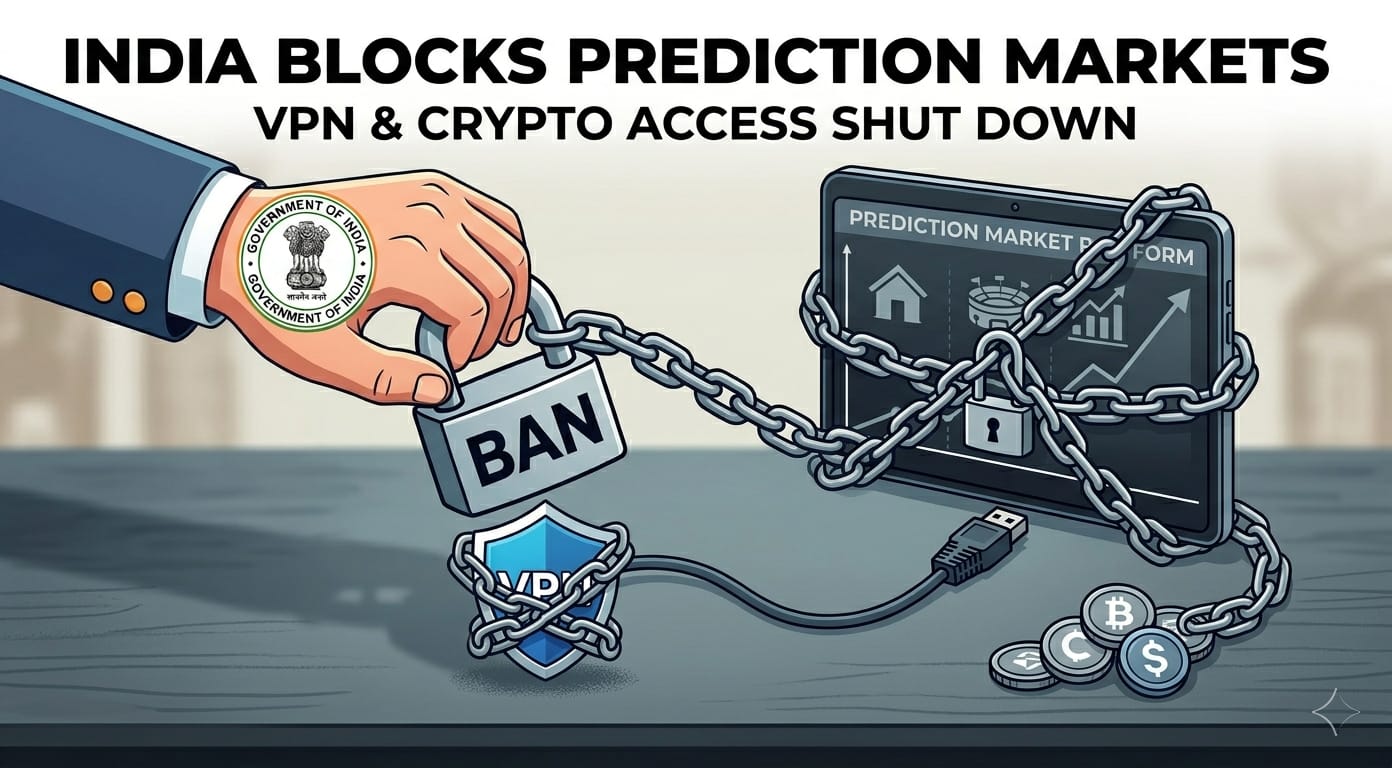
India’s digital economy is growing at a rapid rate, but with that growth comes new regulatory challenges. The Ministry of Electronics and IT (MeitY) recently required Virtual Private Network (VPN) providers to restrict access to banned prediction market platforms like Polymarket. This advisory is a sign of the growing influence of technology in circumventing laws, especially in virtual spaces covered by the Promotion and Regulation of Online Gaming Act, 2025 (PROGA), like betting and gaming.
The government has made it explicitly clear that even with the legal ban, platforms such as Polymarket remain accessible with the aid of VPN service. This essentially means that enforcement is weakened because even if websites are blocked locally, they can still be accessed by users disguising their location. VPN providers and other intermediaries must take “reasonable efforts” to ensure that such unlawful platforms are not accessed (advisory). The failure to do so may constitute violation of both the IT Act and the new gaming law.
What complicates this issue further is the financial aspect. The government has observed that not only are users accessing these platforms via VPNs but that they are also using cryptocurrencies or stablecoins such as USD Coin to place bets. This creates a parallel system that circumvents financial regulations and makes tracking transactions much more difficult. It is, therefore, a regulatory and financial oversight challenge.
The popularity of prediction markets in India shows the government’s rationale for taking this issue seriously. Through these platforms, users can place bets on the outcomes of real-world events, from election results to those of sports games. A prediction market on the Tamil Nadu Legislative Election, for instance, was said to have amounted to $16 million in bets. Such figures stand as the testimony that in spite of regulatory restrictions, the interest of users is very high, curiosity coupled with potential to earn and ease in accessing the web, all combine to drive more and more traffic on these websites.
Looking at the move from a wider view, a bigger trend can be seen which is reflected by this move in India’s policy. Against this background, new economic activities which are not easily regulated by conventional means are arising as the country integrates into the global digital ecosystem. Prediction markets are hard to regulate because they involve finance, technology, and entertainment industries. Enforcement is made more difficult by the use of VPNs and digital currencies, as these are based on the concept of bypassing geographical and financial restrictions.
This advisory creates a new responsibility ecosystem for VPN providers. VPNs, which have been seen as privacy tools, are being pulled into regulatory compliance frameworks. This raises questions as to whether intercepting or blocking certain activities by the intermediary limits user privacy or freedom on the internet. The government’s position is, however, unambiguous: it is unacceptable for citizens to access banned online platforms directly or indirectly.
Finally, this marks that India is now heading towards a more stringent and sophisticated phase of digital governance. As the economy grows and digital adoption deepens, regulators will increasingly focus on closing loopholes and ensuring that technological innovation does not outpace legal frameworks. The challenge will be to maintain a regulatory equilibrium that does not stifle innovation but rather acknowledges its potential risks, especially in financial and consumer-sensitive sectors.

