
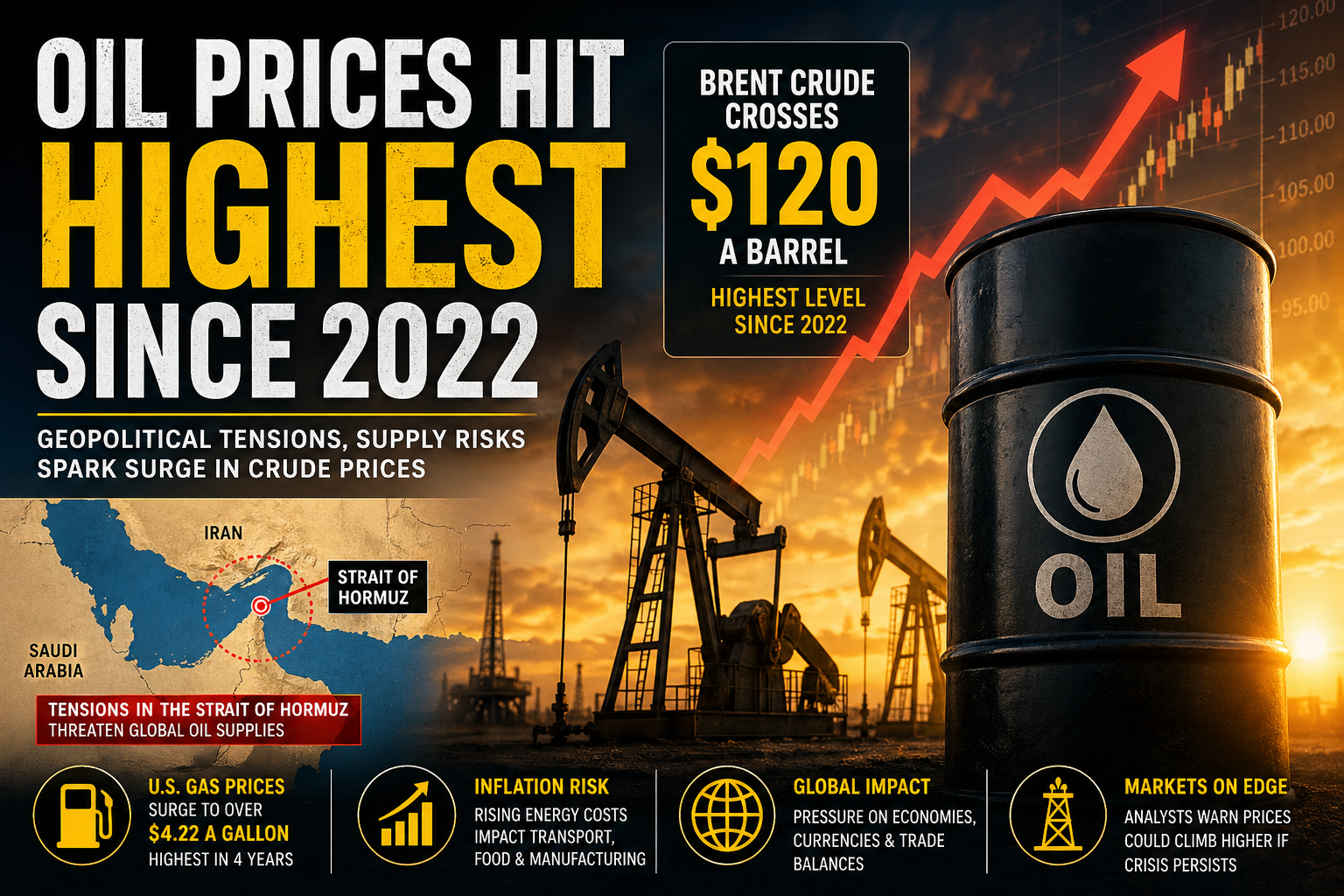
Thanks to the war in the middle east and the closure of the Strait of Hormuz, global oil prices have hit their highest level since 2022.
Global oil markets have entered a phase of extreme volatility, with crude prices surging to their highest levels since 2022. Brent crude, the international benchmark, has crossed the $120 per barrel mark, with some sessions even pushing toward $126—levels not seen in nearly four years. This sharp rally reflects a convergence of geopolitical tensions, supply disruptions, and heightened uncertainty in global energy markets.
At the heart of the surge lies the escalating conflict involving the United States and Iran. The partial closure and disruption of the Strait of Hormuz—a critical maritime chokepoint through which roughly a third of global seaborne oil passes—has severely constrained supply. As a result, traders have priced in a significant “risk premium,” anticipating prolonged disruptions in oil flows. The breakdown of diplomatic talks and the possibility of a sustained blockade have further intensified fears, pushing markets into a bullish frenzy.
The speed of the price rise has been particularly striking. In just a matter of days, Brent crude jumped by over 7%, reflecting how sensitive energy markets are to geopolitical shocks. Analysts warn that if the crisis persists, oil prices could climb even higher, with some extreme scenarios suggesting levels approaching $150 per barrel.
This surge is already having ripple effects across the global economy. Higher crude prices directly translate into increased fuel costs, as seen in the United States where gasoline prices have climbed to their highest since 2022. Beyond fuel, rising energy costs are feeding into broader inflationary pressures, affecting transportation, manufacturing, and food prices worldwide. Governments and central banks are now grappling with the dual challenge of controlling inflation while sustaining economic growth.
For countries like India, which rely heavily on oil imports, the impact could be particularly severe. Elevated crude prices tend to widen trade deficits, weaken currencies, and strain public finances due to higher subsidy burdens. Corporates, especially in energy-intensive sectors, are also likely to face margin pressures if high prices persist.
Meanwhile, the energy shock is reshaping global trade dynamics. The United States, for instance, has briefly emerged as a net crude exporter amid surging global demand, highlighting a shift in supply chains. Oil majors are benefiting from the volatility, reporting strong trading gains, even as the broader economic outlook remains uncertain.

