
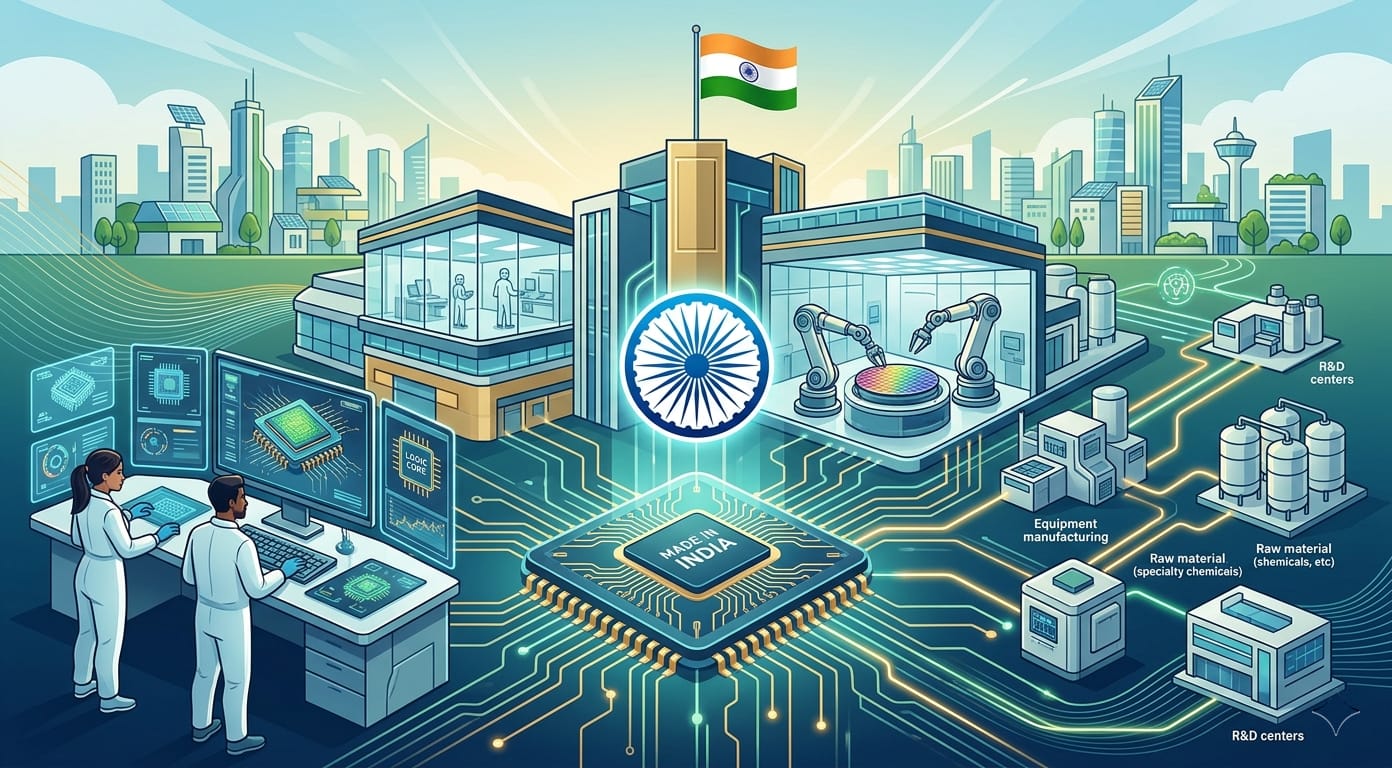
The government is preparing to significantly scale up its semiconductor ambitions with the launch of the India Semiconductor Mission 2.0, or ISM 2.0, likely to be rolled out by May 2026. the Indian Semiconductor Mission was formally approved by Union Cabinet and launched in December 2021. According to an NDTV Profit report citing government sources, the expanded programme carries a proposed outlay ranging between Rs 1 lakh crore and Rs 1.2 lakh crore, a substantial leap from the Rs 76,000 crore earmarked under the original mission.
Inter-ministerial consultations are currently underway, with the Ministry of Electronics and Information Technology (MeitY) awaiting final clearance from the Finance Ministry before the plan is formally unveiled.
The groundwork for this expansion was laid over several years. In March 2025, at India’s first Nano Electronics Roadshow, MeitY Secretary S. Krishnan projected that India’s domestic semiconductor demand market would grow to as much as $110 billion by 2030, a figure that underscored the urgency of building domestic supply capacity.
That same year, the first phase of the India Semiconductor Mission had gathered significant momentum, with the government approving 10 semiconductor projects worth approximately Rs 1.6 lakh crore across six states, covering the full spectrum of fabrication, assembly, testing, and packaging. This laid the physical and institutional foundation upon which ISM 2.0 is now being built.
The formal budgetary signal came in the Union Budget 2026–27, when Finance Minister Nirmala Sitharaman announced ISM 2.0 with an initial allocation of Rs 1,000 crore. She noted that the scheme had already attracted investment commitments at double its original target, prompting a revised proposal to raise the outlay to Rs 40,000 crore to capitalise on the momentum. The expanded allocation now under inter-ministerial review up to Rs 1.2 lakh crore reflects how quickly the policy ambition has grown in scale since that Budget announcement.
Unlike the first phase, which was primarily focused on chip fabrication and design, ISM 2.0 broadens the mission’s scope considerably. The revamped framework is designed to support the entire semiconductor value chain, including semiconductor equipment manufacturers, raw material suppliers, specialty chemical producers, and MSMEs that form the ecosystem’s backbone. Ancillary gas suppliers and other critical input providers are expected to be active participants in this expanded framework, reflecting the government’s intent to build a truly indigenous semiconductor industrial base rather than just downstream assembly capacity.
A centrepiece of ISM 2.0 is the redesigned Design-Linked Incentive scheme, or DLI 2.0, which is expected to allow foreign firms to collaborate with Indian companies for semiconductor research and development within India. This provision is particularly significant as it could accelerate the emergence of up to 50 fabless semiconductor design firms over the coming years, building India’s capacity in high-value intellectual property creation, not just manufacturing. The focus on full-stack IP development signals a maturation of India’s semiconductor policy moving beyond assembly and packaging towards genuine design and innovation capabilities.
The strategic context for ISM 2.0 is also shaped by global disruptions. As geopolitical tensions continue to fracture traditional supply chains, major economies including the United States, the European Union, Japan, and South Korea have been aggressively localising semiconductor production. India’s expanded mission is aligned with this global realignment, positioning the country to reduce its dependence on imported chips while capturing a larger share of the diversifying global semiconductor supply chain.
Officially, the government has set a target for India to meet nearly 75 per cent of its domestic semiconductor demand by 2030 through the mission. Looking further ahead, the roadmap targets advanced manufacturing nodes, including 3-nanometre and 2-nanometre technologies, with an ambition to place India among the world’s top semiconductor nations by 2035 a timeline that reflects both the scale of the challenge and the seriousness of the policy commitment behind ISM 2.0.

