
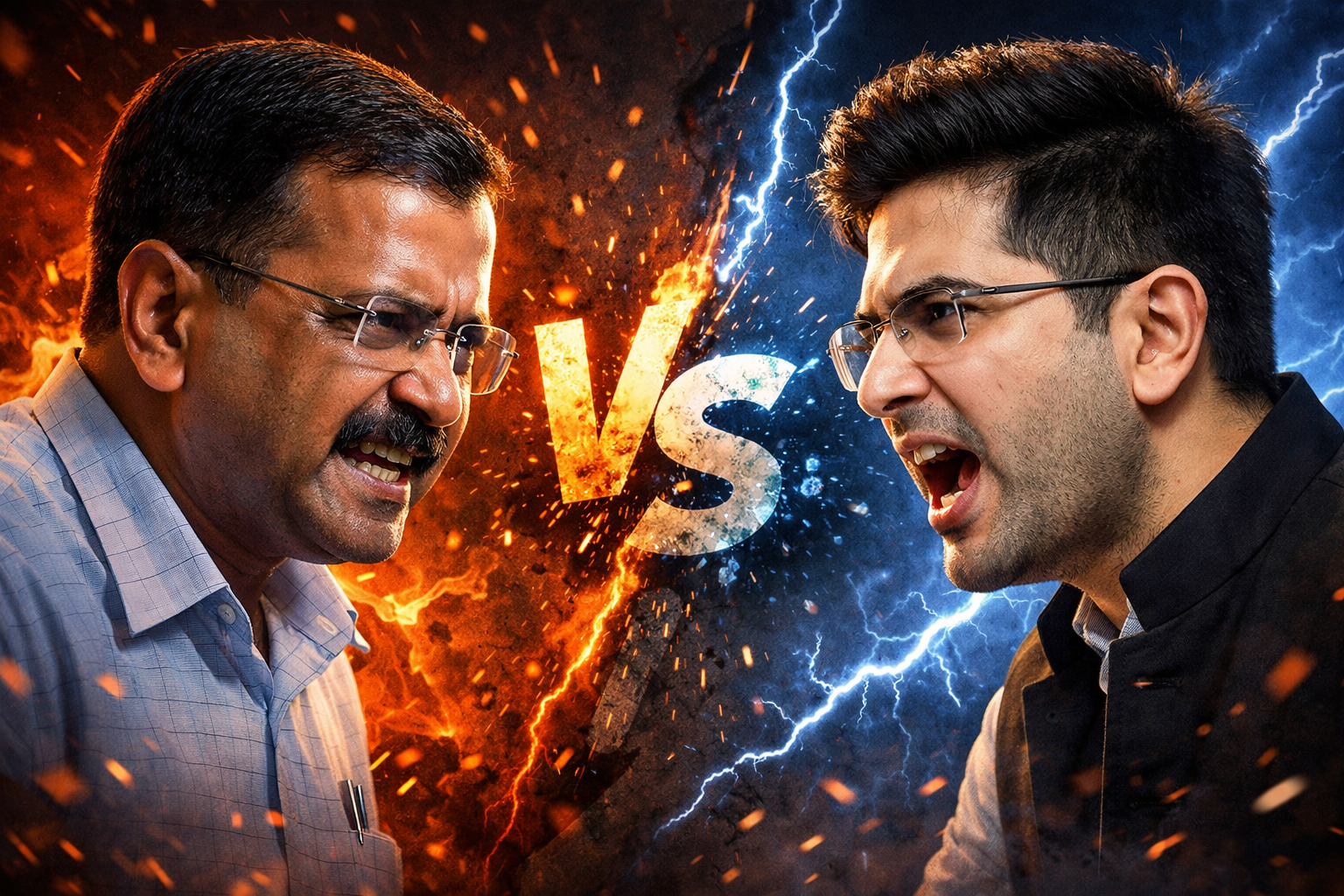
The Aam Aadmi Party (AAP) was founded in 2012, it promised to transform Indian politics. Born out of the anti-corruption movement led by Anna Hazare, the party claimed it would represent the “common man” and clean up a corrupt political system. However, over the past 13 and a half years, when it has managed to form government in Delhi and Punjab, the party has been more in news for its internal controversies than for any good governance work.
The party has been plagued by internal rebellions, corruption allegations, leadership disputes, governance controversies and policy failures. What began as a moral crusade against corruption has often appeared mired in the very problems it once condemned.
The story of AAP today is one of extraordinary rise and persistent turmoil, and at the head of it has been Arvind Kejriwal throughout, the one time ‘Aam Aadmi’ who has been at the centre of all such controversies.
The current controversy involving the Aam Aadmi Party is the one featuring their Rajya Sabha MP Raghav Chadha. He has been removed as the Deputy Leader of AAP in Rajya Sabha. The reason all AAP leaders are giving for this move is that Chadha got scared of BJP and instead of raising issues against Narendra Modi-led government, was raising random issues in Parliament. However, this excuse is not appearing convincing to most of the people of India. The general sentiment is that Raghav Chadha was starting to gain too much prominence in Indian media and that was unpalatable to party supremo Arvind Kejriwal.
The co-ordinated attack on Raghav Chadha by his party colleagues came as a surprise to casual observers of Indian politics, but those who have been following Aam Aadmi Party over the years since its inception. This is hardly news for AAP, and we have seen this happening to several leaders over the years.
The First big rift: Split with Anna Hazare
AAP’s first controversy actually came right at its birth. The anti-corruption movement led by Anna Hazare was supposed to remain non-political. But Arvind Kejriwal and his allies decided to enter electoral politics, leading to a bitter split with Hazare in 2012.
Hazare publicly distanced himself from the party, arguing that entering politics would dilute the movement’s ideals. The split created the first perception that AAP was willing to abandon its original principles for political power.
Internal Revolt: Yogendra Yadav and Prashant Bhushan kicked out
One of the most damaging internal crises erupted in 2015 when prominent leaders Yogendra Yadav and Prashant Bhushan were expelled from the party.
The two founding members of Aam Aadmi Part accused Kejriwal of running the party in an authoritarian manner, crushing internal democracy, and turning the party into a one-man show. Ugly scenes were witnessed when the duo were kicked out of AAP, quite literally.
The feud that played out in public exposed deep internal divisions and raised questions about whether the party that preached transparency could tolerate dissent. It was a major blow to AAP’s image and their claims of having a transparent internal democracy, there was nothing transparent about the party after all.
Further exit of key members
Following the Yadav-Bhushan exit, a mass exodus of founding leaders, started. Leaders like Kumar Vishwas, Ashutosh, Shazia Ilmi, and Kapil Mishra left Aam Aadmi Party. There was one controversy after another as one leader left after another.
All these leaders left after having problem with the great leader of AAP, Mr. Arvind Kejriwal.
Many of them accused the leadership of centralised control and ideological confusion. Kapil Mishra even alleged corruption within the government, claiming he had seen money being handed to Kejriwal by another minister.
The Somnath Bharti Midnight Raid
One of the earliest governance controversies involved Delhi Law Minister Somnath Bharti in 2014.
Bharti led a midnight raid on African women in Delhi, alleging drug and prostitution activities. The incident sparked international criticism and raised concerns about racial profiling and misuse of power.
The controversy severely dented AAP’s claims of progressive politics.
The Delhi liquor policy scandal
Perhaps the most damaging controversy in AAP’s history has been the Delhi liquor policy case.
Investigative agencies alleged that irregularities in the new excise policy led to financial benefits for certain private players. The controversy led to arrest of senior leader Manish Sisodia among others.
The allegations were particularly damaging because AAP had built its entire brand on anti-corruption politics.
The “Sheesh Mahal” bungalow controversy
Another controversy involved the renovation of the Chief Minister’s official residence in Delhi.
Critics accused Arvind Kejriwal of spending large amounts of public money on luxury upgrades, including expensive interiors and fittings. Opponents mocked the residence as “Sheesh Mahal,” claiming it contradicted Kejriwal’s earlier image as a modest leader who rejected VIP culture.
The episode symbolised the transformation of a “common man” politician into a traditional power figure.
AAP Criticism
AAP also faced criticism for failing to deliver on several major promises. Nothing happened in Delhi during their tenure, neither Yamuna was cleaned, nor air pollution in Delhi went down.
One thing AAP successfully did was frequent clashes with the central government led by Narendra Modi.
Disputes over control of bureaucrats, policing and governance in Delhi led to repeated political confrontations. While AAP claims these conflicts hinder governance, objective observers say the party often uses the Centre as an excuse for administrative failures.
Punjab power struggles
After winning the 2022 Punjab Legislative Assembly election, AAP expanded beyond Delhi.
However, accusations quickly surfaced that Punjab Chief Minister Bhagwant Mann was being controlled by the party leadership in Delhi. Critics claim this undermines the autonomy of the state government.
Emerging internal tensions
Recent reports suggest growing internal friction, including tensions involving Raghav Chadha, who was once seen as a rising star in the party.
Such developments indicate that AAP’s internal conflicts have not disappeared despite its electoral successes.
The Raghav Chadha episode exposes a fundamental problem with AAP, nobody should get more press than Arvind Kejriwal. Chadha has been there with AAP since its beginning, he was arguing with veteran politicians as a 25 years old to defend AAP. Now that he started appearing in news too often, he has been sidelined by AAP.
Is that because Arvind Kejriwal is too insecure and can’t tolerate any other leader gaining prominence, or is it because Raghav Chadha overstepped his mark?

