
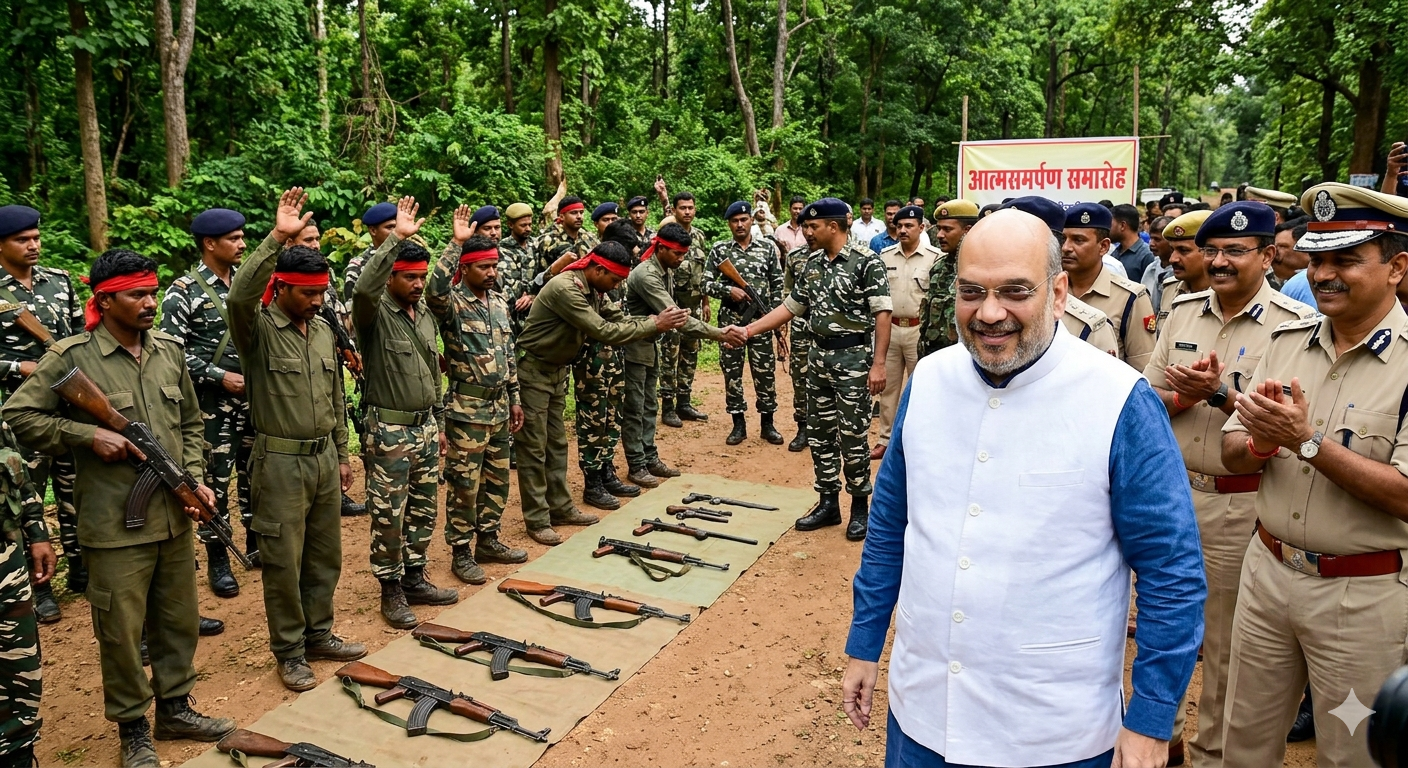
On a humid evening in Sukma, a young man—Keshav (name changed), once known by his underground alias Sonu—quietly returned to his village after years in the jungle. He carried no weapon, only a small bag and a government-issued certificate marking his surrender under India’s Surrender-cum-Rehabilitation Scheme for Left Wing Extremists (LWE). For over a decade, he had lived as part of the Maoist insurgency, drawn in by coercion, ideology, and the absence of opportunity. Today, he runs a small poultry unit, supported by skill training and access to formal banking. His journey captures a transformation that is unfolding across what was once India’s “Red Corridor.”
India’s progress towards a “Naxal-Mukt Bharat” is often attributed to intensified security operations. But that explanation is incomplete. The more consequential shift has been the emergence of a rehabilitation-led approach, one that has gradually altered the incentives, morale, and social foundations of the insurgency itself.
The scale of change is striking. At its peak, Left Wing Extremism affected over 90 districts across central and eastern India. Today, its presence is largely confined to fewer than a dozen districts. Violence has declined by over 90 per cent over the past decade, and the number of active Maoist cadres has collapsed, from over 2,000 nationally in recent years to just a few hundred. Perhaps the most telling indicator, however, is the surge in surrenders. More than 10,000 cadres have laid down arms since 2014, with over 2,300 surrenders recorded in 2025 alone, and hundreds more already in early 2026.
This is not merely attrition, it is organisational unraveling. At the heart of this transformation lies the Surrender-cum-Rehabilitation Scheme, strengthened under the broader National Policy and Action Plan to Address LWE. The scheme offers immediate financial assistance, monthly stipends, housing support, and vocational training. Crucially, it provides something insurgent movements rarely anticipate: a credible and dignified exit pathway.
This has had a powerful psychological effect. For cadres deep within the insurgency, the choice is no longer binary—fight or die. There is now a third option: return, rebuild, and reintegrate. Over time, this has eroded both morale within Maoist ranks and the movement’s ability to retain recruits.
The impact is most visible in states like Chhattisgarh, long considered the epicentre of the insurgency. In Bastar’s dense forested regions, where the writ of the state was once minimal, the number of active cadres has dropped dramatically. Surrenders have surged year after year, culminating in over 1,500 in 2025 alone in the state. High-profile defections from senior leadership ranks have further weakened organisational coherence, signalling that even long-standing commanders no longer view armed struggle as viable.
This transformation is not abstract. During a visit to Bastar, this author had the opportunity to observe some of these changes firsthand, including interactions with surrendered cadres who have since been incorporated into various roles within security establishments. Their trajectories, from insurgency to integration, offer a grounded glimpse into how policy translates into lived outcomes.
What makes this shift particularly significant is that rehabilitation has not operated in isolation. It has been embedded within a broader ecosystem of governance expansion and development.
Initiatives such as the Aspirational Districts Programme, rural road construction under the Pradhan Mantri Gram Sadak Yojana, and the expansion of mobile connectivity have reduced the isolation that once sustained insurgent influence. Over 12,000 kilometres of roads have been built in LWE-affected areas in recent years, connecting previously inaccessible villages to markets, schools, and healthcare. Banking penetration has expanded through thousands of new branches, ATMs, and post offices, integrating local populations into formal economic systems.
This expansion of state presence has fundamentally altered the relationship between communities and governance. Areas once marked by state absence, and consequently insurgent dominance, are now witnessing regular service delivery, welfare access, and even robust electoral participation.
State-level innovations have reinforced this shift. In Chhattisgarh, outreach initiatives delivering essential services directly to remote villages have complemented surrender policies by building trust. In Maharashtra’s Gadchiroli and Odisha’s Malkangiri, improved infrastructure and revised rehabilitation packages have created tangible economic alternatives for former cadres. This combination of incentives and opportunity has ensured that surrender is not merely symbolic, but sustainable.
Importantly, rehabilitation has also disrupted the insurgency at a structural level. Each surrender weakens the movement’s human resource base, intelligence networks, and local legitimacy. When senior leaders defect, the effect is magnified—undermining command hierarchies and signalling decline to those still underground. Over time, this creates a cascading effect: as more cadres exit, the costs of staying within the insurgency increase.
The result is a shift not just in numbers, but in narrative. Maoist insurgency is no longer perceived as an expanding revolutionary movement, but as a shrinking and increasingly untenable enterprise.
This transformation underscores a broader lesson in counter-insurgency. Security operations remain necessary, they have constrained insurgent mobility and disrupted networks. But they are not sufficient. The decisive factor has been the state’s ability to combine coercion with credibility: to apply pressure while simultaneously offering pathways for reintegration and development.
The young man in Sukma is no longer an exception. He is part of a growing cohort choosing reintegration over rebellion—not because the state has simply defeated the insurgency militarily, but because it has made the alternative more viable.
As India moves closer to its goal of eliminating Left Wing Extremism as a major internal security threat, the success of rehabilitation policies offers a clear insight: insurgencies do not end only when they are crushed. They end when they lose relevance—when the promise of dignity, opportunity, and participation outweighs the appeal of armed struggle.
In that sense, India’s LWE story today is not just one of suppression, but of transition: from insurgency to integration.
Author Kamal Madishetty is an Assistant Professor at Rishihood University and a Visiting Fellow at India Foundation, New Delhi.

