
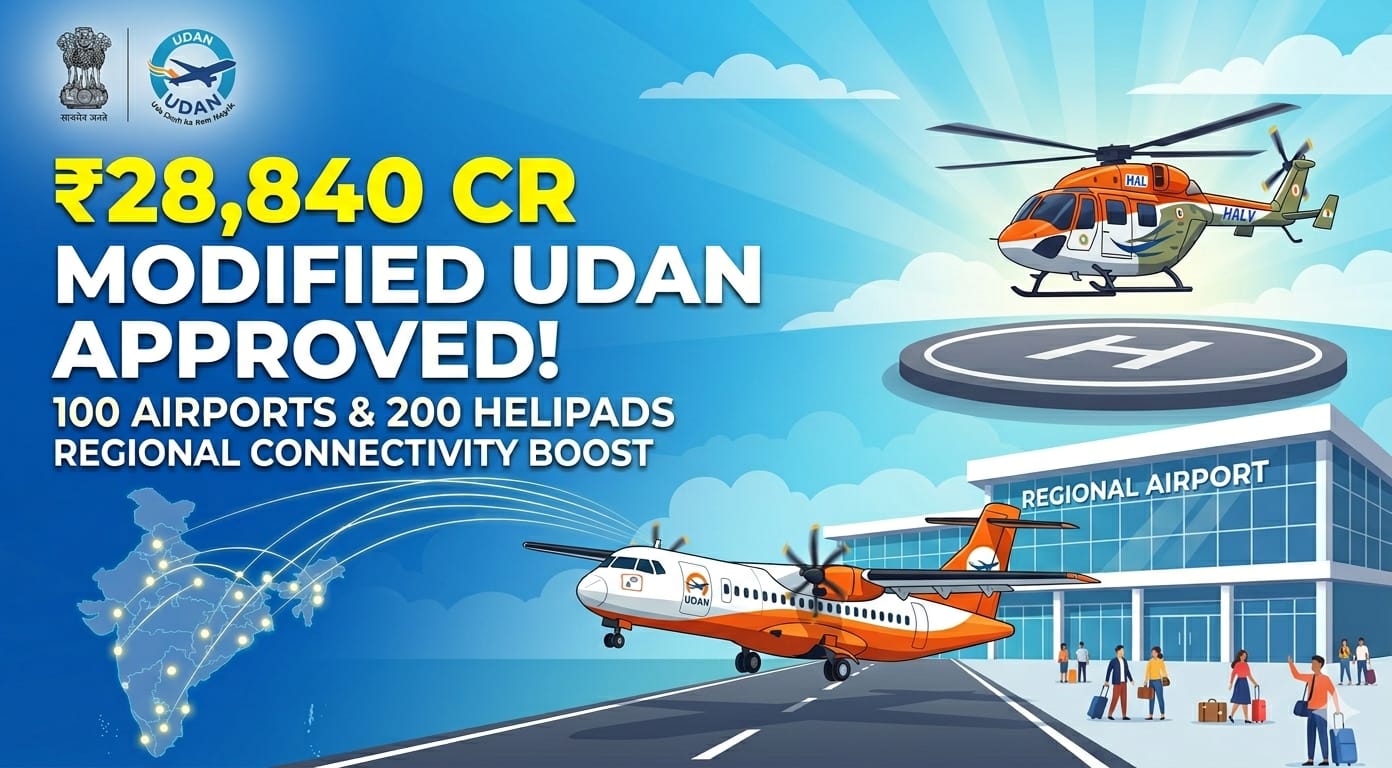
The Union Cabinet on 25 March 2026 approved the launch and implementation of the Regional Connectivity Scheme – Modified UDAN (Ude Desh ka Aam Nagrik) with a total expenditure of ₹28,840 crore over the forthcoming decade. The ambitious plan is meant to embed deeper India’s regional air network with access to unserved and underserviced spaces while promoting air travel affordability for citizens and economic promotion in Tier-2 and Tier-3 cities. The revised UDAN program is to be implemented between FY 2026-27 and FY 2035-36 in phases, which is a further major extension to the government efforts to democratize flying by connecting smaller, less familiar cities to viable air routes.
The scheme sees the large-scale upgrade of infrastructure, including the 100 new airports, using existing unserved airstrips across the country. This alone has been allocated an outlay of ₹12,159 crores and is to be undertaken over the next eight years. The idea is to convert dormant or low-utilized airstrips into operational airports offering regional air traffic services to improve accessibility of smaller towns to air travel, thereby positively impacting these towns’ economies.
In addition to the creation of new airports, the government will also offer operational and maintenance support to approximately 441 existing aerodromes for three years. The allocated ₹2,577 crore for this initiative will ensure regional airports remain functioning, safe, and well-equipped to sustain flight operations. This measure is expected to improve the quality and dependability of regional flight services and reduce risks associated with flight operations by airline operators.
To strengthen the last-mile connectivity and air travels in difficult terrains, the scheme envisages to develop 200 modern helipads at a cost of ₹3,661 crores. They will form a strategic network to provide improved connectivity for medical, tourism, and emergency services in remote areas, hilly lands, and islands. This step is particularly critical for states in the Northeast, the Himalayan belt, and some parts of central India where air travel has been limited due to difficult terrain.
The Viability Gap Funding (VGF) support, ₹10,043 crore in ten years, is a crucial element of the Modified UDAN scheme. This mechanism thus ensures that domestic airlines operate profitably and remain financially viable while servicing unprofitable regional routes. It makes up the difference between the operating costs of flights and the proceeds generated from discounted fares to maintain a continued airline service to distant parts. The viability gap funding mechanism has already demonstrated effectiveness in the original phase of the UDAN scheme, an approach further to be used to extend regular flight networks to more regions.
To remedy the presently low number of small fixed-wing aircraft and helicopters required for mission operations in arduous terrains, indigenous aircraft procurements have been included in the scheme. Two HAL Dhruv helicopters and two HAL Dornier aircraft will be procured for Pawan Hans and Alliance Air, respectively, under the Atmanirbhar Bharat initiative. Besides helping to bolster indigenous aerospace manufacturing, this will help support operations on regional routes and remote areas where such capacity is lacking.
The original UDAN scheme that was launched in October 2016 has greatly expanded India’s aviation footprint with 663 routes currently operational connecting 95 airports, heliports, and water aerodromes across the country as of 28 February 2026. More so, 3.41 lakhs flights have been operated, serving 162.47 lakh passengers, making UDAN one of the most impactful regional connectivity programs implemented so far The modified scheme is thus supposed to better the state of affairs, with greater coverage, newer infrastructure, and more enhanced execution in the following decade.
Officials expect the new phase to stimulate more economic activities, boost tourism, and improve the healthcare and education services in more remote areas. More important is the creation of thousands of direct and indirect jobs, from the building of airports, airline operations, logistics and local services. The government’s objective is to leverage aviation as a stimulus for regional development rather than a luxury enjoyed by major cities alone.
The Modified UDAN 2.0 is not only a continuation of an existing program but a strategic upgrade in line with India’s infrastructural vision of “Viksit Bharat 2047. By coupling infrastructure development with financial and domestic manufacturing, the scheme aims for sustainable, affordable, and inclusive air mobility for millions of Indians.

