
Deloitte’s newest report on India’s semiconductor sector gives an ambitious but achievable outlook for the next decade as story moves into a new chapter. According to the study named Technology, Media, and Telecommunications Predictions 2026.
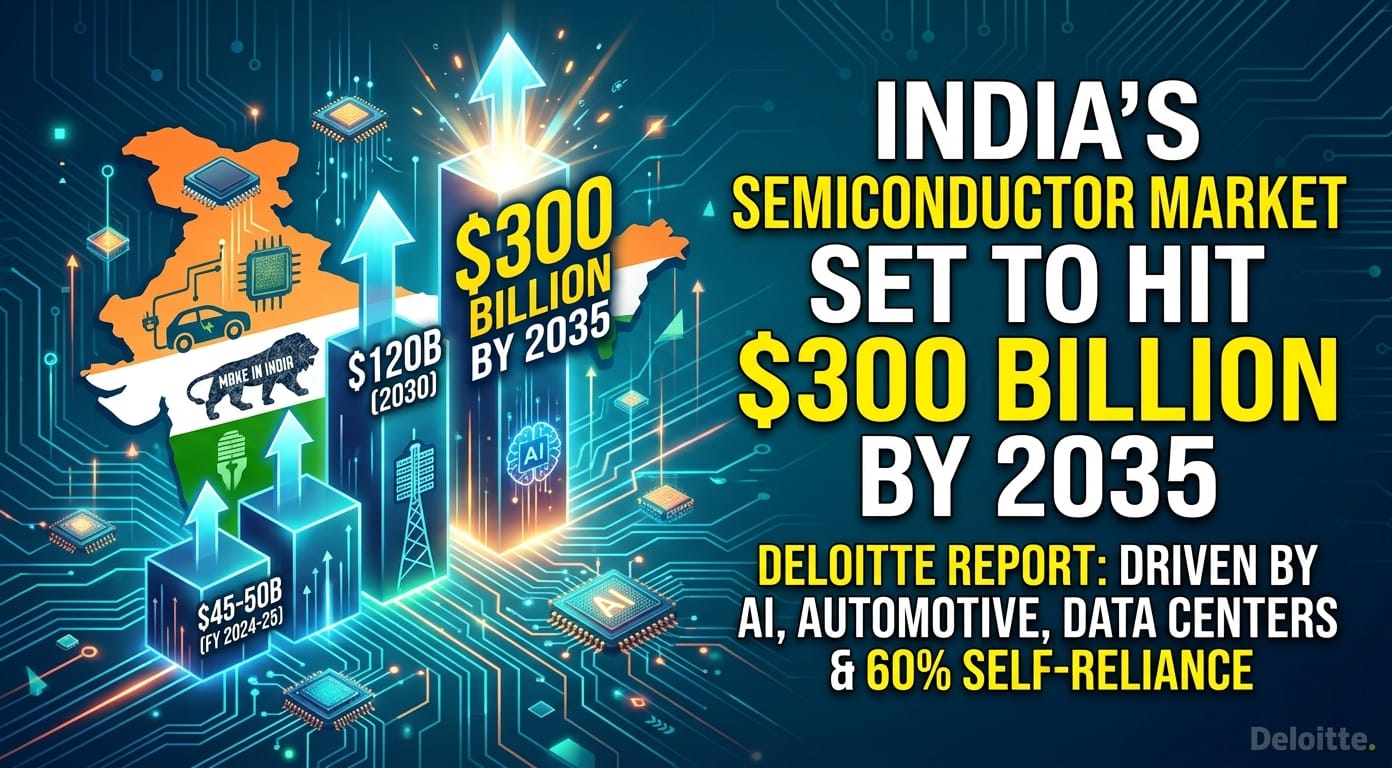
The semiconductor market in India, currently valued at $45-50 billion for the fiscal year 2024-25, is expected to rise to $120 billion by 2030 and $300 billion by 2035. It has become possible because of rapid Artificial Intelligence (AI) adoption, booming automotive demand, growing data centre capacity, as well as strong electronics manufacturing. Local production is expected to meet more than 60% of the country’s semiconductor needs by 2035, a drastic turnaround for an economy that will almost entirely import chips.
The transformation is dependent upon the changing policy and industrial ecosystem in India. The semiconductor market has grown at a compound annual growth rate (CAGR) of nearly 20% over the last three years, reflecting surging domestic consumption across electronics, automobiles, and computing devices.
Deloitte’s projections highlight that by 2035, India will house four to five silicon fabs, up to ten compound semiconductor fabs, one to two display fabs, and as many as 20-25 Outsourced Semiconductor Assembly and Test (OSAT) facilities. These are projected to be the core support for a diversified and self-reliant chip manufacturing ecosystem backed by the India Semiconductor Mission (ISM) and active participation of the states.
Presently, India’s dependence on imports stands firmly intact, as almost 90% of its semiconductor needs are met through foreign supply (India and semiconducting, n.d.). However, this dynamic is shifting as the government’s Make in India vision and the ISM’s Production-Linked Incentive – PLI schemes attract major global and domestic investors.
Referring to the manufacturing investments, the report states that more than $19 billion has been approved over ten projects—eight OSAT facilities, one compound fab, and one integrated semiconductor fabrication. Additional 18 to 20 further proposals valued at $20–25 billion are at different stages of sanction, demonstrating that investor appetite is both healthy and sustained.
The next decade is set to experience unprecedented capital inflows. India’s semiconductor industry could attract investments amounting to $50 billion between now and 2030, another $75-80 billion between 2030 and 2035. According to Deloitte, these investments will not only increase production but will also create a full value chain for design, research, packaging, and testing inside India. The cumulative effect will be a domestic ecosystem that can handle the shocks in global supply chains and geopolitical uncertainty.
But the implications stretch well beyond manufacturing. Deloitte estimates that the semiconductor industry in India could create almost 2 million job opportunities by 2035. About 30% of the projected jobs will be in manufacturing operations, 30% in chip design, and in R&D services, with the remaining 40%, spread across the segments, including logistics, maintenance, and infrastructure
However, for this talent to be sustained, education and training institutions in India will have an essential role to play. The report emphasizes the need to train four to five lakh individuals every year through courses, fabrication labs, and specialized ATMP (Assembly, Testing, Marking, and Packaging) facilities. For this, coordinated efforts will be needed across the government, academia, and private sector players.
Deloitte’s analysis also reminds that ambition is not all that will guarantee success. The report cautions that continued momentum will depend on multiple stakeholders performing in tandem. This requires India to transcend short-term and time-bound incentive schemes to permanent and integrated national semiconductor programs with continuity in policy and funding.
Smooth cooperation between the Centre and states would be critical, especially in speeding up land acquisitions, supply of energy, and infrastructure through single-window mechanisms.
As much as it is economic, the semiconductor opportunity is strategic. With diversification plans for global supply chains away from China and Taiwan, India is poised to gain if the balance between policy and industrial execution continues. The semiconductor demand from areas such as mobile devices, automotive electronics, computing, and data centres can be about 70% of the total demand in India by 2035.
In other words, chips will run just about everything from smart cars and cloud servers to renewable energy grids with India having a sizable share in every layer of that value chain.
If realized, the Deloitte forecast is not a mere number but a reflection of India’s entry into the league of leading semiconductor nations. Based on this forecast, supported by appropriate policy, strong industrial alliances, and a growing talent pool, the country could well be the one to write the next chapter in electronics manufacturing for the world. The road ahead will be steep, but the reward, a three hundred billion dollar domestic market and freedom in technology, are reasons that make this a race that India cannot afford to lose.

