
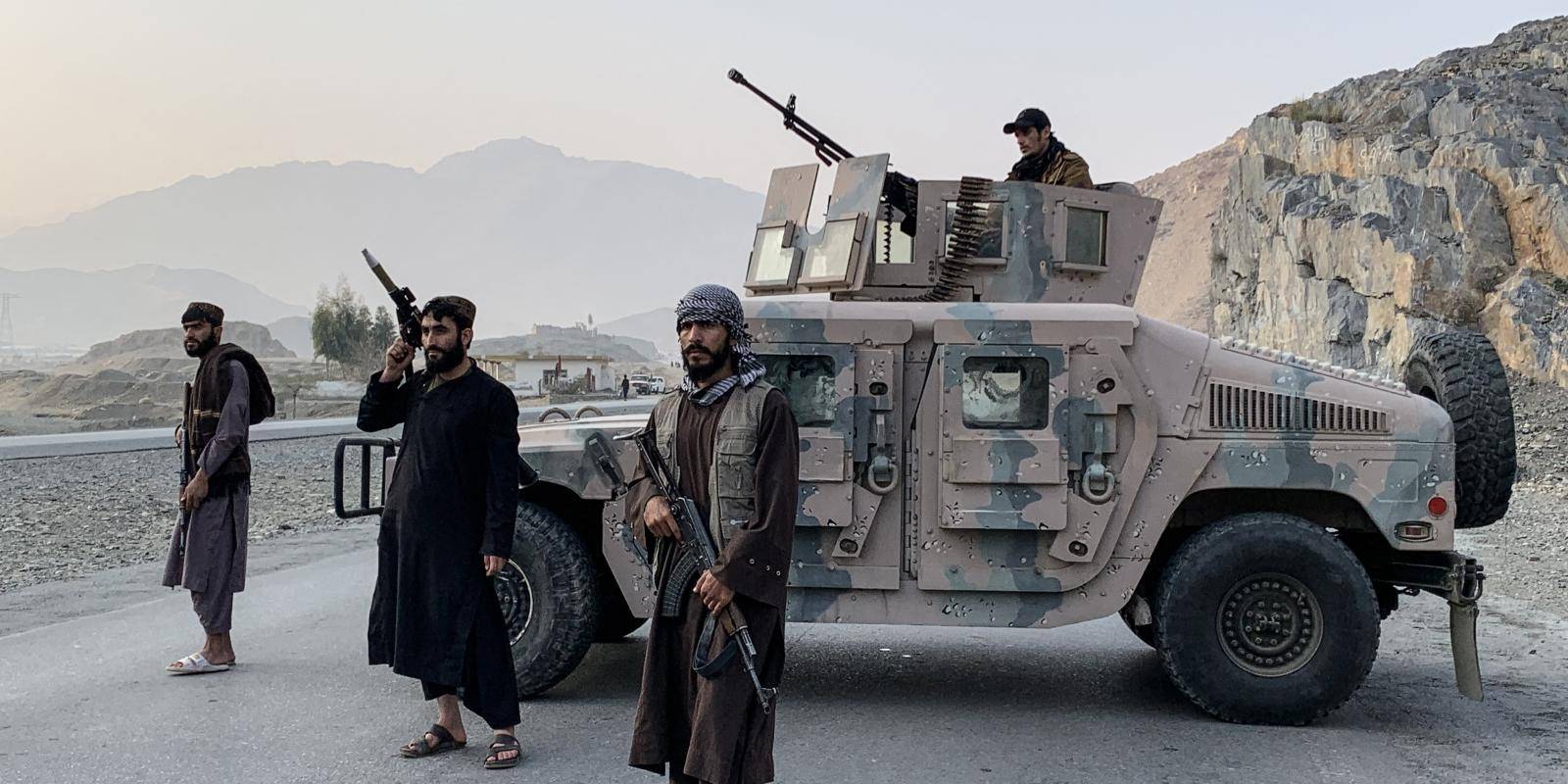
The clashes between Pakistan and Afghanistan, which began on the night of February 26-27, have continued for over 13 days with no clear sign of de-escalation, according to recent statements from both sides.
Meanwhile, reports have emerged on Pakistan’s social media that three individuals from Pakistan and Pakistan-administered Kashmir, previously associated with militant groups, have traveled to Kabul as a delegation. They include Maulana Fazlur Rehman Khalil, Abdullah Shah Mazhar (Pir Mazhar Shah), and Qari Sajid Usmani.
Taliban sources in Afghanistan and a close associate of Maulana Fazlur Rehman Khalil in Pakistan have confirmed, that these individuals have traveled to Kabul.
A senior member of the Taliban government in Kabul has also confirmed, the arrival of these three individuals, including Fazlur Rehman Khalil, in Kabul, but said they cannot share further details.
It is still unclear what prompted these individuals to travel to Afghanistan, and Pakistan has not made any official comments on the matter. But this is a confirmed agenda that any group of political or religious cannot travel to Kabul without the consent of Pakistan intelligence or govt.
Spokesperson for Pakistan’s Prime Minister Shehbaz Sharif, told a delegation of Pakistani religious figures has gone to Kabul. Zaidi added, “Free religious scholars have the right to maintain relations with anyone.” He added Pakistan’s message and approach are clear and unchanged.
Pakistan accuses the ruling Taliban in Afghanistan of supporting the Pakistani Taliban, Tehreek-e-Taliban Pakistan (TTP), and providing them with safe havens. Pakistan has also claimed several times to have conducted strikes on suspected TTP hideouts in Afghanistan.
Maulana Fazlur Rehman Khalil is considered a key figure in Pakistan’s militant circles since the 1980s. He was previously the leader of the Kashmir-based militant group Harakat-ul-Mujahideen, which has since changed its name.
In September 2014, the US Treasury Department designated Maulana Fazlur Rehman Khalil a “global terrorist”. Maulana Fazlur Rehman Khalil is a resident of Khyber Pakhtunkhwa.
Fazal khan expert on militants’ groups told, Harakat-ul-Mujahideen later merged with Harakat-ul-Jihad-al-Islami, resulting in the formation of Harakat-ul-Ansar. According to him, this group had previously carried out major operations in Indian-administered Kashmir under the same name.
These are the militant’s groups who are working under the supervision of state.
It was an influential Deobandi group. They had close ties with Osama bin Laden. At one point, they had military camps in Afghanistan, Pakistan-administered Kashmir, and Mansehra in Pakhtunkhwa.”
Another expert on militant groups, Majid nizama, says Maulana Fazlur Rehman Khalil’s current group is called Ansar-ul-Ummah, and he is also the general secretary of Tehrik-e-Tahaffuz-e-Haram-e-Sharifain.
Majid Nizami adds that Maulana Fazlur Rehman Khalil’s militant background spans around three decades, during which he has established himself as a pro-government militant commander rather than an anti-state one. He adds, “Reports of his ties with Osama bin Laden were also published in the media.”
According to Majid Nizami, Maulana Fazlur Rehman Khalil is now mostly involved in dawat and tabligh work, but his previous connections remain intact. Faizullah Khan also says that Harakat-ul-Mujahideen members were very close to the Afghan Taliban.
He says, “When the Soviet Union withdrew from Afghanistan and the Afghan Taliban government was formed, these individuals joined them due to ideological affinity and fought alongside them on various fronts.”
Abdullah Shah Mazhar is also considered a prominent figure in Pakistan’s militant circles. He had close ties with several militant leaders, including Masood Azhar, the leader of the banned group Jaish-e-Muhammad. However, he later distanced himself from militant activities and also entered politics.
Abdullah Shah Mazhar has changed his name and is now known as Mazhar Saeed Shah. He says, “He was also affiliated with Jaish-e-Muhammad, but later parted ways due to differences and formed a party called Tehrik-e-Ghalba-e-Islam.”
The Taliban government’s Defense Ministry says Pakistan’s military has launched an airstrike on a center in Baluchistan. Muttaqi, we are facing a “proxy” war. Pakistan’s Defense Minister says the country will not hesitate to launch new airstrikes in Afghanistan.
Abdullah Shah Mazhar is originally from Pakistan-administered Kashmir, but spent most of his youth in Karachi and Afghanistan. “Later, he returned to Pakistan-administered Kashmir and was elected to parliament as a technocrat by Pakistan’s Tehreek-e-Insaf, and has even served as a minister.”
Abdullah Shah Mazhar’s madrasa in Karachi operates under the name Jamia Anwar.
Qari Sajid Usman may not be widely known to the general public, Faizullah Khan says Qari Sajid Usman’s brother, Zahid Iqbal, was very active in the armed struggle against the Soviet Union, which led Qari Sajid to associate himself with him.
Qari Sajid Usman runs a madrasa or institution called Khuddam-ul-Quran in Karachi and has always remained close to Maulana Fazlur Rehman Khalil.
According to reports, Qari Usman left Pakistan after the 9/11 attacks and later lived in Saudi Arabia and South Africa. Faizullah says Qari Usman has had three marriages, one of which was in South Africa.
Other analysts and researchers also say that Qari Sajid Usman has close ties with Maulana Fazlur Rehman Khalil.
Qari Sajid Usman is a resident of Rahim Yar Khan and had a background in militant activities.
“In the 1990s, he had a large network in Africa and Bangladesh called Khuddam-ul-Quran, and then returned to Pakistan during Pervez Musharraf’s rule.”
Analyst and researcher Faizullah Khan comments on the delegation’s visit to Afghanistan, saying, “This is an example of jihadi diplomacy, because this time the visitors are neither diplomats nor politicians, but their entire identity is based on militant religious struggle.”
He adds, “Fazlur Rehman Khalil also has close ties with Pakistani agencies. Here too, these people are considered trustworthy, because the Harakat-ul-Mujahideen group has not carried out operations in Pakistan.”
But Afghans Journalists and analysts says about this militant group, Pakistan, having failed in political diplomacy, is also failing in religious diplomacy. A delegation was sent to Afghanistan with apologies, but their efforts seem futile.
The delegation includes Fazlur Rehman Khalil, founder of Harakat-ul-Mujahideen, listed as a terrorist organization by the UN, and involved in Kashmir attacks. Abdullah Shah Mazhar, associated with Jaish-e-Muhammad, and Maulana Sajid Usmani, involved in Jaish-e-Muhammad’s finances, are also part of the delegation.
They’re conveying a message that Pakistan sent such people to Taliban who are involved in terrorism. Taliban is now a government, not a group, and deals with people as a government. Pakistan claims to have invited them for talks, but Taliban doesn’t negotiate with such militant groups. Rather as a guests Amarat Islami treated them as a guest normally.
Afghan analysts says, the question arises whether these militant groups are guiding Pakistan’s diplomacy, proving it’s a state sponsoring terrorism with extremist governance?
By- Laiba Yousafzai

