
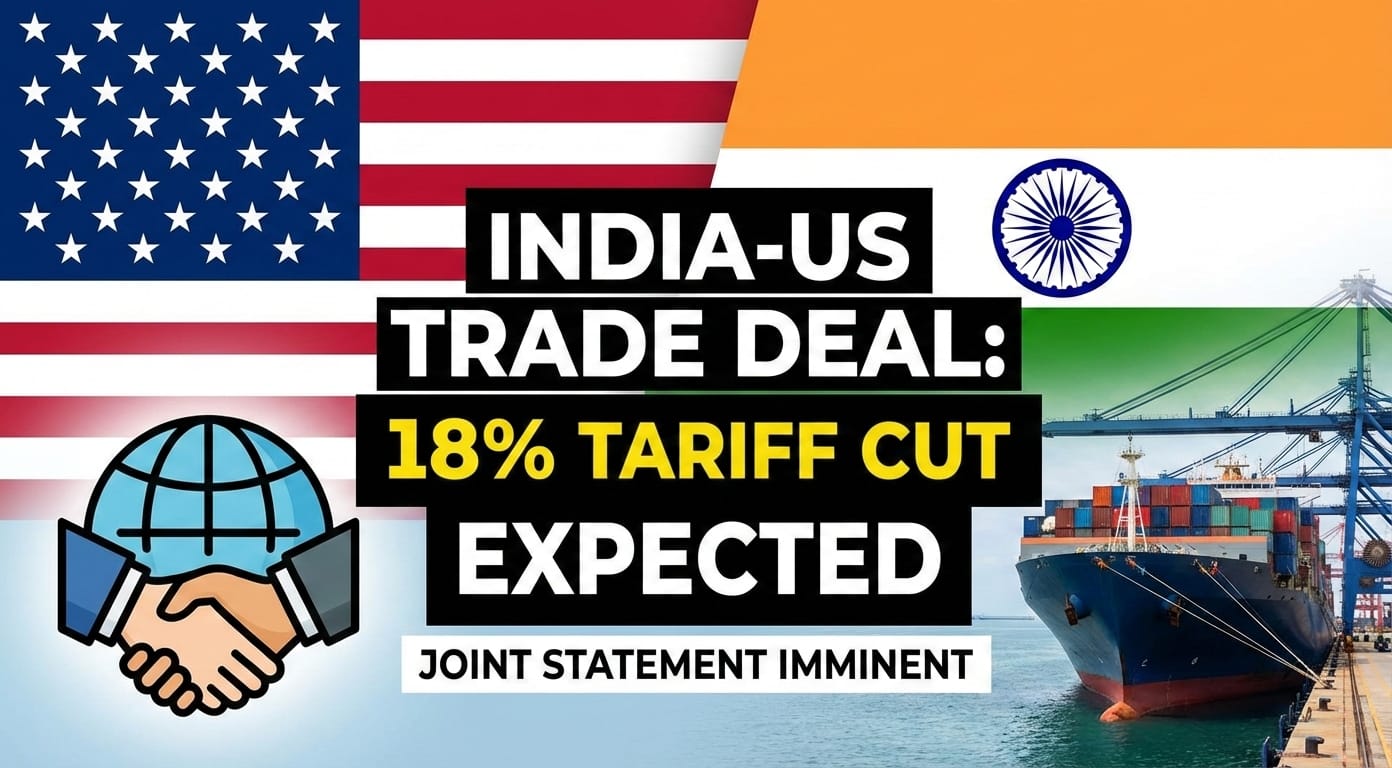
India and the United States are preparing to sign a joint statement on the first tranche of a bilateral trade agreement within the next 4–5 days, Commerce and Industry Minister Piyush Goyal has said, signaling that an initial political understanding is ready even as a fuller legal text is still being drafted. If the joint statement is issued as planned, Washington is expected to follow up with an executive order that would lower US tariffs on Indian goods to 18 percent, according to Goyal.
Commerce Minister Piyush Goyal told reporters that New Delhi and Washington are close to finalizing the first tranche of the proposed pact and expect the joint statement to be signed virtually, marking the start of the initial phase of the partnership. He added that while the joint statement would come quickly, the more detailed and legally binding agreement could take 30 to 45 days to conclude, with the government hoping to sign the legal text by mid-March. The sequencing matters because the joint statement is expected to serve as the bridge between political intent and enforceable commitments, with officials describing the next step as an “exhaustive” legal agreement that sets out the framework in detail.
A central claim in the latest round of reporting is that US tariff relief could arrive sooner than India’s, because the US side can adjust certain duties through executive action. Goyal has said that once the joint statement is signed, the United States would issue an executive order to reduce tariffs on India to 18 percent, providing near-term relief from the current structure that officials describe as a 25 percent reciprocal tariff plus an additional 25 percent levy linked to India’s purchases of Russian crude oil.
Commerce Secretary Rajesh Agrawal, meanwhile, has underlined that India’s tariff changes operate differently, arguing that Indian duties are anchored in the Most Favoured Nation (MFN) framework and therefore require a signed legal agreement before reductions on select US goods can take effect. In other words, even if the joint statement comes first, India’s ability to implement tariff cuts is expected to be triggered only after the binding text is in place, with Agrawal indicating that the agreement is being targeted to come into force in March.
Beyond tariffs, the first tranche is being framed by Indian officials as an early step designed to unlock additional concessions hours later, with Goyal explicitly linking speed to leverage for subsequent rounds. However, the government has also sought to manage expectations about the scope of the initial package: Goyal has clarified that the pact does not contain investment commitments, suggesting the focus is more on trade terms and market access rather than a broader investment treaty-style architecture. Details of what exactly sits inside the first tranche have not been publicly disclosed in the reports so far, leaving sectoral winners and losers to be inferred rather than confirmed.
The political economy backdrop to the talks is the sheer scale of India–US commercial engagement and the competing narratives around what is achievable in purchases and supply commitments. Goyal has pointed to large-ticket imports, saying aircraft demand and orders alone are estimated at $70–80 billion and could form a significant part of India’s purchases from the United States.
In addition, a senior trade ministry official was quoted as saying India’s total procurement over the next five years could rise to around $2 trillion, with the United States expected to supply about $500 billion under the broader trade framework.
For now, the immediate milestone is the joint statement expected within days and the follow-on push to convert it into a legally binding agreement by mid-March, which officials say is necessary for India’s tariff reductions and would clarify the operational details that remain undisclosed. If the timetable holds, the next few weeks could determine whether the initial tranche becomes a durable platform for deeper concessions—or remains a limited, first-step arrangement shaped largely by tariff mechanics and the legal constraints each side faces.

