
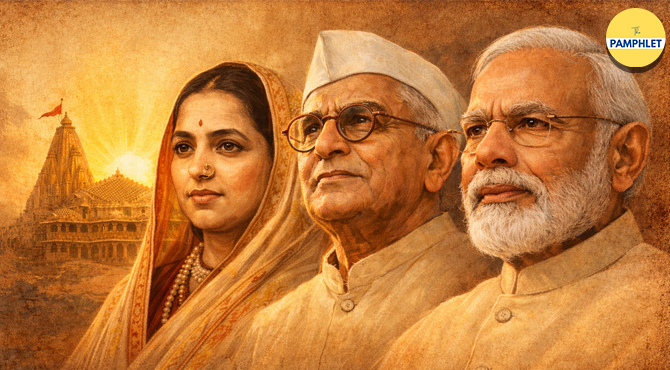
As the Somnath Swabhiman Parva celebrations were coming to an end, two positive expressions of cultural rejuvenation and reclamation, involving the youth and children, emerged on different platforms. These two instances seemed to vindicate and substantiate PM Modi’s decision to celebrate the Somnath Swabhiman Parva. They are not related to Somnath directly, but not completely disconnected with its 1000 year old story of dharmic resilience. To me, both came across as completely aligned with KM Munshi’s desire and vision to ignite at Somnath a cultural reclamation centred on Somnath — for pilgrims from across India. Uncannily, both involve two different Jyotirlingas other than Somnath. They caught my attention in the news cycle and social media posts.
One is tangible in nature and the other intangible. Let’s take up the first. The tangible. In Kashi, 1,500 Hindi- speaking students began their learning of basics in Tamil with the help of 50 Tamil tutors under ‘Tamil Karkalam’ — an initiative meant for spreading the learning of Tamil in different schools in Kashi, last week.
Munshi to Kashi: How Shiva nurtures the devotee’s confluence
‘How is this related to the Jyotirlinga?’ – you might think. The programme has been launched under the Kashi Tamil Sangamam, which witnessed its fourth edition last year. The Kashi Tamil Sangamam, aimed at cultural rejuvenation anchored in pilgrimage and the tradition of teertha of the people of Tamil Nadu to Kashi, is centred on the Kashi Vishwanath Mandir. The Tamil Sangamam is a two way exchange of culture, languages, rituals, tradition, the performing arts, and people interactions between Rameshwaram and Kashi – two prime teerthas in Sanatan history and culture. The Kashi Tamil Sangamam is an act in preservation, creation and sustenance, as it ensures the building of a recurrent motion of pilgrims between the two centres of pilgrimage in a journey.
The journey might seem linear in nature – if a line is drawn on Bharat’s map connecting Kashi and Rameshwaram, but the rhythm of its facets and outcomes has developed gradually in a loop of under-currents and waves of outcomes. It is a civilisational response to a dharmic-calling set in the 21st century — taking place in that period of Hindu history in which destruction of the Hindu centres of devotion and belief are a thing of the past and reclamation and reconstruction is a new and organised pattern — part of a polity, action and the emotional-heft of a dharma-driven Hindu prime minister. Darshan, Ganga, devotion and their permutation in life in Kashi is the nucleus of the Kashi Tamil Sangamam.
The reciprocation in culture and language expressions of people, particularly the women who participate, leads to the germination of new ideas and initiatives – of which ‘Tamil Karkalam – let’s learn Tamil – is one. While upholding the centuries old tradition of journeys undertaken for teertha, the Kashi Tamil Sangamam has ignited people’s curiosity and interest in learning Tamil. A news report mentioned that 300 students from colleges in Kashi will travel to Tamil Nadu for a 15-day programme dedicated to learning Tamil. It mentions that the government schools in Kashi are even planning to offer Tamil as an optional language in the curriculum. Each letter and sentence learned under this programme will build a transition from disconnect encouraged by politics towards deeper connections that have a basis in devotion for Shiva. The learning of Tamil, even though the beginning will be in basics, will crack open an inter-state, inter-region, gateway, to a new linguistic realm for learners. More importantly, however, it might intensify the youth’s inclination for consistent and deeper learning. It might open paths in the youth’s response to the conflux of development and culture, in which language serves not as a protected or guarded political gateway to a region, but as a medium for a unified-expression in Hindu creativity and creations.
The vindication and voice from Mahakaal to Somnath
The second instance of Hindu resilience speaking through the youth was in this post on Twitter. While the video and the spoken does not need explaining, its larger emotion needs to be broken down. What she says today was relatable to many of us 25 years ago, when we stumbled upon the bitter truth, that our devotion was for us to claim, even though and when many around us were determined to mock us for our spiritual leaning, for devotion, for Sanatan roots, for visits to temples. At this point in time, however, I would choose to not focus so much on the crucial point she mentions about the systematic curbing of the freedom of expression by the “Left Liberal” — that dominates several domains of our living as ordinary people. How her pilgrimage to the Jyotirlinga stirred the momentum of words is of interest and importance to me.
Her monologue fills the ears and heart, for its urgent sense of time lost — in having to continuously encounter the “rigid moral gate keeping systems that I have seen” overpowers us. For this author, it is deeply personal, after having spent more than two decades in defying the need to be a “closet Sanatani” — while being in the thick of activities within the art and culture circuit, performing arts and the visual arts, artiste-audience narratives and related facets, within and outside the media. Her monologue reflects “swayambodh” (the realisation of the self) which is crucial for understanding “shatrubodh”.
It seems reassuring that her journey and visit to the Mahakaal Mahalok in Ujjain triggered this cascading-melting of emotion. I have often found myself alone in refusing to be a cynic in celebrating the idea behind the Mahakaal Mahalok. The sprawling display of sculptures and work in stone offers a space for reflection to the millions of Hindus who visit the corridor for the circuitous process of darshan of the Jyotirlinga at the Mahakaal Jyotirlinga Temple, I believe.
The quality of work that constitutes the Mahakaal Mahalok has been a subject of Hindu social media scrutiny. One is open to these debates, but having gone for darshan of the Jyotirlinga multiple times since the opening of the Mahakaal Mahalok, I have noted linkages between Hindu spaces surrounding devotion for Shiva and the opportunity to discover Hindu ancient art in the museums of the ancient city and other parts of one of the ancient Saptapuris. I pause with my urge for observing Hindu aesthetic at these places known and the lesser- known — within Ujjain. I have come across innumerable reasons to believe that the Mahakaal Mahalok has contributed a great deal to the Hindus’ collective understanding of a common public space attached to and surrounding the Mahakaal Jyotirlinga and the darshan of the Jyotirlinga. So, when I heard the young woman splinter out the impassioned account in this video, I was convinced once again — that Hindu heritage has the unsurpassable power to withstand and beat cultural iconoclasm – in the different chapters of Hindu history. I was convinced once again that we owe a lot to KM Munshi and his long term cultural vision behind restoring Somnath Mandir.
I watched this video multiple times. As I did, a sense of vindication shot up through each sentence spoken in it. To me, a 21st century woman’s expression of truth came across as a victory of every unknown ancestor who has fought for dharma against the iconoclast. It has come across as a triumph of the civilisational struggle to protect the Mahakaal Jyotirlinga from foreign invaders and attacks lodged by them on the temple. It has mobilised itself as the celebration of every effort to rebuild and restore the temple.
Her monologue addresses a different dimension of iconoclasm – systematic and organised in nature, the toxic tentacles of which have been fanned by independent India’s political leaders, who have worked to smother the Hindu spirit under the veil of “secularism”. I will expand on that in a different article. For now, I would underline the one factor that has made it possible for Hindus to find and reclaim space that serves as an extension of pilgrimage at the Mahakaal Jyotirlinga, or has made it possible for Hindus to learn from history, its painful episodes, or has made it possible for us to learn to rebuild and celebrate — after encounters with civilisational truths — as they exist today.
The one factor is the extended preservation – between KM Munshi’s efforts and PM Modi’s efforts towards preservation by bringing together cultural policy, political intervention and cultural resurgence — dedicated to Shiva. It is deity-centred, dharma-oriented, and people-centric.
It took the devotee speaking in the video a visit to the Mahakaal Jyotirlinga – to arrive at critical realisations she mentions. The pilgrimage helped in the decoding of challenges forged in a narrative that aims to subsume the devotee’s belief. What could be a bigger triumph for our ancestors, who are perhaps unaware of the different breed of iconoclasts we face today, in a battle that’s not fought with swords but with narratives? Just as Somnath, the Mahakaal Jyotirlinga mirrors our civilisational resilience.
Every effort and sacrifice of our ancestors – dedicated to rebuilding in blood or sweat or words or gold or stone – Bharat’s temple heritage, and compelling its difficult but possible recovery from the scars and blows of the iconoclast, is worth the awakening. It was Bharat’s collective-awakening that Munshi was determined to reclaim through the rebuilding of Somnath. Signs of this collective-awakening are visible in the language-enriched connections of the Tamil Sangamam with the Kashi Vishwanath Jyotirlinga and the Kashi Vishwanath corridor.
‘Resurgence’ – the recurrent theme in ancient Bharat
The rejuvenation and restoration that Munshi envisioned in Bharat through the restoration and rebuilding of Somnath right after India’s independence, and the celebration of the Somnath Swabhiman Parva, present segments of spiritual fulfilment and cultural success in both instances. When a resurgent Bharat’s youth stumbles upon the truth of cultural coercion and its reclamation from vicious Left Liberal narratives, “resurgence”, as it was felt, designed, organised and implemented, in ancient India, springs out from its dormancy. It becomes active. It becomes activated.
Celebration of devotion then becomes the phenomenal and singular emergency. The unjustifiable is questioned. The unaddressed is responded to and countered. The undiscovered is revealed, realised and valued. As it was in the Mahabharata. As it is today.
One of the lesser-discussed aspects about Munshi is that his vision for Bharat’s cultural rejuvenation stemming from Saurashtra was not limited to the Somnath Mandir – the Jyotirlinga alone. Even though he dedicated his explorations and energies to the study of the sequence of destruction of Somnath by the iconoclast and its rebuilding and protection by the Hindu devotee, his consciousness of the Prabhasa-kshetra comprised a 360- degree view of spiritual-eminence stemming from a confluence of devotion for Shiva and Krishna. Munshi tells us that it was here that the eastern Triveni, the confluence of rivers – “Saraswati, Hiranya and Kapila”, nurtured the solemn site where Krishna is believed to have been cremated. It is evident in Munshi’s writings that his mind was forging a movement for the restoration of Somnath, and his heart was engrossed in the recurrent emotion for Dehotsarga.
Prabhasa region was of dual spiritual importance to Munshi. Munshi absorbed it as a place of prime dharmic emphasis in Hindu history. Munshi was aware of the value of “true culture” that lay beneath the scriptures and the Mahabharata, particularly the Gita within the Mahabharata. His reading of the Mahabharata, was of an “Epic” that surpassed its definition as one. For him, it was meant for an immersion of a whole literature, “philosophy” that revealed the learning of the amalgamation of “social and ethical relations”. The coalescence of human conundrums and insights to overcome them. The Mahabharata offered an illustrious realm of knowledge, according to Munshi. His intellectual astuteness is discernible in his celebration of the sacred in the civilisational resilience of Somnath, the deities and the temple’s immersive interaction with the sea and the moon, as well as with the significance of the region in the Mahabharata.
Munshi believed that the “sanctity” of this kshetra, as the place where Soma himself worshiped Shiva to recover from the curse of Daksha, was known even at the times of the Mahabharata. Saurashtra as Krishna’s “adopted home”, as Munshi describes it; Dwarka, events in Dwarka in the Mahabharata; the visits made to Dwarka, the solemnity and the sacred in Dehotsarga; are aspects of spiritual enormity on Munshi’s recollections of Somnath. The ancient tradition of teertha to Somnath for its multifaceted-sacredness is the concept that Modi’s India should clasp itself to, in cultural rebuilding, restoration and rejuvenation.
Another learning from Munshi’s close and emotional engagement with this sacred geography is his conscious effort to underline the accumulation of Puranic and historical references, the assemblage of their tangible symbols, temples, architecture, cultural and traditional. Repeated wresting and reclamation of the deity’s abode from the terror and loot-imposing iconoclast was not the only reason why Munshi would see the region as the fountainhead national resurgence. The longevity of history, its surmounting vastness, from 20th century, to the Mahabharata, to the Indus Valley Civilisation, surrounded his deep engagement with Somnath and the region.
The Mahabharata is the abode for the abundance of belief and certitude (displayed by Munshi) on the dharmic importance of Prabhasa, its edifying presence as a destination of profound spiritual eminence. Munshi was meant to draw inspiration and creative confidence from his reading of the Mahabharata before offering to his reader, his times, peers, and like-minded leaders of Independent India, insights into the provenance of Bharat’s belief in Prabhasa.
Some of the instances that a 21st century reader can discover on the importance of Prabhasa in the Mahabharata. Arjun meeting Krishna at Prabhasa in the Subhadhra Harana Parva. In the Aranya Parva, the plains of Prabhasa have been mentioned as the place of pilgrimage. It is mentioned in the Teertha Yatra Parva, even recommended for pilgrimage. In Canto 88, the Teertha Yatra Parva (continued), Prabhasa is mentioned as a tirtha highly recommended by the devas. The Mahabharata also mentions that it is a place whose fame has been spoken about by the Brahamanas. Janmajeya talks about the Pandavas and Vrishinis reaching holy Prabhasa. Vaisampayana even describes it as a sacred land at the sea coast. In canto 130, the Tirtha Parva illustrates the sacred geography, and reveals Lomasa saying that Prabhasa is the teertha that Indra himself favours.
In Canto 131, Vaisampayana clearly narrates the importance of Prabhasa as the place where Soma, the “lord of constellations” found a cure from the curse, eventually-regaining his illuminating brilliance. In fact, it explains the episode as the reason for the nomenclature. Saraswati’s presence and Prabhas being synonymous with the Soma- Daksha episode is a feature in this part of the Mahabharata that perhaps gave Munshi the confidence for viewing Somnath as the confluence of the tradition of worship of Shiva at this spot and its virility as a teertha (along with Pushkara and Manasa). Reflected is the depth in nomenclature — “Prabhasa” in Canto 343. It explains the natural dispensation of the holy waters where Soma took the dips, to illuminate under his effect, hence the name “Prabhasa”.
Prabhasa is often mentioned in the same breath as Kurukshetra, Gaya, and Ganga. In Canto 165, the sacred water geography broadens, and Prabhasa is not excluded. Canto 83 mentions Arjuna traveling from Gokarna to Prabhasa. The Yadavas are mentioned as going to Prabhasa, to live there with their wives. The aspect of rebeginning made at Prabhasa in the lives of Yadavas, the aspect of dharmic consequence, is that Mahabharata itself offers the divine documentation of Prabhasa as a spiritual destination, a teertha that governs attention, assertion, and reiteration.
The aligning of Prabhasa with the aspect of collective and personal resurgence — as palpable within the Mahabharata — cannot remain unheeded in 21st century Bharat.
Munshi’s insights on the association of the Nagas with the Prabhasa region and the Nagas’ connection with the Linga of Somanatha, consolidates the aspects of unity. The worship propelled their rise against the Kushanas and the Bactrian Greeks. Shiva and Shiva-worship being central to the united eruption of a counter movement of the Nagas, is an underlying facet Munshi cares to highlight. In another historical account, the Bharasivas emerge as the heroes of Hindu assertion against the Kushanas. The performance of the Ashvamedha Yagya is the expression of collective upsurge of Hindu triumph during their times.
The source of the iconoclast’s envy
Mahmud of Ghazni was considered the instrument capable of destroying Somnath, and with that, the arrogance of the Hindus. As a region that is mentioned in the Mahabharata, has been the spiritual catalyst in stirring movements of national resurgence in different phases of Hindu history, the geographical abode of Somnath was bound to be envied by the iconoclast.
According to a historical account, Rauzat-us-Safa of Mirkhond (written between AD 1494 and 1496) documented observations on Somnath in one of its volumes. It says that Somnath was the name of the idol, which was considered the lord of all idols by Hindus. The idol was served by 2000 Brahmins. At that time, the invader found that Hindus drew a relation with the worship of Somnath with the eclipse, that Somnath drew pilgrims from across India. There is a mention of 10,000 villages entrusted with the support to the worship at the shrine. What seems to have gripped the invader is the account of wealth, jewels, celebration in the music and dance, associated with the installation of the idol.
There was a system of “endowments” and gifts from pilgrims that would support the dancers and musicians” celebrating the temple and devotion. There is even a mention of a chain of gold used for a bell, the sound of which was used for calling devotees to the temple. The invader seems to have stumbled upon the importance of the water from Ganga, which was brought for offerings to the idol – despite the distance from Somnath.
In Rauzat-Us-Safa, according to the historical account, in Munshi’s own explorations of Somnath, and in a historical account Munshi himself has referred to, there is a mention of the Hindu belief – that the anger of Somnath – the idol caused the destruction of idols across India, and that if not angry, Somnath would have perished the destroyer. This drove Ghazni to destroy Somnath. He was pinning hopes on the destruction of Somnath for his ultimate goal – religious conversion. This aspect should continue to provide the 21st century Hindu, the clarity on “swayambodh” and the need for “swayambodh”.
Murdering Hindus, destroying temples and idols and taking women and children captive at two halts, finally to reach the fortress at Somnath to annihilate the protector-devotee. Mahmud of Ghazni’s resolve to destroy Somnath did not just perish the tangible wealth, but also the treasure of history and provenance inscribed on the 56 pillars mentioned in one account of history. Adorned with precious stones, these 56 pillars were found supporting the temple. The name of each Hindu king, who was the embellisher, was inscribed on each pillar. There is a description of the idol, of how Ghazni destroyed it, and an account of the different destinations they were to be dispatched. There is also one significant detail, attributed to Ferishta, who is believed to have cited Rauzat Us Safa. The Brahmans of Somnath offered to pay crores in gold, in their effort to dissuade him from inflicting more damage. The “Omrahs” thought that it made sense and he must consider accepting the offer made by the Brahmins, for they believed that destroying the idol would not erase idolatry from the walls of the temple, but the money offered could be directed to the “believers”. They did have a point. But Ghazni was obsessed with the momentum of “destroying Hindu arrogance.” Ghazni, according to this account, wanted to be seen as a breaker of the idol, and decided to continue breaking, over which he discovered the treasure of jewels in the temple.
Historians prefer to lean on Al Baruni’s account instead. Intriguing as it may sound, Al Baruni has looked into the deeper aspect of the worship of Shiva from the perspective of the story surrounding Prajapati, Rohini and Soma. This helps him establish the importance of Somnatha as the ‘nath of Soma’, the god of moon. And that in turn helps record the enormity of the desecration of the Linga by the Mahmud of Ghazni.
Shiva’s heritage – the longevity of devotion
My previous article mentioned Munshi’s curiosity and interest in expert findings from excavations and his reliance on archaeologist-insights for inferences on dharma and religion. Munshi was particularly-moved by the Indus Valley evidence embedded in the seal-amulets discovered from excavations. The aspect of “Pashupati”, and prominence of a deity with three faces shown seated and surrounded by deer/antelope, an elephant, tiger, a buffalo, a figure wearing bangles on either arm, affirmed by Sir John Marshal, as “Shiva”, point to the expressive representation of the deity, as well as the faith and worship. However, they point to a truth unearthed.
The truth: that the seal-amulets and other representations of devotion in Indus Valley, the defiance in devotion of the Nagas and Bharashivas and the building of national resurgence around the worship of Shiva, the unceasing urge to nourish devotion with the teertha to Prabhasa in the Mahabharata, all point to the continuity and longevity of devotion that the iconoclast-invader has wanted to destroy and break. But each time, Hindu devotees rose and arose and fought to reclaim. If they could persist, we must, for them, for the people of the Indus Valley civilisation, for the Nagas and the Bharashivas, for Krishna, his mortal journeys to the region, for the Mahabharata, for the Hindu devotee – involved in worship at the first temple in Somnath — to the Jyotirlinga temple at Somnath today that witnessed the Somnath Swabhiman Parva celebrations. The heritage of Somnath, Kashi Vishwanath, the Mahakaal Jyotirlinga and the nine other Jyotirlingas, preserves our “swayambodh” in devotion. Understanding adversity and preservation would be difficult and impossible without it.

