
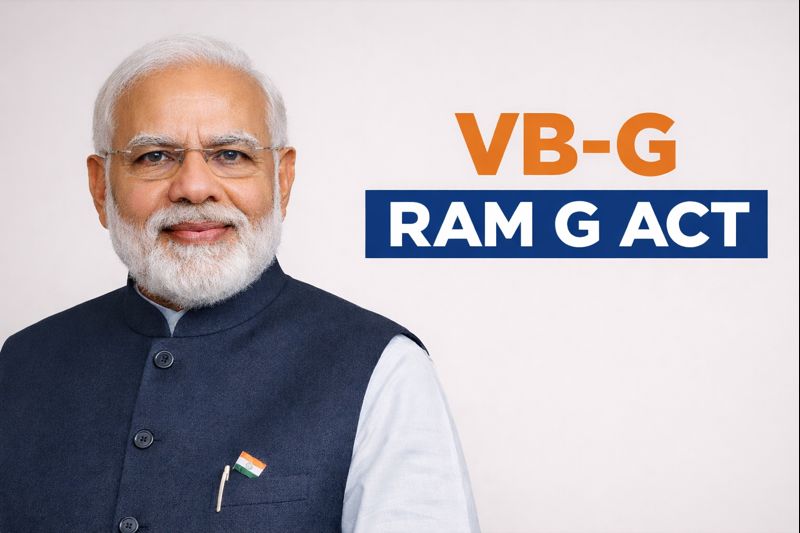
Every major reform in India follows a familiar rhythm. The Congress party first claims emotional authorship of a policy, then resists its reform and finally accuses the reformers of destroying its “soul”. The debate around the Viksit Bharat Guarantee for Rozgar and Ajeevika Mission, or VB-G RAM G, fits this pattern with remarkable precision.
The Opposition insists that MGNREGA is being dismantled by stealth. The evidence, however, points in the opposite direction. What is being dismantled is not rural employment, but the architecture of opacity and inefficiency that once defined it.
Congress’s panic over VB-G RAM G reveals more about its past than India’s future
MGNREGA was introduced with the language of rights but implemented without the discipline of accountability. Under the UPA, welfare policy was driven by moral signalling rather than institutional design. In the absence of biometric verification or digital monitoring, the scheme quickly degenerated into what came to be known as a “ghost economy”. Muster rolls were padded with fake names, job cards were duplicated at scale, and wages meant for the poorest were routinely siphoned off by intermediaries.
CAG reports and CBI investigations, including multiple cases registered in Uttar Pradesh during the UPA-supported period, documented widespread misappropriation. These were not isolated aberrations but symptoms of a system that treated leakages as tolerable collateral. Rajiv Gandhi’s famous lament that only a fraction of welfare spending reached the poor was no longer a confession of failure; it had become a structural reality.
When rights became rackets?
Equally damaging was the UPA’s fixation with counting man-days rather than creating outcomes. Employment generation was reduced to a statistical exercise, with little concern for what was being built or whether it lasted. Rigid wage-material ratios discouraged durable construction, resulting in roads that disappeared after the first monsoon and water bodies that existed only on paper. MGNREGA under Congress became employment without productivity and expenditure without development. When Prime Minister Narendra Modi later described the scheme as a “living monument of failure”, it was less a political jibe than an empirical assessment.
Inflation compounded this failure. During UPA-II, prices rose at an average rate exceeding eight per cent, frequently touching double digits. Nominal wage increases were eroded almost
immediately, leaving workers with more currency but less purchasing power. Welfare existed in budget documents, not in kitchen realities.
The correction era
The NDA government did not abolish MGNREGA, despite Opposition claims to the contrary. Instead, it subjected the scheme to reforms that Congress had consistently avoided. The introduction of the Jan Dhan-Aadhaar-Mobile framework marked a decisive shift from discretion to discipline. By linking beneficiaries directly to bank accounts through biometric authentication, the government dismantled the anonymity on which corruption thrived.
The results were swift and measurable. In a single year, over seven lakh fake job cards were deleted, not because the poor were excluded, but because fraud was exposed. Direct Benefit Transfer reforms have cumulatively saved more than forty-two thousand crore rupees in leakages. This money did not vanish; it flowed to genuine workers. It is no coincidence that political resistance to reform intensified precisely when corruption was structurally disrupted.
Technology also transformed asset creation. Mandatory geo-tagging and public visibility of works through ISRO’s Bhuvan portal ended the era of fake infrastructure. Over six crore MGNREGA assets are now digitally verifiable. Planning itself was professionalised through the Yuktdhara portal, which uses remote sensing to identify where water bodies and check dams are actually needed. Welfare, long trapped in the analogue age, finally entered the era of scientific governance.
This shift was most visible in Mission Amrit Sarovar. Tens of thousands of water bodies were constructed or rejuvenated using MGNREGA funds, with independent studies confirming improvements in groundwater levels and ecological outcomes. For the first time, rural employment was leaving behind assets that generated long-term livelihoods rather than short-term wages.
Despite persistent claims of budgetary neglect, allocations tell a different story. The 2024–25 Budget Estimate of eighty-six thousand crore rupees is the highest ever at that stage. During the COVID crisis, spending crossed one lakh crore rupees, demonstrating that MGNREGA under the NDA remains genuinely demand-driven rather than politically rationed.
Completing the reform: VB-G RAM G
The VB-G RAM G Bill represents the final stage of MGNREGA’s evolution. It addresses structural weaknesses that Congress chose to ignore for a decade. The proposed expansion of guaranteed work from one hundred to one hundred and twenty-five days is the first such increase since the scheme’s inception. While Congress froze the limit, the NDA has expanded livelihood security in response to ground realities. Equally transformative is the move to weekly wage payments. Under previous regimes, delays stretching into months were normalised and defended. The new bill leverages the digital infrastructure built over the past decade to ensure that wages reach workers when they are needed, not when bureaucratic convenience allows.
The introduction of a harvest pause has drawn predictable outrage, yet it addresses a long-standing distortion created under the UPA. By pulling labour away from farms during peak agricultural seasons, MGNREGA inadvertently harmed farmers and inflated costs. The harvest pause restores balance by allowing labourers to earn market wages during sowing and harvesting, while guaranteeing government work during lean periods. It is a rare reform that benefits both the farmer and the worker, which perhaps explains why it is being deliberately mischaracterised.
Changes to the funding pattern and planning process further deepen cooperative federalism. The shift to a sixty-forty Centre-State sharing model aligns with the fiscal autonomy strengthened by the Fourteenth Finance Commission, a reform Congress itself opposed. Normative allocations based on objective data replace inflated labour budgets, ensuring that funds flow to regions that genuinely need them rather than those adept at manufacturing demand. Data, contrary to Opposition claims, is not discrimination. Discretion was.
From token welfare to good governance
The Opposition’s talking points follow a familiar script. Accountability is framed as surveillance. Technology is portrayed as exclusion. Asset creation is dismissed as privatisation. Ending middlemen is attacked as union-busting. These claims reveal less about the bill and more about the ecosystem Congress once presided over. Opacity empowered gatekeepers. Transparency empowers workers. Congress may claim emotional ownership of MGNREGA, but governance is not judged by authorship. It is judged by outcomes. The party introduced a scheme that spent money. The BJP transformed it into a system that delivers results.
As India moves towards Viksit Bharat, welfare is no longer about slogans or sentiment. It is about durable assets, timely wages, and accountable delivery. That shift, more than any name change, explains the Opposition’s unease.
Conclusion
The VB-G RAM G Bill transforms MGNREGA from a paper exercise into a digitally accountable, asset-creating livelihood engine. By expanding workdays, ensuring weekly wages, protecting farmers and eliminating ghost beneficiaries, the BJP turns welfare into empowerment.
Opposition claims of “dismantling” crumble before facts and this reform secures livelihoods, strengthens rural India and redefines the architecture of rural development.

