
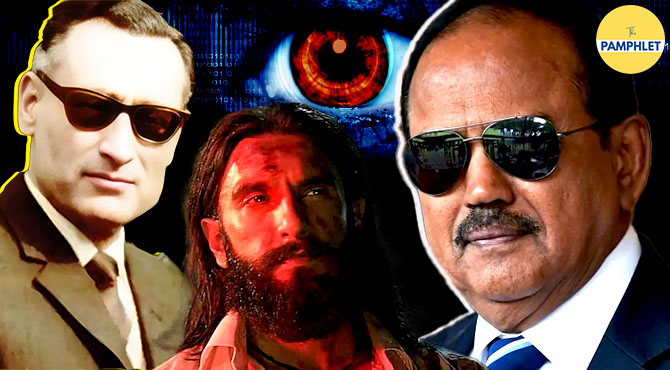
The damp-looking and scruffy chair in Aditya Dhar’s Dhurandhar is no less than a throne. It takes a coveted spot. The character of Hamza Ali Mazari eyes it from the moment he makes a headway into Rehman Dakait’s gang. For a moment, it makes you wonder why a man operating in the jaws of danger and death, in the field of target as a spy on an espionage mission, attaches so much importance to that chair in the dingy, tragedy-infested dens of a local gangster. As the film credits roll after the last scene, there is a moment when Mazari is shown seated on that chair. His face has the devouring pride of a chieftain. The chair becomes the throne for the king of the system he infiltrated as an Indian spy. The importance of that chair is huge – beyond that fiefdom of Lyari in Karachi, Pakistan. Breaking the system it serves is important for India’s sovereignty.
Hamza, the man breaking it, is a Bharatiya named Jaskirat Singh. He does things differently with the dimensions of political power he has at his dispensation.
During the times of Kautilya, a character such as Jaskirat Singh perhaps would qualify as a spy of the fierce category. He runs into the wild – combating them without caring for his own life. He fits the description – centuries apart. Kautilya’s Arthashastra has categories of spies listed – according to their guise, skills, their nature, and their area of penetration and intervention. Each category has a name. Imagine a strategy game where you have to guess the name of the category of a spy according to Arthashastra. Will be fun to know the prime concern of each spy, right?
The prime concern of Hamza (Jaskirat) through the extremities of his assignment, is protection of a political power. This, he ensures by acquiring and augmenting his ruthless grip on the ultimate exploitation of opportunity he has in the field of target – deep inside the enemy’s own bastion. Even through seething pain and abject loneliness, he serves moral ends by using power against the extremely immoral. And while being a bit of it himself.
The eyes have it – between the ancient Indian spy and Jaskirat Singh
Kautilya’s Arthashastra keeps the “king” central to the creation of spies and the institution of spies. Guises are crucial to the institution of spies. Each guise points to a role that the social structure is already familiar with — a householder, a recluse, a disciple, a practising ascetic, a classmate, a colleague and, interestingly, a mendicant woman. The spy is sworn to the king. The spy going for the task in the guise of a disciple is supposed to be skilful of guessing the mind. There is a mention of initiation in asceticism for the guise, which enables the person to develop a particular set of skills, character and a set of duties that involve tasks that demand outcomes in trade, cattle rearing, and agricultural output. As the spy under guise has people engaged in activities related to his own outcomes, he has an additional set of responsibilities related to their well-being and protection on his own shoulders. Sight and foresight are core strengths.
Under him, they set out on espionage assignments that relate with detecting crime. “Foresight” as an attribute and quality holds prominence and emphasis. Those disguised as ascetics know the skill of mingling with others in a larger group to remain unsuspected. For the spy guised as an ascetic in “braided hair”, being surrounded by other ascetics in “braided hair” is about reaching the designated part of the city while pretending to be living on a “handful” of foodstuff including vegetables and particular flora over a long period of time, while having “secret” access to what he actually likes.
After listening to and reading about the accounts of the stellar work of Ashok Chakra awardee Major Mohit Sharma and others like him, in the media and social media today, the spies of Arthashastra appear near yet far. These stories with Dhurandhar as a hook may just make Indian learners discover the Indian spy system as part of Bharatiya heritage rarely discussed or talked about in classrooms, story boards, strategy building etc.
Hindu texts and traditions are as contemporary as ancient they are. Descriptions of Varuna in Atharvaveda referring to his pervasiveness point to his presence across time and things to watch the deeds and misdeeds – towards punishment and bliss – according to the nature of deeds (4/16/4 and 6). Maharishi Valmiki’s Ramayana has a spy system that’s even endearing at times. Imagine a network that has Hanuman and Lakshman, among others, pitching in data, information and inputs at the beck and call of Shri Ram. Scholars have mentioned the importance of spies in the Mahabharata, Kalidasa’s plays, and during the Gupta period.
Entertainment and films built around spies and espionage must lead GenZ to explore Bharat’s civilisational heritage and the two great epics — the Ramayana and the Mahabharata. The circle of heritage must travel. The circle should be covered. The two Epics have wars that become life-churning events and spying plays a role in both. Both have instances that underline the importance of gathering information through individuals to become the ears and eyes of the king or the prime warriors. In ancient India, spies formed a prominent system of information and data for the protection of the king or the land.
N Subhramaniam’s “Sangam Polity” mentions that spies of the Sangam era were known to communicate messages with the help of noises. According to this book, a spy (“orrar”) in this era had his ear to the foreign countries as well as on what was happening within his own country. Foresight on the actions of enemies and potential enemies was central to spying (Orru).
In Kautilya’s Arthashastra, opportunities for specialisation are several for those who bring the finer attributes, such as loyalty and reliability, are adept in the art of guise, and are multilingual. These spies are meant for espionage penetration towards groups that involve ranks of importance in the army, administration and people of higher societal groups. Interestingly, this particular segment of espionage covers the vast landscape in local and geographical roles, because the different ranks and positions that the spies bring under their watch, foresight and tasks, envelop the different areas the men spied upon, serve. Tasks of these different layers of spies then connect and outcomes are collated. Information is set in motion through inputs to specific recipients. Reliability of information stands the test of three sources. Sounds familiar?
The meme and film hook to Indic spy heritage
Imagine the different grooves of spies in motion and their information and data in motion in such a scenario. Does it stir your curiosity on spy systems that supported Indic warrior kings? Does it make you wonder how these different spy systems in the layers of times and centuries have inspired the present day Indian defence intelligence?
I am not sure if you have noticed the flurry of memes titled “My first day as a spy in Pakistan” on Indian social media platforms. Some of them are intelligently made. Some are plain funny. Yet all of them make one wonder how India’s GenZ, which was being chased by a political segment to whip up a coup on the lines of Bangladesh and Nepal, has taken to the trend of memes to show Hindus innocently revealing symbols of their identity, dharma, habit, lifestyle or food, when encountered by imagined locals in a fictional Pakistan.
In these memes, I feel a grim set of truths beneath the veneer of wit. They make you ask some low hanging questions. Such as: why do Indians have to wear a certain identity in Pakistan to go undercover? What is the cost of their sacrifice — if spies and undercover agents are busted and arrested? Is it equally difficult for Pakistani spies in India? If not – why? What is the extent of the changes that Indian undercover agents make in their identity to be able to blend and do the job effectively?
Answers to these questions cover a range of uncomfortable truths about India’s history. And these are questions that make you wonder, again, why espionage is made to be the theme or topic so distant from the ordinary Indian, India’s narrative, media and social media. Espionage is a serious subject and requires experts to build the connection between past and present. Even though in non-serious takes, India’s GenZ is clearly showing interest in Dhurandhar and aspects it shows about a spy’s life. And that exposes a node for a connection with heritage in spy systems, including traditional ones in the heart and soul of Bharat’s forests and cultures.
In “Naya Bharat”, an emboldened by governance and politics Bharat, where valuing past heritage holds a place in understanding the present and its challenges, it is perhaps time to bring the discussion and awareness of the Indic civilisation’s vast journey in spy systems under the Hindu rajas, warrior kings and maharajas. Indian media, social media and entertainment must prompt education to make room for a narrative on India’s evolution toward modern espionage that made way for RN Kao and his extensive work, Ajit Doval’s assignments and challenges, the other known and unknown spies of India, the various operatives under R&AW that helped in tackle challenges against Pakistan, Bangladesh, China, and other counties, to begin with.
Such stories and this awareness will make India’s conscience on sovereignty and security take into account the contribution of the efforts, dangers, sacrifices, involved in espionage and the unnamed people who have empowered the battles and wars against attacks on India – from within and outside. “Naya Bharat” needs to revisit the story-domain of these unknown men – India’s heroes – in present and past. Equally worthy of time and investment will be claiming Bharat’s spy heritage in culture and creative projects and making it converge into the absorption of culture.
The heroes are outside Dhurandhar
Coming to Dhurandhar. It it has no heroes. It has actors who have put every creative muscle and nerve into convention-wrecking storytelling. It has the brilliant Rakesh Bedi – who delivers an acting class – more than three hours long – on how to sculpt a character through a wide range of emotions with theatrical brilliance and the audacity of a Shakespearean court jester. It has R Madhavan who succeeds in comfortably placing his character at the intersection of India’s troubled past and a resurgent present in policy transformation. Dhurandhar has Ranveer Singh, who performs “Hamza Ali Mazari’ for himself more than for Bollywood or anyone else, to help Dhar carry this remarkable film to the audience. It has Akshay Khanna, who aids the process of making room for Baloch sensibilities, and cultural subversion of the Baloch, even as Rehman Dakait, Khanna’s character, operates through frailties and dilemmas. These characters are constantly testing Hamza’s resolve in their mission to make India bleed with a thousand cuts.
The heroes of Dhurandhars are outside the film. They are the “unknown men”, the spies, agents and “assets” protecting India. We don’t know them. We perhaps never will. What we do know is that they are not wearing a uniform when they are fighting to protect India on foreign soil. We know all the difference that one aspect makes to how they walk into danger and stay there, breathing move after move, while staying in balance at the precipice of patience. The eye that watches and patience that’s not supposed to wear. “Nazar aur sabr”. With the same eye they sometimes stare at death.
The espionage bridge to polity, state and statecraft
In Kautilya’s Arthashatra, there is mention of whose who serve the state as “classmate spies” after studying the different aspects of religious life. They study palmistry and other disciplines that aid their interactions with society. This lot of spies is of courageous consequence to the land. They are described to be a “reckless” lot that is capable of confronting the wild. They are fierce.
Having no strain of affection remaining in the heart, or being cruel, has definite and different upshots as spies when it comes to the role of espionage in Kautilya’s Arthashastra. They are chosen to be poisoners and have different areas of work.
Towards the end in Dhurandhar, one hears of the characters narrating why this particular man was chosen to play Hamza and be the “killing machine.” In Kautilya’s Arthashastra, there is a mention of artists, artisans and musicians, too, pitching in as spies when it comes to examining “characters” of “officers”.
The meeting of popular culture and Hindu heritage creates lasting magic as seen with Kantara and the Baahubali series. It also creates panic in the hearts of the cultural and political Left. The cultural Left is in panic with Dhurandhar‘s surge and success. Truth inconvenient to their ideological stakes makes them panic. Here is why. Truth spoken in political speeches can be clipped. Truth spoken in electoral results can be manipulated through narratives. Truth revealed in India’s surgical strikes — a political and military event during Modi rule — can be challenged and mangled for the benefit of Pakistan. But what of truth woven in fiction on the frame of facts and events — with the help of the same Bollywood they successfully tamed into the political timidness of “Aman ki Asha” at one time? Here, truth cannot be subsumed into this or that. It cannot be rapped for “testosterone” taking over the silver screen. It brings a tonal shift that brings a foreshadow for India’s change in anti-terror stance in policy — while staying 10 years distant from the present. The last reference to a date in Dhurandhar is of 2009.
A lot happened in India between 2009 and 2014 – when governments at the centre changed, and between 2014 and 2025 — when Dhurandar came to the screens. Dhurandhar, in this respect, is different from Dhar’s other projects like Uri and Article 370. These films were fairly quick creative responses considering their time-proximity to events they are based on. Even from that perspective, Dhurandhar is different yet fresh in perspective – when it really had the risk of appearing stale by being screened during the year of Operation Sindoor. Today, things regarding governmental effort in operational agility are vastly different from where they stood between 2000 and 2009.
Understanding India’s spy system heritage will protect and shape the understanding of polity, policy, sovereignty and the protection of sovereignty. It compels one to understand why ditching “Aman ki Asha” to dish out a fictional operative stance in “Baby” and “Dhurandhar” becomes important. Or why a covert op in “Uri” becomes crucial. These are products of fiction based on true events. It takes matters beyond knowing the “craft” of things – the craft of politics and film making. When things come to facts, there is nothing left to critique or criticise. Building a connection with this domain in heritage will render the “critic” industry more irrelevant than it is today.
The Left cannot distract by discussing the craft of the film. Not with Dhurandhar. Its craft is a recipe in creative madness. It manages to hold together the thrill of spy and espionage, gangster drama and political drama – of which India has seen intriguing and convincing variety, stomach churning violence, subcontinent-terror intrigue, personal tragedy propelling a “killing machine” – and romance thrown in. There are no linear silos separating these themes in the film, but circles and loops that keep moving into each other and bleed into each other. And that’s why such storytelling has more scope for a tryst with Indic espionage heritage – even as it takes a shot at the documentary style of narrating heart-wrenching events.
‘Dhurandhar’ and the might of the Indian mind
Dhurandhar‘s portrayal of the streets of Lyari is not even sumptuous for a visual backdrop. It stinks of gangs, dirt, ruthless gang-members with a beast-like appetite to avenge, kill and overthrow. It has every mark of the regional factions that Pakistan suffers from while manoeuvring terror against India. On the surface, the idea of watching Lyari’s gang-infested corners lurking with men who are ready to sexually assault other men, absolutely doesn’t go with overpriced butter and caramel popcorn in an Indian multiplex. But people wanted to witness a fictional glimpse of what Indian spies endure, or have or might endure, while serving the nation. Unlock the spy system heritage and Indians will know that we own it for millennia. Younger generations perhaps would want to own more than just entertainment surrounding it. May be, they find the prompt to be the eyes and ears of India’s eyes and ears – just as they want to be scientists or soldiers or AI experts, or doctors or engineers, or more.
This film serves the now-often-repeated fiction-based-on-true events tale telling of the IC-814 hijack and the Kandhar episode, the ISI’s influence on terror funders and the 26/11 attacks, India’s inability to avenge these events and the constant aura of being helpless as terror victims — subject of several films during the last two decades.
Yet with scenes and sounds that are often revolting to the senses, stomach churning for the violence and gore they bring, with a patchwork of truth that’s difficult to hear on Indian politicians, bureaucrats, and particularised “Hindu cowardice”, it has become a rage with the audience. Indians are self-inviting themselves to watch the story of Hamza Ali Mazari crawl into the vicious domain of Rehman Dakait — not expecting the first time that they will see him rise as the most vicious of all vicious and beastly-violent that surround him. Not expecting that it will end up exposing several Indians who become uncomfortable with Pakistan’s truth. Not expecting that Hamza will eventually turn out to be the most vicious.
There is something that makes him more vicious than them all. It’s not his kurta-ripping muscles entirely. It is the Indic mind – that understands local politics as much as it does espionage, nation, religion, regional divides, silos in evil, society and human emotions.
Jaskirat in the guise of Hamza hooks himself into their system like a conniving leech – sucking into their weaknesses, resources, emotions and greed, yet his heart bleeds and eyes spew fire when he finds his murderous company celebrating the 26/11 attacks. He plants trust in the bedrock of mistrust to arrange a series of betrayals. He punishes those who betray while betraying. It’s his eyes, mind and patience.
Dhurandhar makes no superhero of the character of Hamza. He is set to quietly suffer even as he bulldozes quietly the pawns of his chess. The chessboard of Pakistani politics – the layered connection between gangs, city politics and national politics, which Hamza has been able to plough Rehman Dakait into, would have been a subject less likely to keep Indian audience hooked. But Dhurandhar manages to keep the Indian audience interested in political rallies playing out in fictional Karachi when they really will have to go through news feeds to know what happened at Delhi’s Ramlila Grounds on December 14. Because Hamza is the creator of Rehman Dakait’s presence at the rally. They see him ruthless in inflicting violence, but gentle in love that’s arranged by him. They see him blood soaked but asking for food after he serves justice to a perpetrator of the 26/11 attacks. He errs – a few times – and those errors are expensive to his own land and people.
Making Hamza deliver the final blow on Rehman Dakait in a physical one to one is his recent and disturbing memory of this chap celebrating the Mumbai terror attacks along with others. The enemy is one against India and Indians amid their petty differences and greed-driven scuffles – Hamza sees and makes India’s GenZ see. Hamza also exposes the Indian mind that Aditya Dhar carries. It unravels the greyness in thinking violence and intrigue that sends a burst of colour in creativity.
What changed after 2014
The last chapter in Dhurandhar reveals subtly that Hamza, in this adopted identity, is less lethal than Jaskirat Singh – the Indian who went through the furnace of time and training. The brilliant detail, even though right now fading under the rousing noise about this film, is that the character of Hamza carries his original identity with more care and courage, while being mindful of his identity as a Baloch in Karachi and the den of Lyari.
How and what India chooses to narrate in operations involving covert and overt actions changed in 2015 with “Baby”. The film was like a jolt of truth. It told Indians that there are men who put their lives in the line of fire to protect the motherland even when they are officially restricted from doing so, and go beyond the call of duty, at the risk of being “disowned”. During years preceding “Baby”, urban Indians were learning to unlearn the ill-effects of propaganda in films such as Refugee, Main Hoon Na, and Rang De Basanti. Come “Baby”, and the canvas of the perception of the sacrifice of India’s courageous men suddenly became truer, broader, larger, and deeper.
Dhar’s own Uri brought cinema out of the shackles of shyness and rolled it over to the daring subject of surgical strikes in 2019. “Yeh naya India hai…- this is a new India, it will barge into your territory and attack you on your soil”. Army intelligence as a subject of interest got highlighted with Uri. Director Neeraj Pandey landed his espionage thriller the Special Ops series — with a genius harvest of characters, events and sub plots. Pandey gave us stellar characters — such as “Himmat Singh”, “Abbas Sheikh”, “Farooq”, “Banerjee” — nuts and bolts of the Indian spy, espionage and security apparatus who tell us the importance of “nazar and sabr” and every input that counts. Pandey’s art, craft and contribution to the theme in weaving the documentary style of narrative through fiction hits home — as a recall — during the viewing of Dhurandhar.
“The Family Man” series arrived as a spectacular spy thriller combining heroism and profound characters. Its carefully crafted characters — Shrikant Tiwari, JK, Pasha, Zoya, the adorable and dependable problem-solving former spy Chellam sir, are part of a dedicated universe of spies who are not infallible but their courage unflinching, experience and foresight, gripping and patriotism unquestionable at all times. GenZ has liked these series and characters.
Creative attitude for a 2.5 front war
There is a video clip of NSA Ajit Doval speaking during a media interview where he talks about people who help the nation with intelligence. He says that there are millions of patriots in the country. It is just a matter of getting to them and connecting with them. He mentions that it is about good training and creating passion within them. With the stunning success of Dhurandhar, the theme of spies and espionage has achieved a tonal shift within the youngest lot of adults in India — the Gen Z. They may not be immediately ready for a complete absorption of the different political, cultural and historical events that go into the storyboard of Dhurandhar. But they surely have shown interest in the central theme of the film — Indian spies and espionage.
NSA Ajit Doval has given India decades in service. Stories of his courage in espionage became part of the popular media after the Modi government came to power. Today, India’s presence in the global espionage game is reported keenly by the foreign press. There are others whose names have featured in news reports for alleged spying in Pakistan. Their resilience in the seething folds of danger surmounts the tragedy in the story of their life, captivity, and death.
Infiltrating the political establishment in Pakistan and locking the field of target is no mean feat. It entails consequences that are often ruthless and soul breaking but keeping the mind resilient to them – for the sake of the nation – is part of the training. Today, Indians of different generations want to know more and more about Ravinder Kaushik and Major Mohit Sharma. From the responses the different written and oral accounts of the Indian spy-attempts to unlock the sources and resources in the target establishment reveal on social media, media reports and writing, it appears that Indian GenZ is beginning to understand that protecting India involves men and decisions that are in direct conflict with values and events supported by a category of influencers on social media. Filmmakers would do well to pick more of such stories with a conscious effort to accept and not deny that they have based their stories on these men of valour.
These films should become a connecting point for GenZ and learners across generations to India’s own heritage of the spy system in ancient India. The journey from the modern systems of espionage to the intriguing world of Bharat’s spy systems should be introduced to learners to understand strategy, critical thinking, state craft, state security, administrative machinery, policy, and global challenges. It can enable their consciousness of loyalty and give them a background to what constitutes Indian resilience in espionage, today, in the era of Operation Sindoor and a war empowered by indigenous defence systems, the space for Artificial Intelligence in defence training, and psyops.
In a nation that’s fighting a 2.5 front war, the role of Indic historians, Indic scholars, academicians, journalists, writers and authors should be to aid story telling and narratives coming out of India’s defence, security, and espionage apparatus and successes – using the right permissions, checks and with a sense of national responsibility. India has India to protect and generations to protect using the instrument of culture. Director and screenwriter Aditya Dhar and journalist Aditya Raj Kaul have shown how a collaboration between creators and journalists with boots on ground – is built and can be built. For the Indics, owning the creative domain that caters to the world of Indic espionage and taking ownership of this domain, will be incomplete without unlocking the heritage of Bharat’s spy systems. The known spies, the unknown men and our ancestors deserve this tribute. For the eyes, patience, dignity, pride, protection they have contributed to Bharat’s sovereignty over different centuries and chapters of history.

