
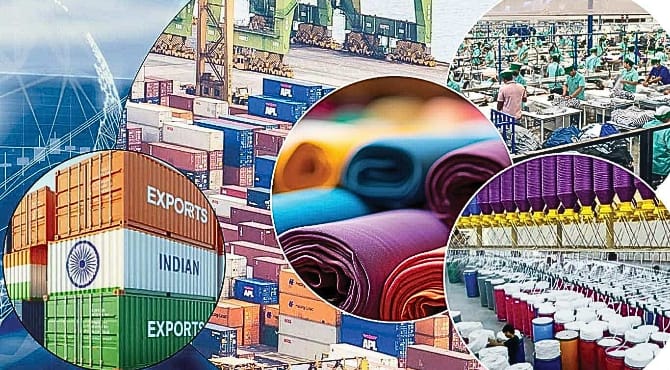
Textile exports, according to Prime Minister Narendra Modi at the Bharat Tex 2025 summit, were not just figures that counted but told the story of India’s creativity, endurance, and trust in a self-sustaining Bharat. The vision to triple textile exports and create jobs was a goal that had now been converted into a mission to empower millions of workers and their families.
The commitment of the government to the labour-intensive sectors such as textiles and apparel was in line with this positive trend, as stated by the Commerce and Industry Minister Piyush Goyal. The government was eager to work towards the industry’s $100-billion export target with full zeal and at a speedy pace.
The textile sector of India, under the Modi government, has made a spectacular turnaround. While the US tariffs disrupted the trade—where the apparel tariffs stood at 63.9%. India was able to raise its exports to 111 countries by 10% during the April–September 2025 period to $8.5 billion against $7.7 billion last year.
It was informed that the decline of 2.6% in exports to the US, the single largest market, had been offset by the innovative policy measures and targeted outreach. In particular, the exports to 38 new and emerging markets have been increased by over 50% year-on-year, and this has been hailed as evidence of the Modi government’s success in the diversification strategy.
The government’s intensive efforts to broaden its commercial horizons were revealed in the deliberate marketing of Indian textiles in various regions of the world such as North America, Europe, Asia, Africa, Latin America, and Oceania. Piyush Goyal observed that the FTA with the UK, negotiations with the EU and Canada, plus the domestic policy had collectively facilitated the sector’s breakthrough to global markets.
Government engagement with the industry was further supported by petroleum reforms such as the PM MITRA parks, the PLI scheme, and the Samarth Skill Mission, which were believed to be the main drivers behind the improvement of quality, creation of employment, and enhancement of value addition. The adoption of steady, innovative textiles, in particular, the technical textiles and handicrafts, was spoken of as providing the Indian textiles global reach with a broader platform.
It was also reported that Prime Minister Modi stressed on the sector as a potential source of employment with emphasis on women and the rural population. The twelfth part of manufacturing in the country was contributed by the textile sector, and the influx of foreign capital in the last ten years had doubled, was what was conveyed.
Experts from the industry believed that the bold $100 billion export target could come true thanks to the government’s visionary reforms and competitive edge that emphasized quality and sustainability.
India’s ability in branding, innovation, and policy execution was considered as an ideal for self-reliant growth and global leadership in the textiles sector. Modi was said to have expressed that the developments in the last decade had made Khadi, handloom, and technical textiles not only strong vehicles of growth and employment but also that India was gearing up to be a textile powerhouse for the future.

