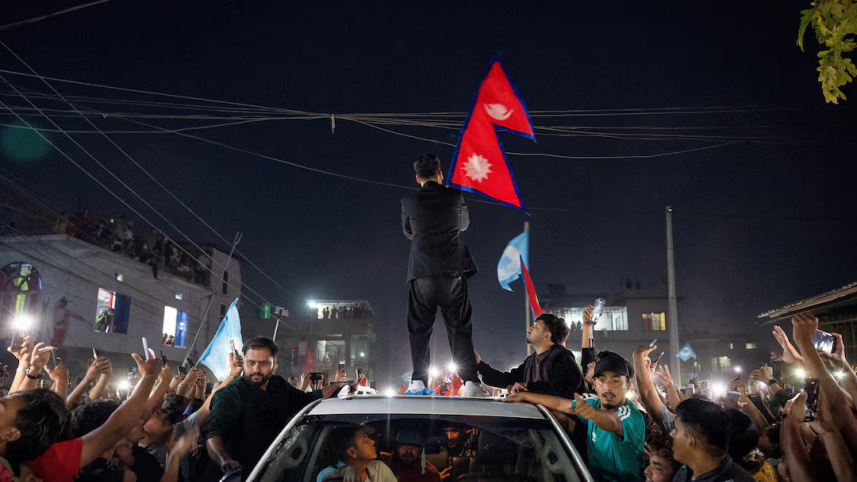
The March 5, 2026, House of Representatives (HoR) elections in Nepal produced one of the most dramatic transformations in the country’s post-2006 democratic trajectory. Conducted for the 275-member federal parliament – 165 seats through the first-past-the-post (FPTP) system and 110 through proportional representation (PR) – the election followed a year of intense political turbulence.
The Gen Z youth-led protests in 2025, largely mobilized through urban networks and social media, forced the resignation of the government led by K. P. Sharma Oli of the Communist Party of Nepal-Unified Marxist Leninist (CPN-UML). The political vacuum that followed created space for the meteoric rise of the Rastriya Swatantra Party (RSP), which has now emerged as the dominant force in the new Parliament.
The elections led to a sweeping victory for the RSP. In the FPTP contests, the party secured 125 seats, including a clean sweep of all ten constituencies in Kathmandu Valley. The RSP’s chair, Rabi Lamichhane, won a decisive victory in Chitwan-2 with 54,402 votes, defeating his closest rival from the Nepali Congress (NC). With the allocation of the 110 PR seats still underway, projections suggest that the RSP could secure more than 150 seats overall, comfortably crossing the majority threshold in the 275-member HoR.
The electoral performance of Nepal’s traditional parties has been markedly weaker. The NC secured 18 seats, with projected overall representation between 30 and 40 seats. The CPN-UML trailed with 9 FPTP seats, likely translating into 25–35 seats overall, while the Communist Party of Nepal-Maoist Centre (CPN-MC) managed 8 FPTP seats, with an estimated 15 to 25 seats in total once PR allocations are completed. These results signal a profound repudiation of the established political elite that has dominated Nepal’s politics since the end of the Maoist insurgency in 2006.
With the RSP positioned to form the next government, attention has turned to the leadership of Balendra Shah – widely known as “Balen” – who is expected to become Prime Minister by late March 2026. Shah’s ascent represents a generational shift in Nepal’s political leadership. A former independent mayor of Kathmandu who built his popularity through anti-corruption campaigns and youth mobilization, Shah embodies the anti-establishment sentiment that fueled RSP’s electoral surge.
However, electoral victory alone does not guarantee durable authority in Nepal’s fragmented political system. The incoming administration will likely prioritize political consolidation across key state institutions, particularly the security apparatus. Control over the internal security system – principally the Nepal Police and the Armed Police Force – falls under the Ministry of Home Affairs, making it a central lever of political authority. Both forces played crucial roles during the protests of 2025, and ensuring their institutional loyalty will be essential for maintaining public order and preventing renewed unrest.
Equally important is the relationship between the civilian government and the Nepal Army. Although constitutionally insulated from day-to-day political influence, the Army has historically exercised significant institutional autonomy and remains a critical actor in the country’s security architecture. Incoming governments traditionally attempt to shape senior appointments through cabinet recommendations to the President, and the RSP leadership may seek to replace senior officials perceived as closely aligned with previous administrations, particularly those associated with the Oli era.
Intelligence coordination will also be a priority. Nepal’s principal civilian intelligence body, the National Investigation Department (NID), has frequently faced criticism for limited operational capacity and political interference. The new government may attempt to strengthen NID’s institutional capabilities and coordination with other agencies, to address emerging threats, including political radicalization, organized crime networks, and cross-border trafficking. Enhanced intelligence oversight may also be framed as part of the RSP’s broader anti-corruption agenda.
Beyond the security sector, the process of consolidation will inevitably extend into the civil administration. Nepal’s federal structure, established under the 2015 Constitution, distributes authority across seven provinces and hundreds of local governments. Aligning provincial bureaucracies and district administrations with the priorities of the new central government will be a complex undertaking. Administrative reshuffles, new appointments, and efforts to introduce performance-based bureaucratic oversight are likely as the RSP leadership attempts to dismantle entrenched patronage networks historically associated with older parties.
Despite their electoral setbacks, the traditional political actors remain deeply embedded in Nepal’s political landscape. The NC retains extensive organizational networks in rural constituencies and is likely to emerge as the principal parliamentary opposition. Within the party, leaders such as Gagan Thapa may attempt to reposition the NC as a reformist alternative capable of reclaiming urban middle-class support.
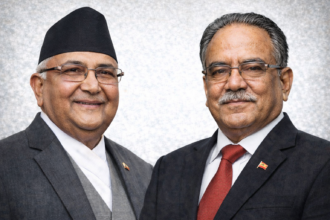
The CPN-UML also retains a disciplined cadre structure and a significant base in rural districts. Under the continuing influence of K. P. Sharma Oli, CPN-UML may adopt an assertive parliamentary strategy aimed at challenging RSP’s governance capacity and mobilizing opposition alliances.
For the CPN-MC, led by Pushpa Kamal Dahal aka Prachanda, the election result deepens an ongoing existential crisis. Once the dominant force in the immediate aftermath of the insurgency, CPN-MC has experienced a steady decline in electoral support. Its strategy in the new parliament may involve tactical cooperation with other leftist factions or attempts to reassert its relevance as a mediator between competing political blocs.
The rise of RSP reflects a powerful anti-establishment wave driven largely by younger voters seeking accountability, transparency, and effective governance. If the new leadership succeeds in strengthening institutional integrity and reducing corruption, the 2026 election could represent a critical moment of democratic renewal.
Yet the transition also carries significant risks. The RSP leadership lacks extensive experience in national governance, and the challenge of managing a complex bureaucracy, while confronting entrenched political opposition, will test its administrative capabilities. Efforts to consolidate authority over security institutions and the civil service could provoke resistance, if perceived as partisan or destabilizing.
Ultimately, the 2026 election marks both rupture and renewal in Nepal’s political evolution. The erosion of traditional party dominance signals a fundamental transformation in public expectations from democratic governance. Whether this moment produces sustained institutional reform or merely another cycle of political volatility will depend on how effectively the new leadership balances reformist ambitions with the demands of institutional stability in Nepal’s fragile federal democracy.
Author: Deepak Kumar Nayak – Research Associate, Institute for Conflict Management