For decades, developed nations lectured emerging economies on fiscal discipline. Now, the tables have turned as India warns of a global “mountain of debt” that could come crashing down.
Picture this: You’re at the World Economic Forum in Davos, surrounded by global bigwigs, and India’s Union Minister Ashwini Vaishnaw drops a blunt truth. He calls out the “huge mountain of debt” in rich countries like Japan and the US as a real worry for India. This isn’t some random gripe. It’s the first time an Indian voice on this big stage has flipped the script. Usually, developed nations point fingers at emerging economies like ours
For as long as most of us can remember, the global economic narrative has followed a very specific script. The “rich” nations of the West and the developed East were the responsible elders, the ones who provided the blueprints for financial stability. Meanwhile, developing nations like India were often seen as the ones needing supervision, frequently cautioned about their spending habits and “fiscal discipline.”
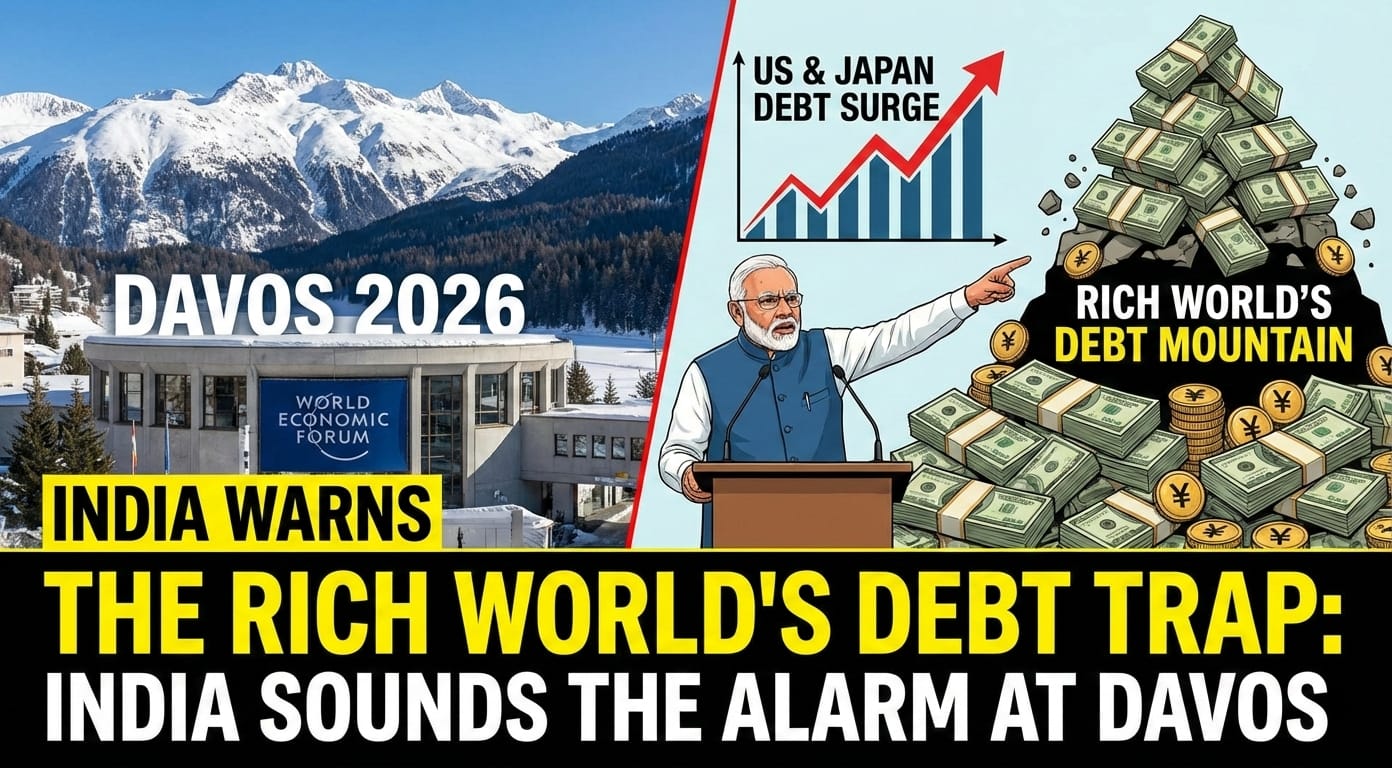
But as the 2026 World Economic Forum in Davos has shown us, that script has been flipped. In a remarkable moment of role reversal, India has stood up on the global stage to point out a terrifying reality: the world’s most advanced economies are currently sitting on a “huge mountain of debt” that is beginning to crumble, and if it falls, it could take the rest of us with it.
Union Minister Ashwini Vaishnaw didn’t mince words when he highlighted this concern. He pointed specifically to Japan, a country that has historically been the poster child for low-interest rates and stability. On a Tuesday that sent shockwaves through the financial world, Japan’s 40-year bond yield—essentially the interest rate the government pays to borrow money for the long term—shot past 4 per cent.
To someone not steeped in finance, 4 per cent might sound small, but in the world of sovereign debt, this is an earthquake. It is a level not seen in over three decades. It signals that investors are losing faith. They are demanding more money to lend to Japan because they see the risk rising. When a “safe” country like Japan starts to look shaky, the “run on bonds” begins, and that is exactly what Minister Vaishnaw is worried about.
To understand why this matters to a person sitting in Delhi, Mumbai, or a small village in India, we have to look at how global money flows.
Think of the world’s investment money as a giant river. Usually, it flows toward emerging markets like India because we offer growth. But if “safe” countries like Japan or the US start offering high interest rates because they are desperate to cover their massive debts, that river of money reverses its course. Investors pull their cash out of Indian stocks and bonds to park it back in Japan or the US. This “outflow” makes our markets volatile and can weaken our currency, making everything from petrol to electronic chips more expensive for the common man.
The situation in the United States is perhaps even more precarious, though it often gets hidden behind the prestige of the Dollar. Currently, the US national debt is hovering around a staggering $37 trillion (approx). For years, the US had a “cheat code”—whenever they were in trouble, they could simply print more money or borrow more at nearly zero interest. But that era is over. Printing money recklessly led to the massive inflation we’ve seen globally over the last few years.
Now, the US Federal Reserve cannot simply “print” its way out of trouble without making a loaf of bread that costs 4 dollars (approx) Furthermore, the US Congress is deeply divided. We have seen the US government literally shut down multiple times because they couldn’t agree on raising the “debt ceiling”—the legal limit on how much the country can borrow. When the world’s biggest economy spends 35 days in a state of paralysis because it can’t manage its credit card limit, the rest of the world has every right to be nervous.
US federal interest payments on national debt will exceed $1 trillion annually in FY2026 (Oct 2025-Sep 2026), a milestone driven by $38T+ debt and higher rates, now the second-largest budget item after Social Security.
Early FY2026 data shows $270B paid through Dec 2025, up 11.9% YoY, on track for full-year trillion-dollar outgo.
Minister Vaishnaw’s warning is a reflection of a new India—one that is confident enough to call out the systemic flaws of the “Rich World.” While developed nations struggle with debt, India is projecting a real growth rate of 6 to 8 per cent. The Minister’s “four pillars”—public investment, inclusive growth, manufacturing, and simplification—are designed to make India the world’s third-largest economy within the next few years.
He pointed out that India cannot simply copy the “China Model.” For thirty years, China grew by using the massive US market as its personal customer base, building huge factories to sell cheap goods to Americans. But today’s world is different. The US is now more protective of its own industries, and global competition is fiercer. India has to rely on its own massive domestic market of 1.4 billion people. We have to be the ones who consume what we produce, creating a self-sustaining cycle of growth that isn’t entirely dependent on the whims of Western consumers who are already buried under debt.
The message from Davos is clear: the old economic order is under immense pressure. The developed world is finding out that you cannot borrow forever without consequences. Japan’s 4% bond yield and the US’s $37 trillion debt are cracks in the foundation of the global economy. India is currently in a “Goldilocks” zone—growing steadily with moderate inflation—but we are not an island. We are part of a global ecosystem. If the “debt mountain” in the West collapses, the dust will settle on everyone.
India’s role has changed from being a quiet follower to a vocal stakeholder. By flagging these risks, India is essentially telling the developed world: “Get your house in order.” As Juvencio Maeztu of Ingka Group suggested, for India to truly shine, it must harmonize with global quality standards. If we combine our high growth with better quality and cleaner cities, we won’t just be the third-largest economy; we will be the most stable one.
In a world drowning in debt, stability is the ultimate currency. India’s journey over the next five years will be about navigating this global instability while fixing the local hurdles of pollution and per capita income. It is a tightrope walk, but for the first time, India is the one holding the balancing pole while the giants are the ones swaying.