Jammu and Kashmir Chief Minister Omar Abdullah recently said that while the BJP-led NDA government at the Centre was “sort of well disposed” towards the National Conference-led administration, the same did not hold true for its appointee Lieutenant Governor Manoj Sinha. Chief Minister Omar Abdullah said that Sinha was “interfering” in the functioning of an “elected government”.
There is a lot that Sinha could be doing “wrong” to be perceived as “interfering”. 2025 was a year of challenges for Jammu and Kashmir, yet it happened to be a period when focused efforts from Sinha went into preserving and protecting security, empathy, safety, development and deliberations of importance defined the journey forward for Jammu and Kashmir. Let’s look into the aspects that make him perceived as “interfering”.
I: India first – because Jammu and Kashmir first
Since 2019 – the year marked by the Abrogation of Article 370, the Jammu and Kashmir administration under LG Manoj Sinha has strengthened the security grid. For decades, Jammu and Kashmir awaited a people-centric and India-centric approach in shaping the collaborative efforts of the most crucial link in the security grid — the J&K Police, in its coordination with the Army, the CAPFs and Intelligence agencies. During the last six years, Jammu and Kashmir has seen a decline in the brazen operatives of armed terrorists, their ecosystem and over ground workers (OGWs) – because LG Sinha brought in place a system where terrorists, OGWs and other links in the terror-ecosystem chain intimidating the social fabric and the common citizen, have been treated at par.
LG Sinha administration’s treatment to counter and stifle terror ecosystem is Jammu and Kashmir-centric — keeping the well-being of the locals by de-linking them from the clutches of the terror ecosystem as top priority make the approach decisively India-centric. What makes 2025 decisive and unique is that Sinha has been able to redefine the landscape amid two serious challenges, the Pulwama attack targeting tourists and the Red Fort bomb blast — targeting innocent citizens in the national capital. This has been done by intensifying proactive security strategies to counter all facets of terrorism from and on the soil of Jammu and Kashmir. Sinha should have received support from politicians in Jammu Kashmir – regardless of political differences for aligning the people of Jammu and Kashmir and social perspectives of their well-being as Indians, with an India-centric approach to security and the war against terror and terror ecosystem. Instead, Sinha has been categorically called out for “interference”.
Anti-India agents often get defined by their ill-actions against the people of Jammu and Kashmir and for harbouring, displaying, executing and encouraging actions against the sovereignty of India. In a post on X, (formerly Twitter) the Jammu and Kashmir Police stated on December 23 that property of Pakistani agent and ISI’s financial conduit and proclaimed offender Ghulam Nabi Shah alias Dr Fai, “accused in FIR No 46/2020, under various sections of UAPA, PS Budgam, has been attached consequent to orders of the competent authority.” The move came when the National Investigation Agency (NIA) took this crucial step against anti-India activities. According to reports, it secured a court order to attach properties belonging to Fai, whose organisation came under the lens of US authorities and was flagged in 2011 as a front for Pakistan’s Inter-Services Intelligence (ISI).
Under LG Sinha, the security apparatus of Jammu and Kashmir in coordination with national agencies are taking steps against anti-India elements, separatists and terrorists not only in India but making them pay the price for their actions against India on foreign soil. Fai, a US-based Kashmiri separatist, faces accusations under the Unlawful Activities (Prevention) Act (UAPA) “for allegedly lobbying on behalf of Kashmir separatists and Pakistan”.
LG Sinha has been continuously asserting the need for coordinated action against terrorists, terror-enablers, the terror ecosystem, and reiterated its need while speaking at the ‘Viksit Bharat: Security Dimensions’, held recently in Jammu and Kashmir. However, demanding attention from all sections of politicians in J&K and New Delhi is Sinha’s assertion – that security gains made in Jammu and Kashmir since 2019 “must be defended and every single terrorist and its supporter operating in valley, forest, hills or village must be neutralised.”
Between 2011 (when Fai’s organisation was flagged by the US authorities) and 2019, politicians of Jammu and Kashmir had ample time for the clamping down of his activities and actions against him. Instead, Jammu and Kashmir has seen the coordinated action taking place in 2025 – six years after the Abrogation of Article 370 – during the tenure of LG Sinha. He often finds himself at the centre of the political storm when he has had no election to fight or win or lose in the union territory and is there to simply serve the people – a job he is doing in the midst of people who have electoral advantages to defend and gain.
The two things different in Jammu and Kashmir before and after 2019 is the Jammu and Kashmir-centric approach to ensuring safety and security. What is aligned with the safety and security of the people of J&K — through policy-making, policies, anti-terror infrastructure and multi-layered measures for development, is, and bound to be, India-centric. The imprints of Sinha’s work in Jammu and Kashmir are arranged for Viksit Bharat 2047. This is the fundamental differentiator that makes the LG distinct in his surroundings in Jammu and Kashmir.
N: Narcotics – The Narco-terror network Sinha administration wants to destroy
In March this year, LG Sinha’s administration invoked provisions of Article 311 to dismiss four government employees. According to reports, they were allegedly involved in cases pertaining to the Narcotic Drugs and Psychotropic Substance (NDPS). According to a report on the Indian Express website, it was the first time that Article 311 provisions were invoked in cases of NDPS in Jammu and Kashmir. Earlier, LG Sinha’s administration had dismissed government employees under Article 311 for their alleged anti-national activities. Sinha has been turning away from J&K people and their lives – guns and agents of chaos – that have for decades pointed inwards.
Reports and events, particularly in 2025, have pointed out that drugs and narcotics are the feeders of terror and infiltration, as funds generated by drug smuggling, drug peddling and the combination of narcotics and hawala money rackets, are used for powering and sustaining terror. It is believed that narco-terror is no longer confined to weapons and fund support to terror. Terror grows its tentacles to use every element in its dispensation. Narcotics are also used as currency for cross-border trade of narcotics – becoming a potent weapon in Pakistan’s proxy war. Effective drying up of the narcotic trade in Jammu and Kashmir under the zero-tolerance policy against terror requires demolishing infiltration and infiltration bids. The “whole government approach” is the key to Lieutenant Governor Manoj Sinha’s integrated action against narcotics which, in J&K governance today, is deeply connected to radicalisation, terror and the terror ecosystem. In Sinha’s momentum against the terror infrastructure through kinetic and non kinetic operations, the approach is in alignment with the vision and action of the home ministry at the Centre. Those who facilitate narco-trade and those who push the proceeds of narcotics trade into the terror ecosystem are being identified and arrested. Union Home Minister Amit Shah has stated that the narcotics network provides support to infiltrators and terrorists in Jammu and Kashmir.
Evidence of the prompt action and rigorous pinning down of people connected with the narcotic trade is in reports of arrests and disrupting the control of people involved in the narcotic trade in Jammu and Kashmir. Between the terror attack in Pulwama and the Delhi-bomb blasts, the Jammu and Kashmir police has been working aggressively on operations against terrorists, their overground workers, linkages of terrorists with those trading narcotics, including drug smugglers and drug peddlers. With the abrogation of Article 370 which created the pathway for better coordination in the operations of the J&K police, the Border Security Force and the Indian Army, operations against drug smuggling have become more unsparing, with cops ensuring a crackdown on the local narcotics ecosystem that terror-support. Besides making arrests of drug peddlers and drug smugglers, the J&K Police has been attaching the properties in Jammu and Kashmir that have come up as a result of involvement in drug smuggling and peddling, terror support, and terror activities.
Reports indicate that the state’s justice machinery, too, has taken note of the shift in the use of narcotics — from being used for drug weapon smuggling — to being used as currency for threatening India’s internal security, economic security, and the social fabric involving the youth of Jammu and Kashmir and families. LG Sinha has been uprooting the agents of chaos who use narcotics and narcotic funds from the soil of Jammu and Kashmir. On the social front, LG Sinha’s government has intensified efforts in J&K’s fight against substance abuse with the help of functional drug de-addiction centres, their expansion and rehabilitation, strengthening the process and reach of awareness on prevention, prevention itself. Making Jammu and Kashmir drug-free is one of the areas of focus of his government.
T: Terror – Unwinding the clockwork to break it
For LG Sinha, the stance of “zero terror” also corresponds to 100 per cent progress. Vigilance, security and anti-terror measures translate to inclusive development. And this is not just official jargon. An administrator of roots in Jammu and Kashmir would have felt shaken with the way revelations on white-collar terror were bombarding police investigations after the Red Fort bomb blast. Sinha did not flinch. Partly because the series of truths pertaining to white collar terror that the Jammu and Kashmir Police stumbled upon, did not surface overnight. The LG Sinha administration was working to cut the tentacles of terror by going with the unpopular move of the dismissal of government employees under Article 311. While the transformed J&K police in an inter-state mission was uncovering the “white collar terror” module involving doctors and other professionals with Faridabad’s Al Falah University turning out to be its hotbed, it was found that a professor hired by the Faridabad university was dismissed in 2023 for alleged links with terrorist organisations. The clockwork of terror and the fight against it, began to unwind. It came to light that Dr Nisar-ul-Hassan, a professor at Al-Falah University, Faridabad was dismissed by J&K LG Lieutenant Governor Manoj Sinha under Article 311(2)(c) of the Constitution. The order mentioned that the step was taken “in the interest of the security of the state”. There was no inquiry because the provision allows the government to dismiss a public servant without a departmental inquiry in cases involving the security of the state. Hassan was serving at a government hospital in Srinagar before his dismissal.
That he was removed two years before the Red Fort incident is not an administrative coincidence. It is a sign of outcomes of the systemic cleansing by Manoj Sinha. Had Dr Hassan remained within the government system, taking advantage of the protection and privileges of state employment in Jammu and Kashmir, India might have been reeling under bigger and more cruel impacts of his actions – within and outside the UT.
On December 20, LG Sinha chaired a review meeting of subordinate departments of the home department of Jammu and Kashmir. Under LG Manoj Sinha, the Modi government is working on building a terror-free Jammu and Kashmir. It was the zero tolerance stance against terror that enabled the people of Jammu and Kashmir to participate in the democratic process in an unprecedented turn out. Sinha’s commitment to operations towards internal security reforms were intensified between the Pulwama terror attacks and Red Fort bomb blast, where his administration continued with a consequential identification and dismissal of government employees who have been found aiding, participating in, abetting, in extremist activities.
Recently, search operations were launched in Udhampur after terrorists allegedly took food from a village-house before setting off to a forest. The searches were conducted under a joint operation. The decoupling of terror and its ecosystem is a project on ground gaining intensity and solid outcomes. Sinha has been left stunned a couple of times – despite all his efforts – in 2025. His administration will have to be right every time – even when the anti-India forces have to be right just once. In 2026, LG Sinha’s fight against terror may or may not find supporters in certain sections of power in the UT. He will have to continue the momentum for gains made against terror since 2019 – on the multi-battle front that J&K offers.
E: Ecosystem of terror under the LG lens
While the kinetic approach involving the security forces and the J&K law and order apparatus has waged a full-blown war against terror and the overground workers, Sinha has kept several unprecedented deterrents in place to eliminate the threat coming from terror-related organizations and anti-India activities. The internal checks carried out in the security machinery have empowered dismissals of people involved in anti-India and terror activities. These have been backed by dossiers that highlight their involvement in extremist and radicalised multi-layered systems. Reforms under Sinha have brought departments and institutions that were perceived as “cannot be touched” in the public and administrative perception under the lens and action. Procedures have been conducted by a special task force constituted for strengthening J&K’s internal security, thorough scrutiny and a watch, placing under the CID lens the leaking of sensitive information; leakage of important details of movements; terror funding, the support and voicing of extremist views and narratives.
These include the law department, the education department, the health department, Kashmir University, J&K Police, and J&K bank. Intellectual infiltration — in which Pakistani strategy of directly-infiltrating the thought process, perspectives and minds in Jammu and Kashmir with a treacherous coercion through propaganda, ideas and material supporting its proxy war, left a huge section of people vulnerable to anti-India and anti-Kashmir political indoctrination. India has shown an aggressive stance in using the security apparatus after PM Modi came to power, followed by the decisions and events of demonetisation and abrogation of Article 370, to identify the loops of terror activities in people working as teachers, doctors, technicians, government officials, police personnel, clerks – who were allegedly working to serve the Pakistani agenda and propaganda. Activities of such people are meant to hurt India and to help Pakistan and its proxy war stay relevant in Jammu and Kashmir.
On December 15, 2005, the Jammu and Kashmir Lieutenant Governor administration terminated the services of103 personnel of the Fire and Emergency Services Department over a “compromised process” of recruitment. According to reports, the decision was taken after the Anti-Corruption Bureau enquiry committee, which was investigating the recruitment process in 2020, stumbled upon large-scale irregularities in appointments made through tampering of records, learning that the firemen were illegally selected. The case surfaced in 2022, according to a report on the NDTV website. According to this report, the administration gave the probe to RK Goyal – Additional Chief Secretary Home at that time. Malpractices in the recruitment of firemen was among the four major recruitment scams that he probed. The report adds that Goyal probed three other recruitment scams in the total four. Three departments saw the cancellation of selection lists. These departments were — police, finance department and junior engineers. While investigations into the firemen recruitment irregularities went to the Anti-Corruption Bureau in Jammu and Kashmir, the three other “job scams” went to the Central Bureau of Investigation (CBI). Cracking down on the ecosystem has its own challenges for the administration. J&K political leaders of different hues have opposed the move – questioning it and perceiving it as the “targeting” of people.
Other challenges could prop up in 2026. According to reports, the J&K Police has warned about “terror or criminal” backgrounds of 29 workers of the Ratle Hydro Electric Project. In a letter addressed to General Manager, Megha Engineering and Infrastructure Limited, the Kishtwar SP, J&K Police, stated that over a routine police verification of the residents of Kishtwar who are working for this project, reports were submitted. In these reports, it was found that 29 workers had been “found involved in subversive/anti-national activities’’. The matter is raising concerns as the project is of strategic and national significance and such projects happen to be the target in Pakistan’s proxy war. The “ecosystem” aspect is one of the most challenging for the administration – as 2025 has shown.
R: Restoration of statehood
In October, 2025, the Supreme Court gave the Central government four weeks to respond to petitions seeking the restoration of statehood to Jammu and Kashmir (from UT). The petitioners urged the Court to ensure the implementation of the assurance given by the Centre to reinstate statehood “at the earliest.” While in J&K, fingers are pointed at him on the issue of statehood, LG Sinha has said that his Government recognizes the significance of statehood. It is engaged with stakeholders in a dialogue required to facilitate the process of statehood.
There are issues on which politicians in Kashmir have had issues with LG Sinha. Restoration of Jammu and Kashmir statehood, the duality of control of the Jammu and Kashmir and the government headed by chief minister Omar Abdullah, perceptions related to business rules, the back and forth on the business rules, and issues related to the perceived empowering of the LG by the centre, his administrative authority, final say on matters related to the functioning of All India Services in the union territory. These are some of those issues.
Sinha is working on ground, talking from the ground and perhaps the knowledge of the pulse makes him give statements that are not flattering in nature. “All powers are with the elected government. I want to emphasise that (they) should stop fooling people and use their powers for the benefit of the people of Jammu and Kashmir,” Sinha has reportedly said.
Earlier this year, sections of the media reported that the Ministry of Home Affairs amended the rules of the Jammu and Kashmir Reorganization Act, 2019, widening the powers of the lieutenant governor in the union territory. In July, there were reports saying that sources in the government clarified that only the Transaction of Business Rules have been amended in the Jammu and Kashmir Reorganization Act, 2019.
The move was criticised by Kashmiri politicians, including CM Omar Abdullah. He has accused the Centre of betraying Jammu and Kashmir and Ladakh and deepening mistrust by delaying the restoration of Statehood. Abdullah has chosen words that create an impression that the Centre has made the people of the state powerless.
The development saw politicians in the Valley give strong reactions. The larger strain of reaction was driven by CM Omar Abdullah himself with the perception that the Centre was persisting on its control over Jammu and Kashmir — a union territory — where the powers of the chief minister were going to be limited. One politician even likened it to being at war with the people in Jammu and Kashmir. Others looked at it as “betrayal” and as an effort to disempower democracy and the democratic institutions. Yet others rued the perceived lack of “real power” for the chief minister and the handing over of power of the elected representative of the people to an unelected administrator — meaning LG Sinha.
There is another intriguing dimension to this issue. Chief Minister Omar Abdullah’s recent remarks acknowledging the empowerment of the UT by the Central Government got a strong reaction from BJP leader Er Sahil Bashir Bhat who said that Abdullah’s statement regarding the Centre’s positive stance “amounts to a public admission of the strong and enabling governance of the Centre led by Prime Minister Narendra Modi.” Bhat added that Abdullah’s statement was exposing his own governance failure. Abdullah’s statement is being perceived as contradictory. Bhat has pointed out that the statement itself exposes Abdullah’s inability to deliver on the promises he made to the people of Jammu and Kashmir amid the Central’s support, policies, policy framework, empowerment to his government, the inflow of resources, administerial authority, and stability that the Centre’s support brings.
While sections of politicians of J&K want statehood, and demand it, Sinha himself has not denied its possibility. What he has categorically said is that the absence of statehood cannot become and cannot be used as an “excuse for underperformance”.
The restoration of statehood has come up in the background of the heated exchange of political statements — with names taken and names not taken — between LG Sinha and CM Omar Abdullah. The push for the restoration of statehood will become more intense in 2026. And each time a mirror is held on the elected government’s work, LG Sinha will be shown as “interference” and “interfering”.
CM Omar Abdullah has been a strong critic of LG Sinha over the Pahalgam attacks, for which Sinha himself was quick to take responsibility. But it is not where the politics ends. CM Omar Abdullah has been quoted as saying: “Unemployment was rising. GST earnings had fallen, and tourism and handicrafts were suffering in the wake of the April attack in Pahalgam that killed 26 tourists.” This indicates the vastness of difficulties Sinha is facing as an administrator with no election to fight in J&K and opposed by those whose politics is defined by local emotions that sway electoral gains and losses. Yet he remains unflinching in his efforts. “One of the foremost aspirations of the people of Jammu and Kashmir is the restoration of full statehood. My Government remains steadfast in its commitment to addressing this legitimate desire of the citizens of Jammu and Kashmir. My Government recognizes the emotional and political significance of the Statehood for the people and is actively engaging with all stakeholders to facilitate this process in a manner that ensures peace, stability, and progress,” Sinha is reported to have said. He has expressed that the foremost aspiration of the people of Jammu and Kashmir is the restoration of statehood.
F: Friction – The food for politics
In politics, friction is often created to cover manufactured fallacies. In the tussle for identity politics of the past and present, LG’s administration is quickly addressed as the “unelected government” by a section of politicians in J&K. Scaling up the pitch of identity politics and scaling down the value of the transformation in Kashmir between 2020 and 2025 has been a method in shaping the friction. For the politicians of Jammu and Kashmir, before the abrogation of Article 370, the field of action for friction was easier to create and define than it is today. A union territory receiving a thick supply of support, funds, resources, attention, policies and other progress-related inputs. That’s how things have transformed. The display of confrontational attitudes against LG Sinha – who has been candid in presenting the contrasts between the past and present of Jammu and Kashmir, is loaded with uncomfortable truths – some of which are spoken by Sinha himself.
Sinha recently said that in the past, ‘overground workers’ OGWs (those who support terror and terrorists) were “appointed to government jobs while genuine victims of terror were hounded” in Jammu and Kashmir. In the current political scenario, confrontations or frictions with LG Sinha is a way for local politicians to tell the Centre that while they are dealing with the outcomes of the abrogation of Article 370, Sinha is continuing to “control” many key institutions and sectors in governance and administration that should come under the elected representatives in the Union Territory. When Sinha praises the positive shift in the law and order in J&K, for which the J&K police deserves credit – outside the realm of the security forces and the Indian Army, he is praising the efforts of the J&K Police. “J&K police stand as a testament to selfless service, duty and sacrifice. Its legacy is written by the blood of its brave personnel, whose ultimate sacrifices have strengthened national unity, inspired new hope and propelled J&K towards an era of peace and prosperity.” J&K police are playing a crucial role in India’s war against terror — not just the UT’s alone. Sinha’s message to the police department is: “Don’t touch the innocent and do not spare the guilty is our policy. We believe in establishing peace and not buying peace.” The last sentence is noteworthy.
It establishes the difference in the approach of LG Sinha to ensure security in the state with the situation in the past. It indicates reform and changes that reach the roots of not just the security apparatus but also the terror infrastructure. The J&K Police is perhaps one of the “key institutions” that the NC government would want transferred.
The dismissal of government employees on alleged links with terror outfits and ecosystem, under Article 311 of the Constitution, which allows dismissal without inquiry in the interest of national security, was another step from Sinha that left a section of J&K politicians displeased. Besides that, on the issue of Kashmir, CM Abdullah has said that “India and Pakistan came closer to resolving the Kashmir issue during the Manmohan Singh-led UPA government.” CM Abdullah has heaped praises on the work of former prime ministers Manmohan Singh and A B Vajpayee. While the statement has not seen any confrontation or reaction from leaders in his opposition, it is clear that they have chosen battles other than piling retorts on Abdullah’s personal views.
While the NC leader thinks he might “not see a return to the situation in my lifetime,” it is true that there is nothing to suggest otherwise on Indo-Pak relations. However, Abdullah’s praises of Manmohan Singh’s policies on Kashmir do indicate his expectations from the Modi-government. It also keeps the room open for the resonating of the related stance on the landscape of J&K.
E: Expectations, Expenditure
From news reports in the section of the J&K media and opponents such as Bhat, it becomes evident that Abdullah’s inconsistency in statements regarding the Centre’s role in the progress of Jammu and Kashmir is in conflict with his own political accountability, his government’s and the expectations of people.
Currently, Abdullah’s temptation seems to lie in shifting the blame for not being able to empower people after being empowered by the Centre. Ironically, sections of the media at the National Capital Region do not ask the him questions on why he is not able to deliver on his promises in the presence of LG Sinha, who himself has gained the perception of being the sincere representative of the Centre, continuously working on bringing vigilance through transparent governance, financial assistance, resources, stability, security, adequate budgetary allocation, policy and development frameworks, execution of those frameworks, authority with understanding, empathy, intent for progress, and commitment to the developmental vision of the PM Modi-led Centre.
While the NCR media seems unwilling to ask Abdullah why political interests weigh above the welfare of people under his government – his critics — in statements and through the media, are questioning him on the perception of “victimhood” he is building around himself. This – despite the mandate given by the people. While Abdullah cites lack of political power to take actions for J&K’s progress, his critics call it “lack of intent and political will.”
The cut in the expenditure relates to direct consequences in day to day lives of people, as the cuts translate to facets of infrastructure and development being delayed or being absent from the landscape of Jammu and Kashmir. This article on the Times of India website clearly states where the tilt of intent in the governance lies: “Between 2020 and 2024, Jammu & Kashmir witnessed one of its most efficient phases of governance. Under Lieutenant Governor Manoj Sinha, capital expenditure became synonymous with progress. Every rupee released was tracked, every bridge or school geo-tagged, every project tied to measurable outcomes. The LG’s tenure saw record-high utilisation exceeding ₹13,000 crore annually, transparent e-tendering, time-bound administrative sanctions, and real-time dashboards that connected funding to field execution.”
One of the loudest critics of Abdullah’s work as chief minister is People’s Conference leader Sajad Lone. In June, 2025, Abdullah was seen explaining to a journalist how the NC government in Jammu and Kashmir was handling the open merit and reservation issue.
In reference to the video clip, Lone described Abdullah as “an emperor, who is answerable to none” in a post on X (formerly Twitter.” Lone’s post said: “For all those who voted for NC——just observe the arrogance. Reeks of self righteousness and utter contempt and disdain for views that are contrary. Seems he will eat up KNS editor Aslam sahib. I thought we were UT. Forget 370. Forget Internal autonomy. We now have an Emperor. Who is answerable to none.” While there are politicians who see through the errors of CM Abdullah, Sinha is less likely to find their support. Sinha is perceived as synonymous with the Abrogation of Article 370. And that’s enough of a problem.
R: Reliance on self
The years after the Abrogation of Article 370 have turned the idea of reliance inward in Jammu and Kashmir. In 2024, The Constitution (Jammu and Kashmir) Scheduled Tribes Order (Amendment) Bill, 2024 was passed by the Parliament. This brought the inclusion of ‘Pahari Ethnic Group, Paddari Tribe, Koli and Gadda Brahmin’ communities in the list of STs of UT of Jammu and Kashmir. This was a long pending demand of these communities. The Valmiki Community’s inclusion in the SC category, benefits of reservation at par with residents of LoC Areas to people residing in areas adjoining International Border and efforts towards development focussed on the tribal communities, provisions for the nomadic communities of Jammu and Kashmir are some aspects that have helped secure several sections of the social fabric. Jammu and Kashmir’s progress under the Forest Rights Act (FRA), 2006, has been noteworthy. As on 31.05.2025, individual titles distributed were 429, community rights recognised were 5,591 with a total of 6,020. Under the FRA and rules made the UT administration is responsible for implementation of various provisions of the Act.
The transformation of Jammu and Kashmir depends on the development of the education sector. Under the support from the Central government, the union territory has seen significant progress with education-centered innovative interventions, digital resources, smart classrooms, and tinkering labs. Skill development of women and youth is a focus area for ensuring empowerment. “My government is prioritizing capacity building programs for educators, ensuring a more dynamic and effective learning environment. Vidhya Samiksha Kendra is being operationalized for data driven decision making and improved educational outcomes. Real time recording of student attendance and tracking of teacher attendance have also been introduced,” LG Sinha informed the assembly in one of his addresses. Improving research facilities for faculty and students under National Education Policy (NEP) 2020, making IIT Jammu and IIM Jammu operational, pursuing the completion of AIIMS Srinagar, focusing on youth engagement, employment opportunities, and digital transformation are not small strides of development in a short time.
E: Economic Resurgence
LG Sinha’s five years in office have brought transformation to Jammu and Kashmir in social terms as well. Out of 19,25,535 total households, 15,64,062 households have tap water connections (81.23 per cent coverage) in Jammu and Kashmir under the Jal Jeevan Mission. People have participated in efforts to reject the joining of terror outfits. Sinha recently said that against the 100-150 youths who used to become part of terror outfits, only one joined this year. The Jammu and Kashmir Bank which was running losses of Rs 1,300 crore, saw profits of Rs 1,700 crore, according to Sinha. The Union Territory is attracting investments. Setting up of BPOs in Kashmir is one of the outcomes looking at creating better employment opportunities for the youth.
The boosting of all weather connectivity to the region with the dedication of the Udhampur-Srinagar-Baramulla Rail Link (USBRL) project — the 272-km rail link (cost around ₹43,780 crore) spanning 36 tunnels, 119 km of stretch and 943 bridges; the spectacular Chenab Rail Bridge connecting Jammu and Srinagar. The development of IIT, IIM, NIFT, new medical colleges in the Union Territory, sanctioning of projects of over 3,100 megawatts and improvement in transmission capacity, improvement in tourism-related activities and employment opportunities, improvement in private investment — with operational projects worth Rs 10,000–12,000 and operations in pipeline worth Rs 28,000–30,000 crore. Digitisation of over 1,140 government services is one of the major highlights of governance ensuring transparency and accountability. The vision of doubling the contribution of the agricultural sector to the GDP through a developmental plan launched in 2022 aided by the arrival of the first-ever foodgrain freight train in Kashmir – a huge milestone in the connection of Kashmir with the national freight movement system opens up the inflow of freight-related wide-ranging benefits for the people, economy, business opportunities of Kashmir.
N: Nation building – From and for Jammu and Kashmir
LG Sinha talks about nation building from Jammu and Kashmir while underlining the importance of effective governance. He recently addressed the Strategic Management Forum Conference organised by IIM Jammu (in collaboration with the Strategic Management Forum and NITI Aayog). Here he mentioned that Jammu and Kashmir is rich in limestone, sapphire and lithium and that with focused policy interventions this sector could generate between ₹15,000 crore and ₹20,000 crore annually over the next five-seven years.
For decades in Jammu and Kashmir, the narrative was restricted to the impacts of and participation in Pakistan’s proxy war prior to the Abrogation of Article 370. Sinha breaks these norms each day, redefining participation. An unusual voice in the UT, he raises aspects such as macroeconomic stability in the developmental narrative. Talking about higher investment in education and health, ideating on adoption of digital tools for all-round development, emphasising participatory governance, and speedy project implementation during an assignment in Jammu and Kashmir reflects his idea of nation building. For a UT — formerly a state — aspiring to be a state soon — imagining Jammu and Kashmir as a participant in nation building did not involve passion and willingness till 2019. He is normalising it. Sinha is defying all conventions in Jammu and Kashmir by relating security, social, developmental and cultural progress in Jammu and Kashmir with nation building. Enhancing the hydropower sector, using the strength of suggested amendments to empower Holistic Agriculture Development Programme (HADP) for J&K’s economic needs, has the larger intent of nation building. This might open the gates for policymakers, industry, industrial transformation and business leaders, provided Sinha receives the cooperation of those who accuse him of “interfering”.
C: Culture – Its restoration and rejuvenation
The temperament for the celebration of one’s own culture was being systematically faded in Jammu and Kashmir. For a long time, the people of Jammu and Kashmir had been conditioned to celebrate political strife, separatist sentiments, friction with security forces, and disruption of normalcy in all facets of public, social and cultural life. Manoj Sinha’s administration undid it, and rearranged the space for the celebration of artistic capabilities. His concern, primarily, is to help younger generations of Jammu and Kashmir reclaim and secure their own culture. He recently announced that a diploma course in calligraphy will soon be launched by Kashmir University in collaboration with the Jammu and Kashmir Academy of Art, Culture and Languages. Reviving the Valley’s centuries-old artistic traditions through art in education and education through the arts, language, and design is not a small feat. LG Sinha has institutionalised the institutional preservation, propagation, and celebration of Basohli and the rich legacy of Basholi aesthetic, painting, style and techniques and themes used in the making of Basholi. Give him the space for intervention and he sure will weave a harmonised coordination of the strengths and skills of local artisans, craftsmen, tradesmen, officials and public representatives to preserve the tangible and intangible expression of Kashmiri heritage and the rich reserves of Jammu and Ladakh art, traditions and culture.
LG Sinha’s is an administration that thinks about establishing raw material banks for pashmina and wool to ensure that high-quality raw materials reach artisans and manufacturers. It is a small step for preserving traditional craftsmanship that has a huge role in boosting the local economy based on handicraft, on the interweaving of local resources of nature and human skills. Initiatives for the rejuvenation of the Dogra Art Museum, steps taken to support the artistic and literary community, measures for preservation of local heritage with archival repositories and cultural centers got added to the cultural landscape of Jammu and Kashmir after LG Sinha’s arrival.
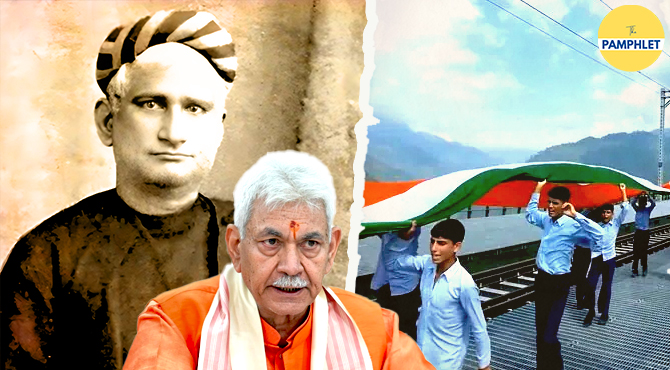
Earlier this month I had reported in detail why Lieutenant Governor Manoj Sinha’s celebration of Vande Mataram in Jammu and Kashmir was a powerful signature of the shift in culture that has taken place during his tenure. The message in the success of the celebration of the 150 years of Vande Mataram in Jammu Kashmir is that people from different walks of life made the choice for standing up for the values the nation reflects by turning up in huge numbers. It gives a clear indication of a referendum against the friction that some politicians were trying to build on the singing and celebration of Vande Mataram.
Sinha believes that preserving the cultural heritage of Jammu and Kashmir is crucial for rapid economic growth. Interventions he made to the preservation of the Martand Surya Mandir in Jammu and Kashmir — by sowing the beginning of a support shown through his presence, and the offering of prayers at the temple of prime importance to the Indic civilisation, are profound. His support has percolated to the local melas — traditional fairs — that are nourishers of the celebration of communities, the ways of life, flavours and festivities.
Prior to the abrogation of Article 370, the youth of Jammu and Kashmir would be handed stones to hurl at the security forces. Sinha’s administration is opening up Jammu and Kashmir’s cultural traditions, arts, crafts, and customs to younger generations, who were being drifted away from the intangible and vibrant expressions of culture by politics and politicians for personal gains. Sinha has the granular understanding of the convergence of J&K’s philosophical, spiritual and artistic heritage and its place in India’s culture and soft power globally. Basohli art from Kathua district obtained the Geographical Indication (GI) Tag after the approval by the National Bank for Agriculture and Rural Development (NABARD) Jammu, in 2023. Basohli Pashmina Woolen Products, known for their human artistry and a craft more than 100-year-old traditional received the Geographical Indication (GI) tag in 2023.
Sinha’s presence itself has worked to connect natural heritage of spiritual importance, the Indic identity of Jammu and Kashmir and history with the governance narrative. This includes the rejuvenation of the Purmandal Temple by the temple trust, the signing of a Memorandum of Understanding between the National Hydroelectric Power Corporation (NHPC) and Relief and Rehabilitation Commissioner (M) Office, J&K, for the Development of Bhadrakali Temple as Cultural Heritage Centre in Village Thalwal of Jammu. The temple is situated at the banks of the Nikki Tawi river in Jammu and hold significance for the Hindus of Jammu and Kashmir. The initiative will help in restoring a thriving temple life and the meeting of devotees from the different parts of the union territory and other states. The beginning of the Tawi Aarti at the Tawi Riverfront is a step towards the restoration of Indic roots in Jammu and Kashmir and the rejuvenation of the sacred river. Community participation at the banks of Jhelum through the Srinagar Heritage Festival; events organised at Dal Lake, broadening of the cultural space with the Kashmir Haat, welfare of artisans and folk artists who contribute to the cultural heritage of local economies of Jammu and Kashmir, policy intervention to boost tourism, have given the people of the union territory meaningful glimpses of their own strengths and their own land. Many of these components were missing in administration-interventions prior to Sinha’s arrival in the state. Their absence had become a status quo that no politician was ready to do anything about. Culture suffered disempowerment most disruptive. Sinha has reversed that scenario.
E: Establishing peace versus electoral advantage
“Establishing peace and not buying it” — is not just a political statement. It might become the key to Jammu and Kashmir’s progression from anti-terror stance in 2025 under Lieutenant Governor Manoj Sinha to sustaining the momentum on coordinated efforts and operations to weed out the ecosystem sympathising with terror outfits and terror exporters. On December 11, 2025, Sinha said that his administration “will reopen all terror-related cases to ensure justice in the Union Territory (UT)”. Empathy towards the victims of terror, handing of appointment letters to 41 relatives of terror-victims within the UT and Sinha’s vow to deliver justice against the backdrop of victims suffering in silence for decades, is an indication of his own moves. Predictably, voices against him for “interference” have risen, and will intensify, even as he works on recognising, giving respect and rehabilitating the victims of terror. Sinha is seen crediting the leadership of PM Modi and home minister Amit Shah for their efforts in dismantling terrorism and enabling development and progress in Jammu and Kashmir.
The more his critics try to separate him from the centre in their acceptance of the funds and support from the Centre while rejecting Sinha’s policies and ways of working, the more Sinha will be recognised as the third face of the power trinity. More his critics within the UT take some foretold stances for garnering electoral advantage, more strongly the people of UT might recognise Sinha as the enabler of peace, development, anti-terror stance, and security minus the advantage of electoral gain.
There are matters outside the LG’s powers, but they give indications of directions that some political matters take in the UT. The High Court of Jammu and Kashmir and Ladakh recently dismissed a Public Interest Litigation (PIL). It was filed by PDP chief and former Chief Minister Mehbooba Mufti. She was seeking the repatriation of undertrial prisoners from jails outside Jammu and Kashmir. According to reports, the Court said: “The petitioner’s request for omnibus directions is legally unsustainable, particularly as no specific transfer orders have been challenged or even brought on record for the Court’s consideration. Given that the affected undertrials have raised no grievance regarding their transfer to prisons outside UT, the petitioner stands as a third-party stranger to the cause and has no locus standi to invoke the Court’s jurisdiction.”
While local politicians may take positions where they intend to show Sinha as inconducive to the welfare of the people of Jammu and Kashmir, Sinha’s vision is percolating deeper into the work of Jammu and Kashmir Police. Nalin Prabhat, DGP, Jammu and Kashmir recently said that terrorism and all other criminal activities are under the strict vigil of the Police. 2026 is bound to be period of high action on multiple fronts. There are tasks that have spilled over — from 2025 to 2026. The “unelected administrator” has loads to establish in Jammu and Kashmir so that the elected ones can deliver their promises to the people.