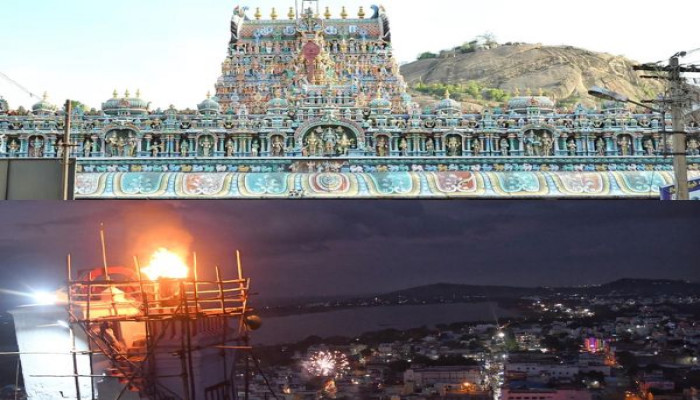
The Madras High Court’s recent order, permitting the lighting of Karthigai Deepam lamps at the Deepathoon, a stone lamp pillar situated at the summit of the Thiruparankundram hills, has yet again bought into light the long-standing discussion surrounding this ancient landscape regarding its heritage, faith, and administrative rights.
Justice G.R. Swaminathan, while delivering the order, clarified that the lamp pillar lies outside the land belonging to the dargah administration, and therefore the Hindu ritual of lighting lamps would not infringe upon the rights of the Muslim community.
Although the order sought to settle a site-specific dispute, it has ignited intense debates within Tamil Nadu’s political sphere and even resonate with the perpetual question of secularism and its principles at the national level, culminating in the submission of an impeachment motion against the judge by the Member of Parliaments belonging INC, SP & DMK. This incident has further triggered a wider discussion on judicial independence, separation of power and the delicate fabric that separates politics from religion.
To understand the sensitivity of the issue, it becomes necessary to revisit the layered history of the Thiruparankundram Murugan Temple. Revered as one of the six sacred abodes of Lord Murugan, the temple has its origins stretching back to the 6th century CE.
It is considered as the divine site where Lord Murugan married Goddess Deivanai, the daughter of Lord Indra. The temple, sculpted into the ancient rock of the hill, stands as a testament of early Tamil rock-cut architecture. Over time, it underwent significant transformations. During a particular period in Pandyan rule, it is believed to have been converted into a Jain shrine before being restored by Minister Gajapathy in the 8th century. Later, the Madurai Nayaks contributed substantially to its architecture, adding vast pillared halls and enhancing the grandeur that devotees witness today.
Murugan himself occupies a deeply emotional and cultural space within Tamil society. With many epithets such as Kartikeya, Subramaniam, Sanmukha, Skanda and Guha., he is more than a warrior god – he is a symbol of wisdom, youth, courage, and divine knowledge. According to Skanda Purana, Lord Murugan was born from the six sparks that emitted from Shiva’s third eye. These sparks, carried by Agni and the river Ganga, manifested as six infants cared for by the Krittikas, until Goddess Parvati united them into the single deity with six faces.
His battle against the asura Soorapadman remains one of the most inspiring legends of Tamil spiritual literature, celebrated especially at Thiruchendur. Each of Lord Murugan’s six abodes, from the renunciation-themed hill of Palani to the wisdom-filled plains of Swamimalai and the tranquil hills of Thiruthani, carries a distinctive dimension of his journey and divine purpose. Thiruparankundram, as the place of his marriage, is among the most sacred.
The temple’s traditions run deep. One of the most ancient celebrations associated with it is the Karthigai Deepam festival, whose references date back to 200–300 BCE in classical Tamil literature. The Tamil poetic work ‘Akananuru’ and the verses of the renowned poetess Avvaiyar describe the lighting of lamps on hills during this festival. At Thiruparankundram too, lighting the hilltop lamp has been an enduring cultural and spiritual practice for centuries.
It also houses the dargah of Sikandar Badshah, who was once the governor of Jeddah adding another layer to its tapestry of spiritual heritage. He arrived in Tamil Nadu alongside Hazrat Sultan Ibrahim Shaheed Badshah from Madinah. They clashed with the Pandyan king, Thiru Pandiyan, defeated him, and Sikandar took over as the ruler of Madurai. But Thiru Pandiyan struck back, reclaimed the empire, and killed Sikandar Badshah right there on the Thiruparankundram hill caves. In the 13th century, one of Sikandar’s followers built the dargah at that spot, and it was rebuilt in 1805.
Forget the “Sufi saint” spin—this guy was just another Islamic invader who conquered and ruled Madurai’s locals, no different from Babar or Khilji. It’s all propaganda.
A significant milestone in the administrative history of the site is the 1931 Privy Council ruling, which affirmed Hindu ownership of the hill except for a specific 0.33-acre stretch where the dargah stands. This legal recognition continues to shape jurisdictional and ritual boundaries.
In more recent decades, administrative questions surrounding the hill have grown more pronounced. The Archaeological Survey of India (ASI) had declared the hill a protected site in 1908 and again in 1923, creating restrictions on certain types of construction, access, and activities. As religious practices evolved over time, disagreements emerged regarding access to specific parts of the hill, the right to light lamps during festivals, and the extent of both temple and dargah control.
Fast-forward to October 2025: The Madurai Bench of the Madras High Court has finally brought clarity to several long-standing disputes surrounding Thiruparankundram Hill-its very name, what religious practices are allowed at the Sikkandar Badusha Dargah, and how Muslims may continue offering prayers in the Nellithoppu area.
Justice Vijayakumar dug deep into more than a century’s worth of official records and found something unmistakable: the hill has always been officially known as Thiruparankundram Rock. From old revenue documents to archaeological surveys, right up to Gazette notifications issued way back in 1908 and 1923, the evidence was clear. These notifications had already placed 172.2 acres of the hill under ASI protection. Relying on these documents, and even a 1920 civil court decree, the judge remarked that calling the hill “Sikkandar Malai” was not just inaccurate-it was a deliberate attempt to twist history.
The Court also addressed practices at the Sikkandar Badusha Dargah. It made it clear that animal sacrifices cannot go on, because there’s no proof that such practices were ever a core or ancient part of the dargah’s traditions. If the administration wants to claim otherwise, they’ll have to prove it the proper way-before a civil court, with real evidence.
Finally, on prayer rights at Nellithoppu, the Court struck a balance. Muslims can continue offering prayers there, but only during Ramzan and Bakrid, and under regulated conditions. While part of the Nellithoppu area does legally belong to the Muslim community, the pathways leading up to it-and continuing up towards the Kasi Vishwanathar Temple-are temple property. And those steps, the judge stressed, must always remain open, without any obstruction, for devotees who climb the hill.
These longstanding tensions resurfaced during the 2025 Karthigai Deepam season when petitioners claimed that traditional lamp-lighting rituals had been restricted for several decades without clear legal justification. The High Court’s judgment addressed this directly, reaffirming that the Deepathoon stands outside dargah land and that there is no legal impediment to the continuation of the centuries-old Hindu ritual. The ruling emphasized that the hill’s ASI-protected status does not nullify established religious customs when conducted within lawful boundaries.
Justice Swaminathan’s ruling on the Karthigai Deepam festival hit Tamil Nadu’s political landscape like a thunderbolt. With one decisive order, he restored a centuries-old tradition that had been sidelined for decades. The court didn’t just permit the lighting of the sacred lamp at the hilltop-it revived a ritual woven into Tamil identity long before modern political parties even existed. And that is precisely what rattled the ruling establishment.
Instead of respecting the judgment or engaging with its legal reasoning, the DMK chose confrontation. The government openly dragged its feet on implementing the order and then escalated matters by backing an impeachment motion against the judge. This maneuver raises an uncomfortable but unavoidable question: is this how a government “protects the Constitution”-by targeting judges who pass verdicts that don’t align with its political interests?
The pattern has become impossible to ignore. A party that positions itself as the champion of democratic institutions somehow finds itself repeatedly locking horns with constitutional authorities-from the Governor to the judiciary. Every disagreement becomes a battleground, every verdict an affront, every independent institution a perceived enemy.
The impeachment move has only amplified that impression. It sends a chilling message that judicial independence is negotiable if the political stakes are high enough. And for a government that often invokes the language of social justice and constitutional morality, this contradiction is glaring.
This is the same political party that once did the public humiliation and physical assault of a sitting women MLA and Leader of opposition Late Smt. J Jayalalithaji inside the state assembly-a moment that continues to haunt Tamil Nadu’s democratic memory. If that level of disrespect could be shown to an elected leader, should anyone be surprised when similar hostility is directed at constitutional offices today?
The controversy surrounding the Karthigai Deepam order is no longer merely about a festival or a ritual. It has evolved into a test of how far political power will go to maintain control, even at the cost of undermining institutions meant to keep that power in check. And in that battle, the people of Tamil Nadu can see clearly who is defending tradition, who is defending the law-and who is defending only their political interests.