Arise, Awake, and stop not till Vivekananda’s Vision is Realised
As India embarks on its journey into Amrit Kaal, it aspires to achieve the status of “Viksit Bharat” and to experience a revival of its civilization, with a goal of establishing a $30 trillion economy and becoming Vishwaguru, all while navigating through multiple crises such as climate change and geopolitical tensions.. India’s external resilience relies on internal strength, but its social fabric is strained by West imported identity politics vs. indigenous universalism, notably affecting Gen Z.
In recent decades, there has been an increase in cybercrime, cases of missing persons, and drug-related offenses, all of which have had a considerable effect on the security of citizens. NCRB data reveals persistent, evolving security challenges requiring varied interventions. In summary, cybercrime experienced a significant increase of 217% from 2018 to 2023.
Digital space cases against women (over 19,000 in 2023) and children (nearly 2,000) have risen significantly. Over 13.13 lakh girls and women went missing from 2019-2021, often linked to trafficking, with most missing persons being women and girls. In 2022, of 76,069 children kidnapped, 62,099 were female. An average of over 44,000 children go missing every year, and approximately 11,000 remain untraced and very low conviction rates (under 0.3%). Widespread alcohol and rising narcotic drug use, often via the darknet, is causing a serious public health crisis with major health and social issues, particularly among youth.
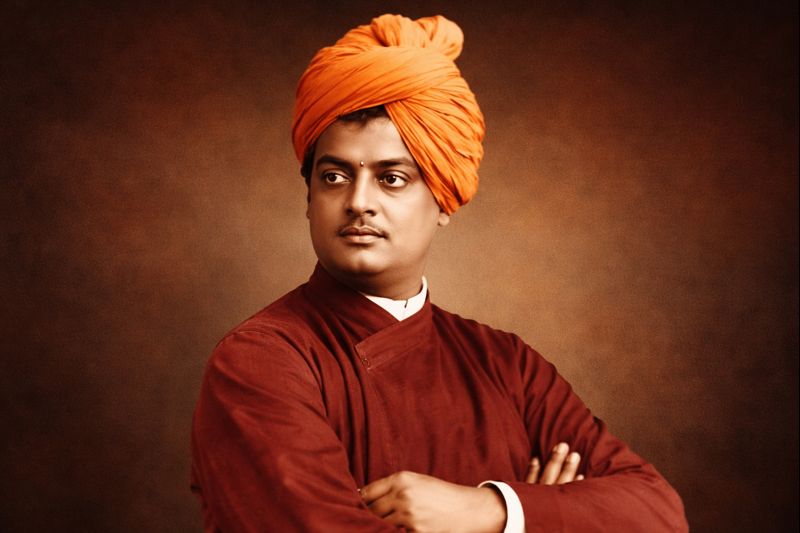
In this unpredictable environment, Swami Vivekananda’s vision provides an advanced, forward-looking structure for national revival and strength. Subhas Chandra Bose called Vivekananda the “maker of modern India” for synthesizing ancient and modern ideals. His philosophy was a radical “man-making,” “nation-building” ethos, diverging from passive spirituality, demanding material strength to achieve spiritual elevation. Vivekananda envisioned a “New India” that would emerge not from the enclaves of the elite but from “the peasant’s cottage, the huts of the fisherman, the cobbler, and the sweeper”, resonating with the contemporary mandate of inclusive growth and the “democratization of prosperity.”
Vivekananda’s vision, rooted in “Transcendental Humanism,” provides the intellectual and spiritual framework for India’s 2047 development. The development of Bharat necessitates the cultivation of capacities such as social cohesion, ecological balance, cognitive sovereignty, and ethical governance. These elements must harmonize scientific efficiency with spiritual depth, rather than solely depending on imported Western paradigms.
Digital assault on concentration and quest for purpose
Swami Vivekananda placed his immense faith in the youth, declaring, “My faith is in the younger generation, the modern generation, out of them will come my workers. They will work out the whole problem, like lions”.
The demographic dividend of India—where over 50% of the population is under the age of 25—faces unprecedented psychological challenges in the digital age. The “attention economy,” driven by algorithmic feeds and hyper-connectivity, has precipitated a crisis of mental resilience especially among digitally integrated Gen Z, resulting in rising anxiety and a “scattered mind.” The ability to concentrate deeply and maintain sustained focus—qualities vital for effective leadership and innovation—is declining.
Vivekananda emphasized, “The power of concentration is the only key to the treasure house of knowledge,” advocating for mind discipline through Raja Yoga. Modern “man-making” requires “cognitive control” and “mind-training.” Integrating Indian mindfulness practices significantly reduces stress and boosts performance. The ability to achieve Ekagrata will be a key competitive advantage for the Indian workforce in the AI age. Beyond a crisis of concentration, a lack of confidence fuels fragility amid hyper-competition and social media comparison. Vivekananda’s core message was Abhi (Fearlessness), diagnosing weakness as the root of misery and strength as the remedy: “Strength is life, weakness is death.” His philosophy provides psychological armor against “victimhood narratives” by reframing challenges as opportunities to manifest inner divinity, urging youth to be “lions,” not sheep, fostering agency.
Fragmented identity, ideological fault line wokeism vs universalism
Modern identity politics, which relies on a binary of “oppressor versus oppressed,” cultivates a narrative of “Breaking India” that promotes social division and animosity. Western “Woke” ideologies and Critical Race Theory pose a major “cognitive security” challenge to Indian social discourse. While these frameworks originated in the West to address their specific historical injustices (primarily race and slavery), their uncritical application to the Indian context—mapping “caste” directly onto “race”—creates deep social fissures. Vivekananda’s “Universal Humanism,” rooted in Advaita (Oneness) and the belief that “Jiva is Shiva“ (Divine in the Human), offers a contrasting, healing vision. This philosophy promotes social justice as a form of spiritual self-care, rejecting division and advocating for unity through the spiritual and cultural empowerment of all. India needs to address the “balkanization of the mind” by adopting this cohesive framework of social justice.
Internal Security, Radicalization, and Spiritual Nationalism
Internal security in a hyper-diverse nation like India is inextricably linked to the management of the true nature of its diversity. The threat of online radicalization, fueled by global conflicts and distorted narratives, is a pressing concern for civilians and the security agencies. The “4N Framework”—Needs, Networks, Narratives, and Naturalisation—explains how individuals are drawn into extremist ideologies. Radicalization often exploits a “crisis of meaning” (Need) and provides a toxic “Narrative” of superiority and victimhood, propagated through digital “Networks.” Incidents such as the Israel-Hamas conflict are exploited by online entities to radicalize young individuals in India, fostering “distorted religious narratives” that depict the world in binary terms of “believers vs. infidels.”
Swami Vivekananda offered the strongest intellectual argument against religious fanaticism. At the Parliament of Religions in 1893, he famously hoped that the bell of the convention would be the “death-knell of all fanaticism”. His teaching that “all religions are different paths to the same goal” dissolves the theological basis for inter-religious hatred. This is not a passive tolerance but an active acceptance of diversity (Sarva Dharma Sambhava). He emphasized “Religious unity as a foundation” for national solidarity. He envisioned a “Spiritual Nationalism” where the love for the motherland is elevated to a spiritual sadhana. By anchoring national identity in the spiritual heritage of the land—which includes the pluralism of the Indic civilization—the state can create a “cognitive shield” against foreign extremist ideologies. Counter-radicalization strategies must move beyond policing to “counter-narratives.” Advocating for Vivekananda’s principle of universal brotherhood within academic settings can act as an “intellectual vaccine” to combat the infection of religious exclusivism.
“Smart Spiritual Cities”: Integrating culture in urbanization.
As India moves rapidly towards achieving a $30 trillion economy, urbanization serves as the tangible representation of this expansion. The vision of Amrit Kaal includes the development of 100 Smart Cities and the modernization of urban infrastructure. However, Vivekananda warned that material civilization without a spiritual core is unstable: “Knowledge is only skin-deep, as civilization is, and a little scratch brings out the old savage”. The challenge for 2047 is to build cities that are technologically futuristic yet culturally anchored—”Smart Cities with a Soul.”
Rapid urbanization often leads to anomie—the breakdown of social bonds and the isolation of the individual. In the West, this has led to a loneliness epidemic. Vivekananda argued, “Until you give them culture, there can be no permanence in the raised condition”. Historically, the Indian temple was not just a place of prayer but the center of economy, arts, education, and community gathering.
Vivekananda’s view that India’s “national individuality” lies in its spirituality, and its modernization must reflect this core identity. A unique phenomenon in India’s urban development is the revitalization of ancient pilgrimage cities using cutting-edge technology. The “Smart Spiritual City” integrates the efficiency of the “Smart Cities Mission” with the sanctity of the Tirtha. The redevelopment of Ayodhya is a prime example of this synthesis. It is envisioned as a “Solar City” and a sustainable spiritual capital.
AI Ethical “Pause”: A vedantic critique of chit vs manas
As AI systems approach “Artificial General Intelligence”, humanity faces profound ethical and ontological questions. Can machines be conscious? Do they have rights? Western materialism, which largely views consciousness as an “emergent property” of the brain, struggles to draw a definitive line between human and machine.
Vivekananda’s Vedantic psychology offers a sophisticated framework to address the “Hard Problem of Consciousness.” Vedanta distinguishes between Manas (the sensory mind), Buddhi (intellect), and Atman (Pure Consciousness). From this perspective, AI is a supreme replication of Manas and Buddhi—it can process data, recognize patterns, and simulate logic faster than any human. However, it lacks Chit (Consciousness). It is an object of perception, not the Perceiver. It has no “inner world.” This distinction is vital for AI ethics. It prevents the “hallucination” of attributing agency or “rights” to algorithms. It clarifies that AI is a tool, however complex, and must remain subservient to human welfare.
Justice, governance, and leadership systems
A developed Bharat needs ethical “Rajarshi” governance, blending power and wisdom, alongside infrastructure. To overcome its colonial legacy of ruling rather than serving, the Indian bureaucracy is implementing “Mission Karmayogi.” This structural reform shifts the civil service from a rule-based to a role-based competency framework, inspired by the Bhagavad Gita and Vivekananda’s Karma Yoga. A “Karmayogi” official performs with “perfect efficiency” without selfish attachment to power.
Vivekananda completely redefined the concept of leadership. In a letter to his disciples, he wrote, “Do not try to be a ruler. He who knows how to obey knows how to command”. He championed the idea of Dasasya Dasa (servant of the servant). “Everyone can play the role of a master, but it is very difficult to be a servant”. In the context of 2047, political and corporate leaders are expected to view their positions as trusts held for the welfare of the people (Praja). The Prime Minister’s self-description as Pradhan Sevak reflects this ethos. Vivekananda warned that “jealousy” is the bane of Indian organizations. “The least show of leading destroys everything”. Therefore, the resilient capacity required for 2047 is “impersonal leadership”—leaders who are committed to the mission rather than their own ego.
A developed Bharat necessitates a prompt justice system grounded in Dharma, emphasizing Nyaya (Justice) rather than Danda (Punishment) through the replacement of colonial penal codes. Vivekananda’s vision demands a strong national character and a high-trust governance model, achieved through self-certification, reduced compliance, and technology to fight corruption.
Resilient Bharat of 2047
The journey to Amrit Kaal is fundamentally a journey of self-discovery. India is not merely developing; it is remembering. It is remembering the vision of Swami Vivekananda, who saw in this ancient land the potential to be the spiritual engine of the world. In order to achieve the status of a “Developed Nation” and Vishwaguru, India needs to cultivate four vital and resilient capabilities.
- Cognitive Sovereignty: A youth demographic that is mentally resilient, focused, and intellectually decolonized, capable of leveraging AI without being subsumed by it.
- Social Integralism: A society that rejects the divisive binaries of identity politics in favor of a “Transcendental Humanism” that sees the divine in every citizen.
- Ecological Dharma: An economy that respects the “solidarity of the universe,” proving that prosperity need not come at the cost of the planet.
- Karmic Governance: A state apparatus that functions with the efficiency of a machine and the empathy of a sage.
Swami Vivekananda’s exhortation—“Arise, awake, and stop not till the goal is reached”—is the eternal motto for this resurgence. The “goal” is not just a statistical milestone of GDP, but the establishment of a civilization that harmonizes science and spirituality, individual liberty and social duty, material prosperity and inner peace. In realizing this vision, Bharat does not just rise for itself, but for the well-being of the entire world.
Authors:
Dr Amaranadha Reddy Manchuri – CEO, Director (R&D) – VIRAT Integral R&D Foundation, Hyderabad.
Lt Col Dr Praveen Kumar Reddy – Director, Swami Vivekanand Health Mission Society (SVHMS), New Delhi.