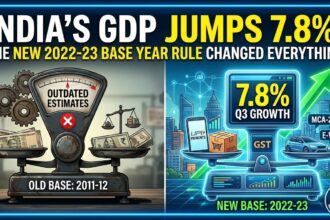
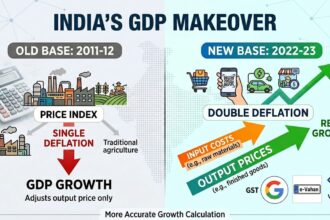
The second quarter of FY26 begins with a simple question: if the RBI itself had projected 7% growth, then why are analysts saying the actual number may go even higher – 7.3%, maybe even up to 7.5%? Is this just the festive-season effect, or has the engine of the economy genuinely gained extra horsepower? Early estimates from economists suggest that in the July–September quarter, India delivered solid growth above 7%, slightly lower than Q1’s 7.8%, but still strong, and all this while facing global headwinds like the 50% U.S. tariffs that kicked in from late August.
The story’s first twist comes from consumption. Think about it: GST rate cuts became effective only from September 22, and yet analysts say private consumption in Q2 jumped to nearly 8%, which could be the highest print since Q3 FY25’s 8.1%. How did demand accelerate so sharply in just one quarter? The answer comes from three fronts – retail inflation stayed stuck at an average of just 1.7%, rural agricultural wages grew around 6%, and Union Budget personal income tax cuts put extra money in households’ hands, giving discretionary spending a clear push. Urban India reacted instantly to GST cuts, with demand for consumer durables and high-ticket items jumping, while rural India saw a broader recovery driven by better crop output and a stronger labour market.
The second twist comes from nominal growth, where the story gets a bit more complex. In Q1 FY26, real GDP grew 7.8%, but nominal growth fell to just 8.8% – a three-quarter low – because inflation was so low that current-price GDP got compressed. Now estimates suggest nominal growth could slip below 8% in Q2, while the Budget had assumed 10.1% nominal growth for the full year. What’s the bigger picture here? When nominal GDP slows, tax collections don’t rise as fast, making fiscal deficit and debt-to-GDP ratios look higher than the Budget math had projected. It means that even with strong real growth, pressure builds on the government’s revenue side.
Within this nominal story sits another technical but crucial angle: GDP vs GVA. In Q1, GVA growth was 7.6%, while GDP was 20 basis points higher at 7.8% – because net indirect taxes (GST minus subsidies) were giving positive support. Now back-of-the-envelope estimates show that in Q2, government net indirect taxes fell year-on-year, compared with 10% growth in Q1. The key thing to understand is that GDP = GVA + net indirect taxes, so when tax-collection growth slows or turns negative, GDP growth can fall below GVA. This is why institutions like SBI Research are projecting Q2 GDP in the 7.5–8% range and GVA around 8%.
Now comes the question: is all this purely due to domestic factors, or has India become an outlier in the global backdrop? In Q2 FY26, corporate India sent another powerful signal – listed companies’ sales rose only 6%, but profits jumped 13%, making it clear that low wholesale inflation, which was near zero in Q2, kept input costs tame and sharply improved margins. Economists at Bank of Baroda and HSBC see this not just as “satisfactory financial performance,” but as a profits-led boost to value-added, which could keep GVA and GDP growth anchored around 7% going forward.
Behind this growth, government capital expenditure plays the hero’s role in full filmy style. Central government capex in Q2 surged 31% year-on-year to nearly ₹3.06 lakh crore, reflecting an aggressive push on roads, railways, logistics, and physical infrastructure. Private-sector intent has also turned a corner – according to Projects Today data, about 71% of total fresh investments in the first half of FY26 came from private firms, sharply higher than last year’s 61%, showing that the appetite for capacity expansion is returning.
Now we come to your core angle: since 2018–2019, how often has India beaten projections, and what does the RBI vs IMF–World Bank gap tell us? If you look at the trend, global agencies like the IMF and World Bank generally stay on the conservative side, while the RBI’s outlook tends to be more closely aligned with ground realities and high-frequency indicators. A recent example is FY26 itself: the IMF initially projected India’s growth at roughly 6.4–6.5%, later upgrading it to 6.6%, while the RBI raised its October policy forecast straight to 6.8%. The latest World Bank overview also sees near-term growth around 6.5%, while domestic projections are clustering around 7%, as reflected in reports from Ind-Ra, SBI Research, and multiple private economists. Over the past few years, the pattern has been the same: the IMF and World Bank start with cautious estimates, actual prints come in above them, then revisions follow – while the RBI’s figures tend to land closer to reality.
And inflation? Based on Moneycontrol polls and recent outlooks, FY26’s median inflation estimate is around 2–2.1%, while Q2 retail inflation seems to be around 1.7%, far below the RBI’s 4% target. The simple translation: if real GDP prints around 7.3% and inflation stays near 2%, nominal growth will land around 9.3%. That’s still slightly below the Budget’s 10.1% assumption, but it feels better than Q1’s 8.8%. From here, the key question is: can policymakers balance growth comfort with fiscal pressures, especially as the impact of global uncertainties and tariffs becomes clearer in the coming quarters?
If you look at this timeline from 2018–2019 onward, India’s story repeats the same pattern again and again: global institutions give cautious forecasts, actual numbers exceed them, reports get revised, and the RBI’s projections stand as a steady anchor in the middle. The Q2 FY26 build-up looks exactly the same – the RBI’s forecast at 7%, the IMF at 6.6%, the World Bank around 6.5%, but street estimates rising to the 7.3–7.5% zone, powered by low inflation, strong capex, rising private consumption, and improving corporate profitability. The question now isn’t whether India will beat projections – the bigger story is whether an economy that has repeatedly “under-promised and over-delivered” since 2018–19 is now settling into a structurally high-growth league for good.