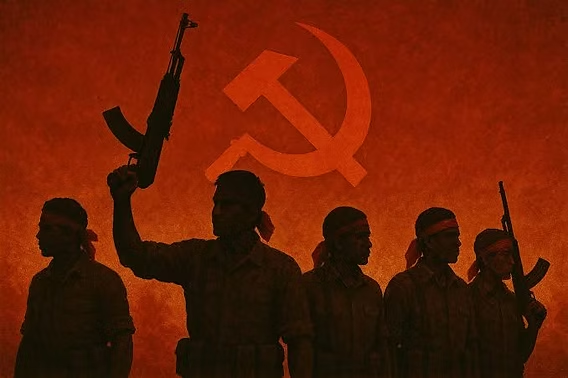
In conversations around Left-Wing Extremism, infrastructure is often reduced to a supporting role, something that enables security operations. That framing is correct, but incomplete. In India’s Maoist-affected regions, roads, telecom networks and financial access are not just development tools. They are instruments of state formation.
They change the geography of isolation and strategic advantage of remoteness, thereby making administration cheaper and more regular. Infrastructure expands legal commerce. And most importantly, they alter how citizens see their relationship with the state. In such regions, connectivity is not a by-product of peace. It is one of the conditions that makes peace durable.
There is a reason Maoists consistently targeted these projects. For the CPI (Maoist), roads and telecom towers were never neutral assets. They threatened a system built on distance, fear and control. An isolated village is easier to dominate – economically, politically and psychologically. Poor communication allows insurgents to monopolise information, disrupt governance and project the state as absent. Attacking infrastructure was therefore not incidental. It was central to preserving insurgent relevance.
Over the past decade, the State’s response has been to treat infrastructure as strategy. The scale is evident. By mid-2025, over 17,500 kilometres of roads had been sanctioned under LWE-specific schemes, with nearly 15,000 kilometres completed. Thousands of mobile towers have been installed, expanding connectivity into previously unreachable areas. Banking infrastructure has also grown, with thousands of post offices offering financial services, alongside new bank branches and ATMs.
These are not just large numbers. They represent layered interventions with multiple effects.
A single road in a former Maoist zone transforms daily life. It not only enables faster movement for security forces, but it also allows teachers, doctors and administrators to reach villages consistently. It reduces transport costs, improves market access and connects communities to district centres. For young people, it opens up mobility leading to education, training and opportunity no longer feel geographically out of reach. Just as importantly, it visibly challenges the insurgent claim that the state cannot or will not reach these regions.
Telecom connectivity has an equally transformative effect. It expands access to banking, welfare delivery, telemedicine, education and emergency services. It breaks the information monopoly that armed groups often rely on. A connected citizen is harder to isolate and easier to empower. In security terms, connectivity enhances both state visibility and citizen agency.
Financial inclusion reinforces this shift. Where formal banking reaches, informal and coercive systems lose ground. Welfare delivery becomes more reliable, leakages are reduced and economic transactions begin to formalise. This is not just economic change, it is a reconfiguration of power at the local level.
Critics sometimes argue that infrastructure in conflict zones is simply another form of militarisation. There is some truth to the claim that roads enhance state reach, including coercive capacity. But that is only part of the picture. The more important question is whether these benefits are limited to force alone. In India’s LWE regions, the answer is increasingly no. Roads, towers and banking networks are enabling governance, services and markets to function where they once struggled to exist.
The results are visible in the shrinking footprint of Left-Wing Extremism. The number of affected districts has dropped sharply over the years, and incidents of violence have declined. Connectivity alone did not produce this outcome, but it has removed one of insurgency’s oldest advantages: enforced remoteness.
There is also a deeper political shift underway. “Mainstreaming” is often criticised as a term, and rightly so when it implies cultural erasure. But in this context, it means something far more practical – the extension of constitutional and economic access to regions long excluded from them. A tribal district does not lose its identity when a road reaches it. It simply loses the burden of isolation.
The debate, however, must avoid two extremes. The first is official triumphalism – the assumption that infrastructure automatically generates legitimacy. It does not. Poor governance, corruption or insensitive policies can travel as easily as roads themselves. The second is insurgent romanticism, which treats isolation as authenticity and connectivity as betrayal. That view ignores the lived reality of poorer services, limited opportunity and restricted mobility that isolation often brings.
India’s anti-Maoist strategy has worked best where it recognises a simple truth: roads are not just civil works. They are political corridors. They carry security forces, but they also carry teachers, traders, health workers and the aspirations of citizens who no longer want to live at the margins.
The contest in former Maoist regions is no longer only about territory. It is about circulation – of people, services, information and opportunity. When roads, networks and institutions begin to move more freely than fear, insurgency loses not just ground, but the very geography that once sustained it.