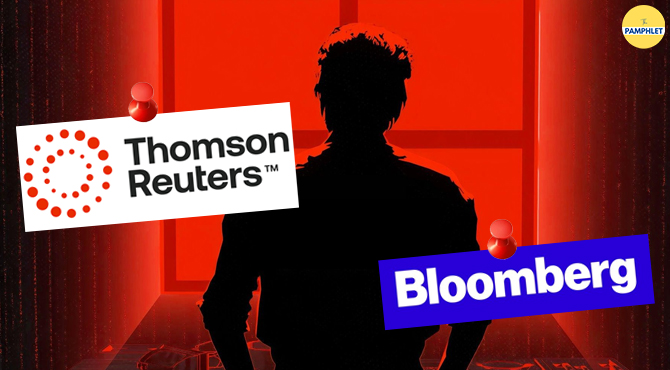
Is the Indian industry facing a deliberate campaign from the international media? It seemingly appears so, as Reuters and Bloomberg have been on a similar trajectory in recent months. Just in 2026 itself, these two have collectively spread 3 fake news stories against the Indian industry! The fact-checks happened—but no one paid attention to the pattern! Yes, friends, PATTERN.
Today, we will tell you about this pattern that Reuters and Bloomberg have been following for a long time.
On 12th January 2026, Bloomberg published a report “Reliance Halts Cell-Making Plans After Failed Bid for China Tech.”
The report stated Mukesh Ambani’s company Reliance will no longer make lithium-ion battery cells because a Chinese company is not transferring technology. But Reliance immediately issued a statement clarifying that the battery storage manufacturing plan has not been paused.
FYI, in present age, lithium-ion battery cells are equivalent to petrol and diesel! The world today—EV, mobile, drones, solar storage, data centers, defence—everything is dependent on lithium-ion cells.
So think! How big is this news from Bloomberg on the production of this critical technology—what impact will it have on Reliance’s investors?
But perhaps this time, before more damage could happen, Reliance issued a press statement denying the report. It seems they learned from their experience.
On 2nd January, Bloomberg had published another report which had claimed 3 Russian oil tankers are heading toward Jamnagar Refinery. 3 days later, clarification came from Reliance’s side that this news is “blatantly untrue,” no Russian oil tanker has come there in 3 weeks and there is no plan for any in January either.
But the damage was done. Reliance Industries shares fell 5%, and more than 1 lakh crore market-cap was wiped out!
How can this not be called a hitjob?! Maybe that’s why this time, instead of waiting 3 days, Reliance gave clarification immediately. The year has just begun, and Bloomberg is targeting Reliance surgically.
Now let’s take a look at Reuters, too. They also recently published a report, “India proposes forcing smartphone makers to give source code in security overhaul”. Along with it, they also wrote that phone manufacturers like Samsung and Apple are upset about this.
But this news is also fake. According to PIB, the government has not proposed any such step as of now.
The clear denial by GoI warrants a question: What is the source?
When we take a second look on Reuters’ article, it says “four people familiar with the discussions” about the source. Interestingly, whenever Bloomberg and Reuters publish stories on Indian inc, the sources—which are familiar with the matter—often appear to be anonymous. Being from the media, we can understand this discretion for investigative stories, but this has become their pattern.
For instance, look at this headline from Reuters: the source was ofcourse Bloomberg, and they reported on the trade deal between the European Union and India seeming difficult by the end of this year. The year was anyway about to end, but how cleverly the headline was construed as if the deal wouldn’t happen till the end of 2026!
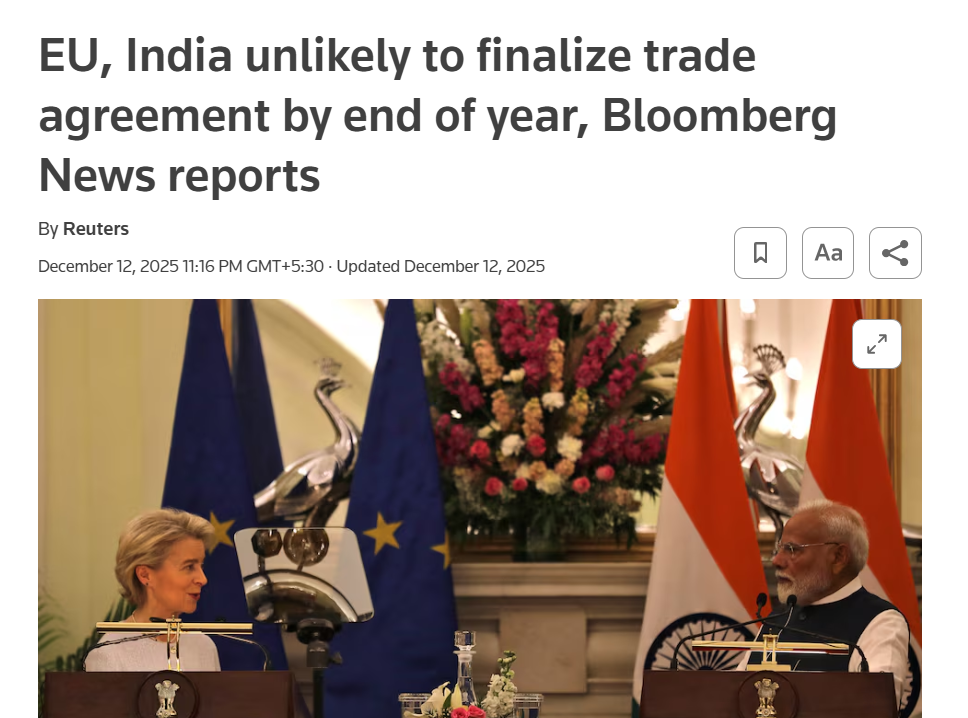
However, in the latest news, Germany’s Chancellor Friedrich Merz appears to confirm that the India-EU trade deal will happen by the end of January.
Now look at this Reuters report from 29 December 2025, “India claims $30 billion from Reliance Industries, BP for underproduction from gas field”. Report presents facts as if the Indian government is demanding compensation from its own corporates,, and that too $30 billion! Ofcourse the sources in the matter are 3 people familiar with the matter.
But this news also turned out to be factually incorrect—and the $30 billion claim is exaggerated.
This is how facts and figures of government dealings are misquoted and exaggerated to build a narrative.
And not just Reliance; even the Adani group has been a victim of fake news from the duo. Last year, Bloomberg published a report, quoting people familiar with the matter, ‘Adani seeks battery tieup with BYD in renewables push’.
BYD is a Chinese company known for EV manufacturing. And one knows Adani on the other hand is vital for Indian strategic interests, so a project with a Chinese company will raise questions and invite criticism.
However, the tieup report was quickly denied by the Adani group, which termed it “baseless”.
In one instance, Reuters ran a story about Adani Defence facing a probe by the GoI on tax evasion. The report was rubbished by the Adani Group, stating that the Reuters selectively cherry-picked portions of a govt report.
Did you notice a pattern?
The target is Indian industry leaders, corporates who are vital for the national interests. This aligns with the opposition’s narrative, and the left-liberal ecosystem amplifies these reports without a second thought.
So next time, when you see such a story, make sure to check the source.