
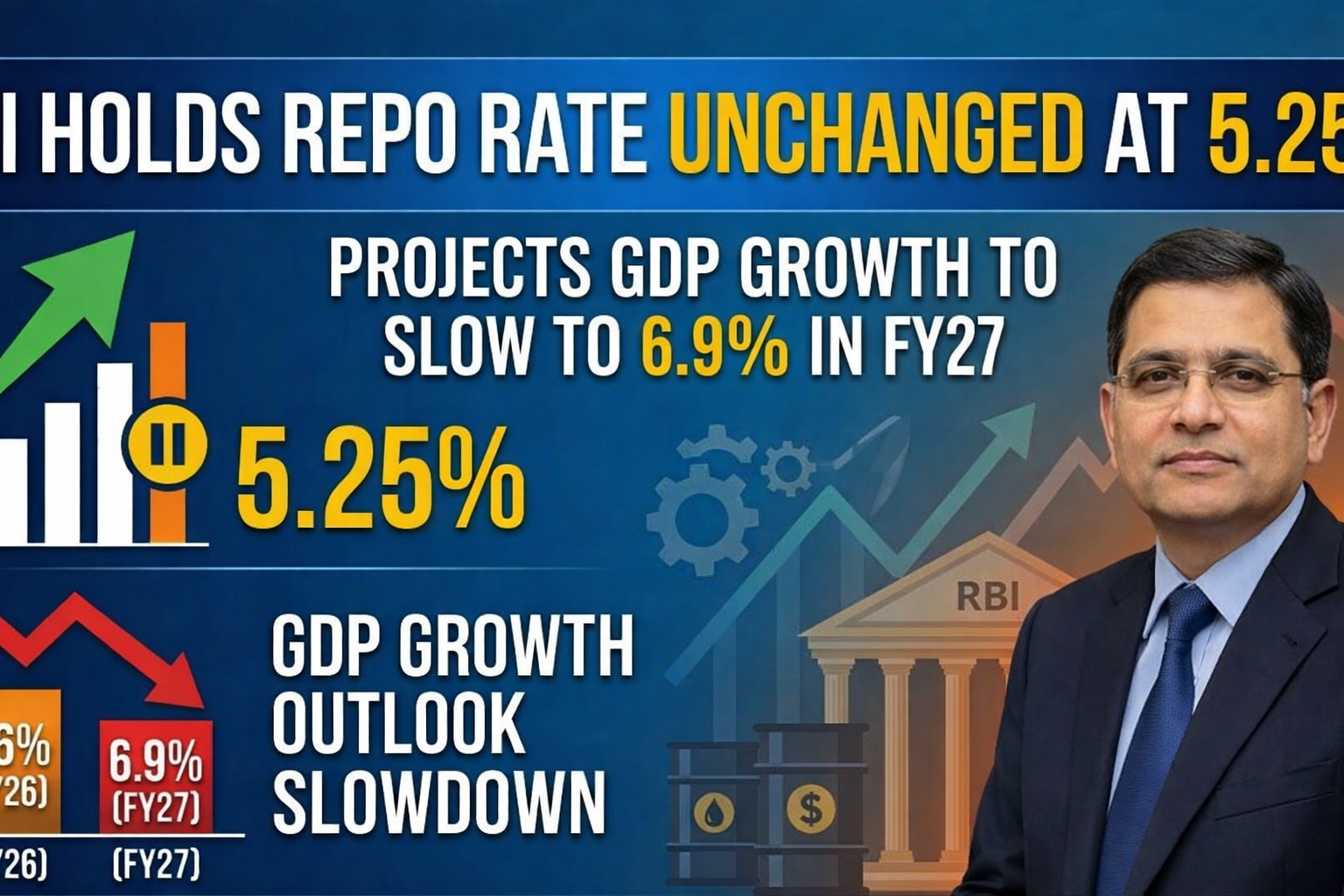
The Reserve Bank of India (RBI), India’s central bank, has made a decision to keep the repo rate – the rate at which it lends funds to commercial banks – unchanged at 5.25%. This decision shows a cautious and balanced approach by the Monetary policy Committee (MPC) as the global uncertainties continue to loom over India’s economic outlook. The West Asia conflict has disrupted energy supplies and caused oil prices to rise sharply, despite a two-week temporary ceasefire between Iran and the US, forcing the RBI to be cautious.
However, a clearer picture with regard to all the economic ramifications can only emerge in the coming weeks when more information is available. The conflict had earlier led to disruptions in the Strait of Hormuz – one of the world’s crucial oil shipping routes – which saw a tightening of global energy supply chains and contributed towards increased input costs in various industries. Though the route has since reopened, there are many questions as to what the state of energy infrastructure is in the region, and whether more price shocks might ensue.
Reflecting these risks, the RBI revised India’s GDP growth forecast for FY27 to 6.9%, compared to 7.6% in FY26, indicating a slowdown in economic expansion on external headwinds. Second, retail inflation is predicted to be 4.6 per cent on average this fiscal year, a far cry from just about 2 per cent last year. Its stand was that though the growth risks are tilted to the downside, the inflation risk is on the upside, especially if the oil and commodity prices continue to stay high.
High crude prices have, therefore, become a grave concern. The RBI now assumes that the Indian crude basket will average $85 per barrel in FY27, higher than the earlier assumption of $70. In March this year, oil prices suddenly jumped more than 60% to $113 per barrel and touched $129 in early April. This sharp rise apart from putting pressure on inflation, it also adds pressure to India’s import bill and puts pressure on the rupee.
Rupee alone has seen stormy weather in its lifetime. After delays in the India-US trade deal, foreign investors began withdrawing from India markets, making the rupee cross the ₹90 per US dollar in December. The currency further depreciated amidst renewed war tensions, closing recently at ₹92.58 to the dollar. However, Governor Malhotra stated that the RBI was committed to a market-determined exchange rate and thus, any intervention it makes will only be intended to control unnecessary volatility.
The immediate takeaway for Indian borrowers is positive. This means that lending interest rates offered by banks may not increase any time soon. This helps Indian home, car, and business loan borrowers to maintain the status quo with their EMIs. Deposit rates, too, are expected to be largely unaffected, thus providing relief to the borrowers and the depositors alike at this uncertain juncture.
Economists believe the is therefore a central bank “pause” prudence for uncertain world. It meant to demonstrate that it could steer the economy in the desired direction without stifling consumption or investment. RBI will strive to maintain a fine balance between its twin objectives of managing inflation and nurturing growth as international prices of fuel, exchange rate movements and geopolitical developments unfold.
In the words of Governor Malhotra, India’s economic fundamentals remain stronger than many other economies, thanks to robust domestic demand and resilient macro indicators. The environment may be unpredictable and it is better to remain prepared rather than take actions in haste, is the central bank’s message though.
Overall, the RBI’s latest policy decision indicates caution rather than aggression – a strategy to keep India’s economy grounded at the centre amid the turbulence in the global economy.

