
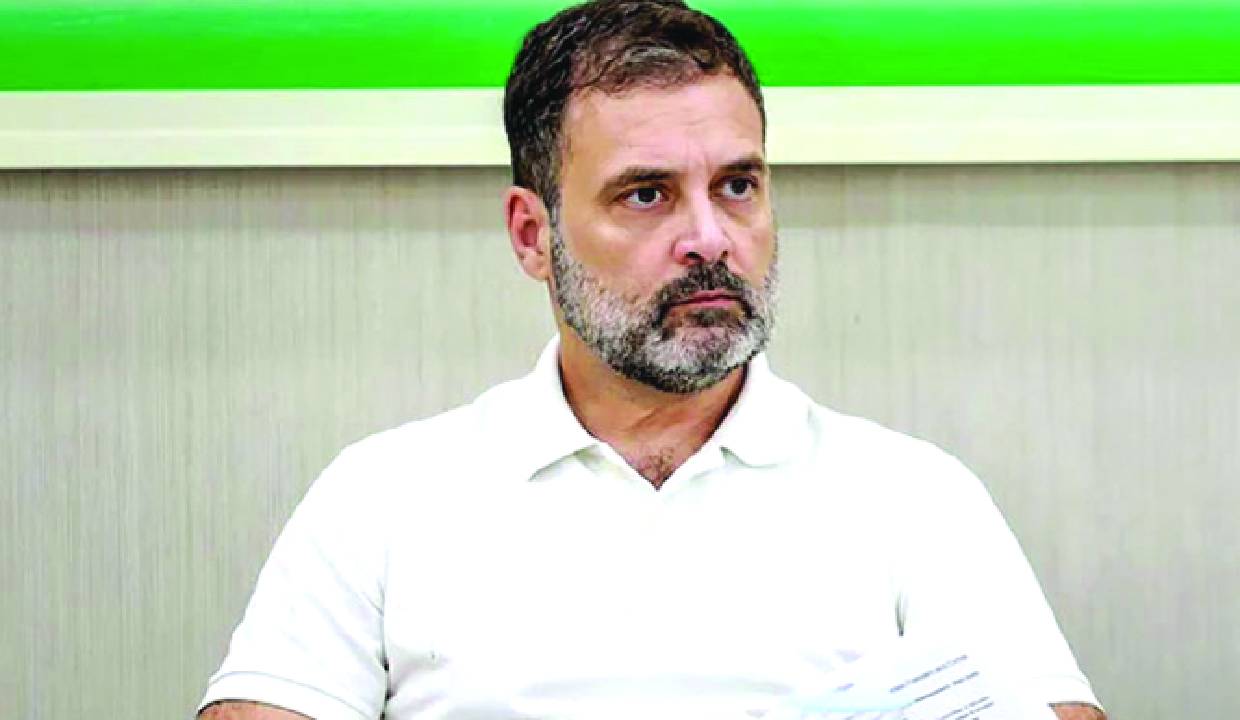
Earlier this week, Congress scion and the leader of the opposition Rahul Gandhi visited Nicobar island in the Andaman Sea. During his visit, Rahul Gandhi expressed his opposition to the Great Nicobar project citing environmental concerns.
Rahul Gandhi said, “The government calls what it is doing here a “Project.” What I have seen is not a project. It is millions of trees marked for the axe. It is 160 square kilometres of rainforest condemned to die. It is communities that have been ignored while their homes have been snatched away. This is not development. This is destruction dressed in development’s language.”
I travelled through Great Nicobar today.
— Rahul Gandhi (@RahulGandhi) April 29, 2026
These are the most extraordinary forests I have ever seen in my life. Trees older than memory. Forests that took generations to grow.
The people on this island are equally beautiful – both the adivasi communities and the settlers – but… pic.twitter.com/vYdBWdYfIJ
He further wrote, “So I will say it plainly, and I will keep saying it: what is being done in Great Nicobar is one of the biggest scams and gravest crimes against this country’s natural and tribal heritage in our lifetime. It must be stopped. And it can be stopped – if Indians choose to see what I have seen.”
This rhetoric against a major development project, and a strategically critical project from the LoP is highly problematic and harmful for Indian interests. First let us see why this project is crucial for India.
Strategic significance for India
Control over critical sea lanes
The island sits near the Malacca Strait, one of the most vital maritime chokepoints in the world. A significant portion of global trade—and a majority of China’s energy imports—passes through this route.
By developing Great Nicobar, India gains a vantage point over these sea lanes. This enhances maritime domain awareness and gives India a strategic edge in monitoring and potentially influencing traffic through the Indo-Pacific.
Countering China’s expanding influence
China’s growing footprint in the Indian Ocean Region—through ports in Gwadar (Pakistan), Hambantota (Sri Lanka), and Djibouti—has raised concerns in New Delhi.
The Great Nicobar project acts as a counterweight. It strengthens India’s ability to project power eastward and secure its interests in Southeast Asia. Analysts have described the island as an “unsinkable aircraft carrier” due to its strategic military potential.
Strengthening India’s tri-service military presence
India already operates a tri-service command in the Andaman and Nicobar Islands. Expanding infrastructure in Great Nicobar enhances logistics, surveillance, and rapid deployment capabilities.
This is particularly significant in the context of increasing naval competition in the Indo-Pacific.
Economic independence in maritime trade
Currently, a large share of India’s transshipment cargo is handled by foreign ports. The new terminal in Great Nicobar aims to reverse this trend, keeping revenue within India while boosting its role in global trade networks.
This aligns with India’s broader ambition to become a global manufacturing and export hub.
Gateway to Southeast Asia
Geographically, Great Nicobar is closer to Southeast Asia than mainland India. Its development enhances connectivity with ASEAN economies, strengthening trade, diplomacy, and regional integration.
Rahul Gandhi’s harmful rhetoric against the Great Nicobar project
As we see that the project is crucial for India in multiple ways, but Rahul Gandhi comes out and say they will not it happen. The reason cited by Rahul Gandhi is that he is concerned about the environment. Is he really concerned about the environment or is it an excuse to try and instigate locals against the government?
If he was genuinely concerned about the local environment, he could have had an honest conversation with the government that how the local ecosystem and habitat will be protected during this project. However, he was not interested in all that, he just went to Nicobar to utter his rhetoric against it.
This development project is very important for India’s maritime trade, maintain control over these sea routes, and to counter growing Chinese influence in the region. So why will a responsible LoP oppose it?
That brings us to the China question. Is Rahul Gandhi not happy that Chinese influence will be curtailed in the region? The only ones unhappy with India’s development in the region should be the Chinese after all. Nicobar islands lie 150 KMs away from the exit of Malacca Strait. Most of the Chinese trade flows through this narrow strait. Greater Indian presence in the area will definitely make the Chinese nervous.
These developments in Nicobar islands and Rahul Gandhi’s statements have also brought Congress-Chinese Communist Party (CCP) MoU back into discussion. The MoU was signed in 2008, and provided the two parties the opportunity to consult each other on important bilateral, regional and international developments. Now people are getting curious about the MoU and what bilateral, regional and international developments were included in it.

