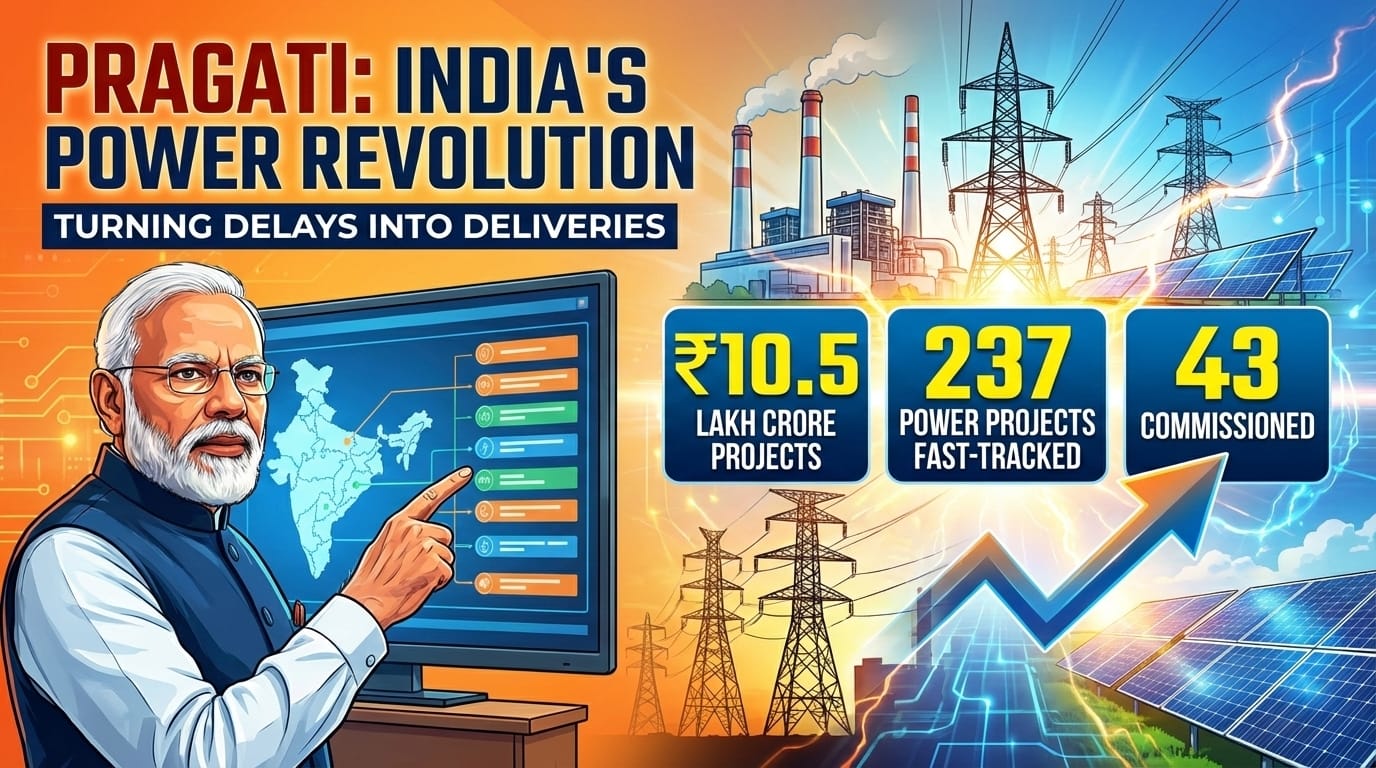
When Prime Minister Narendra Modi launched PRAGATI on March 25, 2015, few could have predicted the transformative impact this governance platform would have on India’s infrastructure landscape. Eight years and fifty review meetings later, the initiative has emerged as perhaps the most powerful mechanism for converting bureaucratic logjams into commissioned megawatts, proving that direct executive oversight combined with multi-level coordination can indeed move mountains—or in this case, gigawatts of stalled power capacity. The numbers themselves tell a compelling story of administrative resolve meeting ground-level challenges, with 237 power sector projects collectively valued at Rs 10.53 lakh crore now reviewed across various levels of the PRAGATI ecosystem, transforming what were once monuments to red tape into functioning assets serving millions of Indians.
Records show the Prime Minister has personally reviewed 53 big power projects worth ₹4.12 lakh crore, including power lines, power plants, and coal mines. Because of this, 43 projects that were behind schedule, worth ₹3 lakh crore, are now up and running. What shows this change? You can notice it in the buildings and structures all over the country, like the Gadarwara and Lara Super Thermal Plants, the Parbati-II and Kameng hydroelectric projects, the Tehri Pumped Storage project, and the Khetri–Narela transmission route. PRAGATI’s oversight turned these plans into real power sources. The Power Ministry’s latest info shows that Power Grid Corporation is first with 22 projects checked, and 20 are now working. NTPC is next with 16, and 14 are now powering homes and businesses. The scale of achievement becomes clearer when examining what PRAGATI has accomplished at the highest level of review.
When people wondered if problems in the system could ever allow coordination, PRAGATI’s results gave a clear answer. More than 70% of the problems fixed had to do with land, forest permissions, or right-of-way disagreements—things that used to make projects take years longer. By connecting the central and state governments, PRAGATI showed that hands-on governance is not just a saying but a way to change things. For a country that needs more and more power, every project that’s done faster means not only progress reports but also lit-up villages, supported businesses, and stronger communities. The story of India’s power sector, once slow because of delays, is now better because of PRAGATI’s careful watch—showing that when governance is active, development follows quickly.
The Ministry of Power’s documentation reveals that forty-three of these delayed projects, representing nearly Rs 3 lakh crore in investment, have already been commissioned following PRAGATI intervention, while the remaining projects have advanced to final stages of completion. This represents not just administrative efficiency but economic value unlocked—capital that was trapped in partially completed structures now generating returns and serving citizens.
As PRAGATI moves beyond its fiftieth review meeting, the challenge shifts from proving the concept to institutionalizing the approach. Can the governance model that has unlocked Rs 10.53 lakh crore in power projects be sustained and scaled? Can the spirit of rapid problem-resolution and transparent accountability become embedded in normal administrative functioning rather than requiring direct Prime Ministerial oversight for every project? The answer may determine whether PRAGATI represents a temporary intervention that cleared a backlog or a permanent shift in how India executes infrastructure. For the millions of Indians who now receive reliable electricity from projects that were once indefinitely stalled, and for the economy that depends on energy infrastructure for growth, PRAGATI has already proven its worth. The platform has bridged what has historically been Indian governance’s most persistent gap—the distance between policy formulation and field-level execution—showing that with the right mechanisms, even the most stubborn bottlenecks can be cleared and national development can proceed at the speed of ambition rather than the pace of bureaucracy.