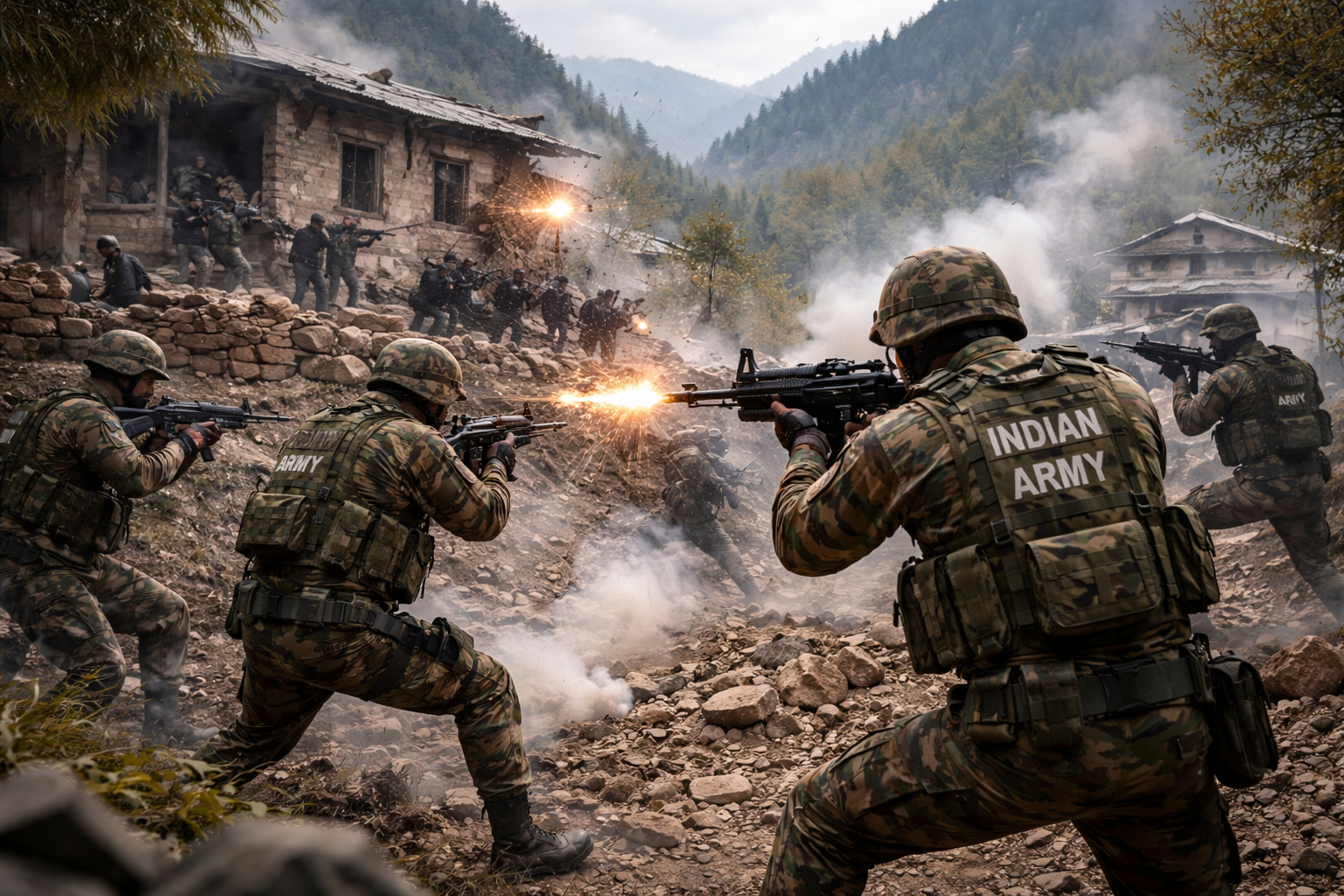
On the intervening night of March 14–15, 2026, Security Forces foiled an infiltration bid along the Line of Control (LoC) in the Buchhar area of the Uri Sector in Baramulla District, killing one Pakistani terrorist.
On March 10, 2026, SFs had thwarted another infiltration attempt in the Jhangar area of the Nowshera sector in Rajouri District, killing one Pakistani terrorist and injuring another. These incidents underline the continued attempts by Pakistan-backed terrorist formations to infiltrate across the LoC, even as counter-infiltration measures remain robust and effective.
Prior to these incidents, on February 22, 2026, SFs eliminated three Jaish-e-Mohammed (JeM) terrorists, including a top ‘commander’, Saifullah, during an encounter in the Chatroo area of Kishtwar District.
On February 4, 2026, two Pakistani terrorists – Abu Maviya aka Mavi aka Badshah and Sufiyan aka Niku aka Jabbar aka Chaudhary – associated with JeM, were killed in the Joffer area of Udhampur District. In another incident on the same day, one Pakistan-based JeM terrorist was neutralised at Dicchar in Kishtwar District.
On January 25, a Pakistani intruder was shot dead along the International Border (IB) in Samba District.
On January 23, Security Forces neutralised a Pakistan-based JeM ‘commander’, Usmaan aka Abu Maviya, at Parhetar village in Billawar, Kathua District.
According to partial data compiled by the South Asia Terrorism Portal (SATP), at least 10 terrorist/associate fatalities have been recorded in Jammu & Kashmir (J&K), in 2026 thus far (data till March 28, 2026). These fatalities have occurred largely in the context of counter-infiltration operations and targeted engagements against Pakistan-based terrorist operatives, indicating a continued emphasis on neutralising foreign terrorists attempting to sustain militancy in the Union Territory (UT).
One SF fatality has been recorded during this period. In the night of January 18–19, 2026, eight SF personnel were injured when terrorists lobbed grenades and opened fire during a search operation in the upper reaches of Sonnar village in the Chatroo area of Kishtwar District. One of the injured personnel succumbed to his injuries on January 19.
Consequently, the SF-to-terrorist kill ratio for the current year stands at 1:10 (SFs: 1; terrorists: 10), overwhelmingly in favour of the SFs. This marks a sharp improvement over the corresponding period in 2025, when the ratio stood at 1.4:1 (SFs: 7; terrorists: 5), in favour of the terrorists. However, the ratio shifted in favour of the SFs in the latter half of 2025, with the overall ratio for the full year recorded at 1:2.76 (SFs: 17; terrorists: 47). The current trend in 2026 suggests a consolidation of operational gains by SFs, with improved intelligence, surveillance, and tactical responses contributing to higher neutralisation rates and minimal own-force casualties.
Significantly, no civilian fatalities have been recorded in J&K thus far in 2026. The last civilian fatality in the UT was reported on April 22, 2025, when Pakistani terrorists opened fire on tourists in the Baisaran Valley in Pahalgam, Anantnag District. The attack resulted in the deaths of 25 Indian tourists and one Nepalese national, marking one of the most heinous civilian-targeted attacks in recent years. Apart from this incident, 2025 recorded only one other civilian fatality: on February 3, when a retired Army soldier, Manzoor Ahmad Wagay, was killed, and his wife and niece were injured, after militants opened fire in the Behibagh area of Kulgam District. There were 31 civilian fatalities in 2024, across 13 separate incidents.
Indeed, for the first time since 1989 – when there were 92 total fatalities – the overall fatalities in the State/UT were recorded in double digits in 2025, again at 92. Between these two points, fatalities remained in the thousands for 17 years (1990 to 2006) and in the hundreds for 18 years. The peak of overall fatalities was recorded in 2001, at 4,011. Civilian fatalities reached their highest level in 1996, with 1,333 deaths, while SFs fatalities peaked in 2000, with 638 fatalities. These long-term trends underscore a dramatic decline in violence in J&K over the decades, culminating in historically low fatality levels in recent years.
The sustained dominance of SFs on the ground has been a critical factor underpinning this relative peace. Continuous counter-terrorism operations, combined with effective intelligence gathering and coordination among various security agencies, have significantly degraded the operational capabilities of terrorist groups. Nevertheless, Pakistan’s Inter-Services Intelligence (ISI) continues to attempt to destabilise the situation in J&K by supporting terrorist proxies, particularly through infiltration attempts and logistical support.
Peace along the borders has also played a vital role in stabilising the security environment. Only one ceasefire violation (CFV) has been recorded in 2026 thus far. On February 20, Pakistan violated the ceasefire along the LoC in Kupwara District, with firing reported around noon at Toot Mar Gali in the Nowgam Sector from Pakistan-occupied Jammu and Kashmir (PoJK) posts, targeting Indian positions. The exchange of fire ceased after some time, and no casualties were reported. Comparative data indicates that only one such incident was recorded in 2024, three in 2023, and one in 2022. This is in stark contrast to 2021, when as many as 609 CFVs were recorded. The dramatic reduction in CFVs follows the ceasefire agreement reached between India and Pakistan in February 2021, which has largely held, notwithstanding occasional violations. In 2025, however, multiple CFVs were reported along the LoC and IB before, during, and after Operation Sindoor (May 7–10, 2025), including the last such incident recorded on the intervening night of July 20–21, when an exchange of fire occurred between the Indian and Pakistani Armies in the Kargil sector. Two CFVs were reported in February 2025 as well.
The decline in ceasefire violations has been directly reflected in a corresponding reduction in net infiltration, according to available official data. Net infiltration decreased significantly from 138 in 2019 to 34 in 2021, further dropping to 14 in 2022, and reaching zero up to June 30, 2023. However, no official data is available for the period thereafter. This trend has had a significant impact on the number of foreign terrorists operating in the UT, which has declined substantially over the years.
Current estimates indicate that approximately 90 terrorists remain active in J&K, the majority of whom are assessed to be Pakistan-based. Of these, approximately 40 to 50 are operating in the Jammu region, while around 40 are active in the Kashmir Valley. The number of local terrorists has diminished sharply.
Despite these gains, challenges persist. The April 22, 2025, Pahalgam attack serves as a stark reminder of the residual threat posed by terrorist groups, which retain the capacity to execute high-impact attacks against civilian targets. Moreover, evolving tactics employed by Pakistan-based terrorist formations, continue to pose new challenges for security agencies.
Another area of concern is the emergence of linkages between terrorist networks in J&K and incidents beyond the UT. The reported connections to the November 10, 2025, Delhi blast– when a slow-moving car exploded near the Red Fort, killing at least 10 civilians and injuring 32 – highlight the potential for spillover of terrorist activities into other parts of the country.
Moreover, the increasing use of drones for the transportation of arms, ammunition, narcotics, and funds across the LoC and the International Border is another concern. Several instances of drone sightings have been reported in the Jammu Division. Recent disclosures by arrested terrorist associates indicate that drones are being used extensively by terrorist groups to deliver consignments deep inside the Valley, as well as in the Samba–Kathua and Rajouri–Poonch Sectors. This shift towards technology-enabled logistics represents a significant adaptation by terrorist groups aimed at circumventing traditional counter-infiltration measures.
Meanwhile, the Union Government has not announced any clear timeline for fulfilling its core political commitment to restore statehood to J&K. While the Supreme Court’s December 2023 judgment upholding the abrogation of Article 370 recorded the Centre’s assurance that statehood would be reinstated at an “appropriate time,” no concrete steps or schedule have been made public. Instead, the focus has remained on strengthening the existing UT framework through continued institutional adjustments. Notably, the Jammu and Kashmir Reorganisation (Amendment) Bill, 2025, introduces provisions allowing for the removal of a Chief Minister or Minister upon detention for serious offences, further reinforcing Central administrative control and oversight.
Despite differences in political ideology, there is a broad consensus among mainstream political actors in the region that the restoration of statehood is a necessary precondition for meaningful political engagement and democratic normalization. At the same time, the absence of any legally permissible separatist platform outside the constitutional framework has narrowed the scope of political articulation. This combination – delayed restoration of statehood and restricted political space – risks prolonging uncertainty and may impede the emergence of a durable and inclusive political resolution in the region.
Sustained counter-terrorism efforts, strengthened border management, and proactive intelligence-led operations will remain critical to preserving and further consolidating the improving security environment in the UT. At the same time, the pursuit of a credible and inclusive political solution at the earliest is imperative to ensure long-term stability and durable peace.
Author: Ajit Kumar Singh, Senior Fellow, Institute for Conflict Management