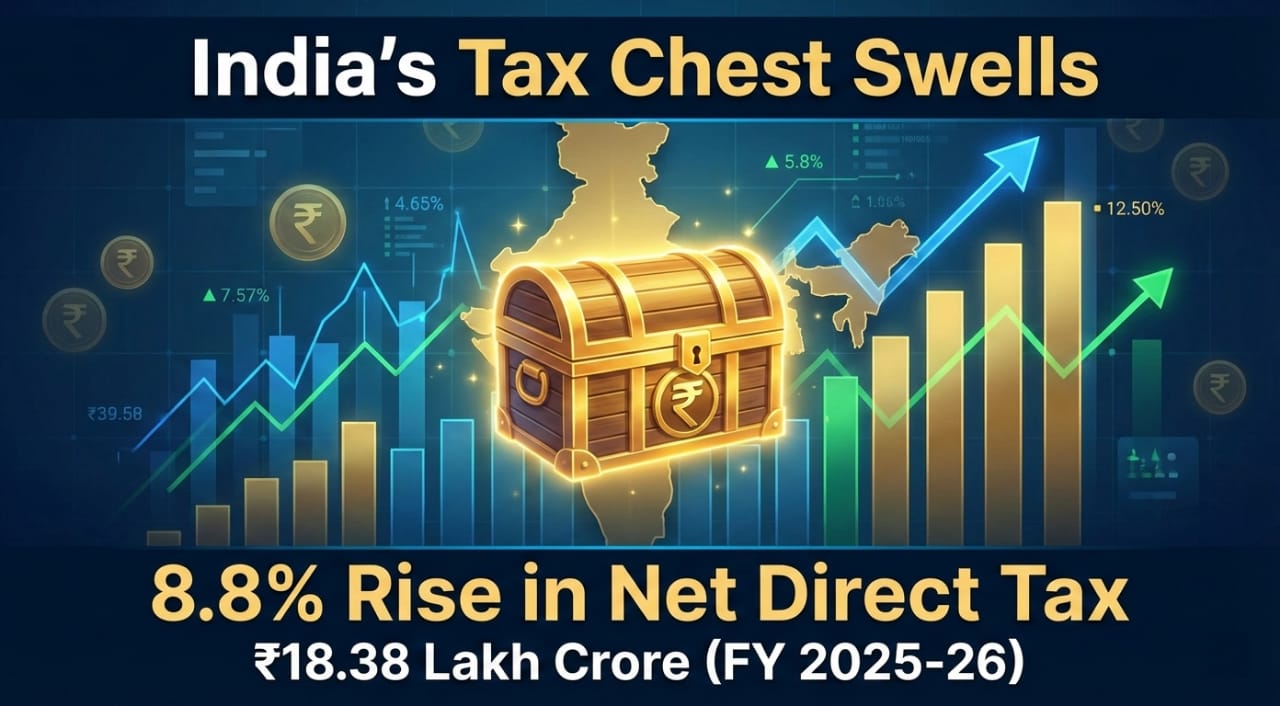
Imagine the government’s tax vault as a bustling treasure chest in the heart of India’s economy, steadily filling up drop by drop from salaries, business profits, and stock market trades. As the financial year 2025-26 races toward its March finish line, fresh official data paints a picture of quiet progress: Net direct tax collections have risen 8.82% from last year, reaching a hefty ₹18.38 lakh crore by January 11.
That’s no small feat in a nation of 1.4 billion dreamers and doers, where every rupee counts toward building roads, schools, and a stronger future. Yet, this growth feels like a steady jog rather than a sprint, lagging behind the 12.7% jump budgeted at ₹25.20 lakh crore for the full year. With just under three months left, the air is thick with cautious optimism—Can the chest overflow just enough to hit the mark?
Let’s break it down simply, like slicing a familiar roti into easy portions. Direct taxes are the money people and companies pay straight from their earnings—think income tax on your salary or profits from a shop or factory. From April 1, 2025, to January 11 this year, corporate taxes—those from big businesses and factories—poured in ₹8.63 lakh crore, a solid chunk fueling the economy’s engine. Add to that ₹9.30 lakh crore from non-corporate folks: everyday individuals like you and me, plus Hindu undivided families running household ventures. It’s the people’s tax, reflecting wages from offices in Mumbai, farms in Punjab, and startups in Bengaluru. Then there’s the thrill of the stock market: securities transaction tax, or STT, hit ₹44,867 crore so far. That’s the small fee traders pay every time they buy or sell shares on the bustling exchanges of Dalal Street. The budget eyed ₹78,000 crore from STT alone, so there’s still room to grow as investors chase bull runs.
But here’s the twist in this treasure tale—a slower flow of refunds has supercharged the net numbers. Net refunds, the money returned to honest taxpayers after checks, stand at ₹3.11 lakh crore, down 17% from ₹3.75 lakh crore last year. Picture it as the government holding onto some cash a bit longer, perhaps double-checking claims amid a push for fairness. On a gross basis, before refunds, collections grew a more modest 4.14% to ₹21.50 lakh crore. Experts like Rohinton Sidhwa, a partner at Deloitte India, call this 9% net growth encouraging, hinting the government might just cross the finish line. “It’s on track,” he notes, but flags the refund slowdown as a puzzle. Why the dip? Details are fuzzy—maybe tighter audits or digital tweaks delaying payouts to corporates and individuals alike. Still, it buys time for collections to catch up.
This story isn’t just numbers on a page; it’s a snapshot of India’s economic heartbeat. Direct taxes make up over half of the government’s revenue pie, funding everything from soldier salaries to village toilets under Swachh Bharat. A slower mop-up could squeeze spending on welfare schemes or infrastructure, but the 8.8% rise shows resilience amid global headwinds like trade tensions and inflation jitters. Compare it to last year’s sprint: collections then raced ahead, but this year’s steadier pace aligns with a maturing economy where growth is quality over quantity. Budget planners had penciled in 12.7% based on booming GDP forecasts around 7%, yet real-world refunds and corporate caution have tempered the tempo. With February and March bringing bonuses, year-end profits, and advance taxes, the final push could surprise.
Peering ahead, optimists see the glass half full. Lower refunds mean more cash in the government’s pocket now, easing borrowing needs and keeping interest rates friendly for home loans and business expansions. If STT keeps climbing with market highs—Sensex touching record peaks—and salaried classes file diligently, that ₹25.20 lakh crore target feels within reach. Pessimists, though, worry about a refunds backlog sparking grumbles or court cases. Either way, this tax tale underscores India’s fiscal discipline: collecting steadily to power reforms like digital payments and ‘Make in India’ factories.
In the grand narrative of a rising India, these ₹18.38 lakh crore aren’t mere digits—they’re the seeds of tomorrow’s skyscrapers and superhighways. As the fiscal curtain nears its close, watch this space: will the treasure chest brim over, or settle for a respectable fill? The coming months will tell a story of prudence, growth, and the everyday magic of a billion taxpayers pitching in.