For years, critics have hammered the Modi government with one persistent complaint: factories fleeing China are landing in Vietnam, Thailand, and Bangladesh, not India. The narrative was simple and stinging. When global manufacturers decided to de-risk their supply chains and reduce dependence on China, India supposedly missed the bus. Vietnam emerged as the darling destination, offering tax breaks, simpler compliance, and a business-friendly environment that seemed to elude India despite all the Make in India slogans. But now, the Finance Ministry has quietly introduced a proposal in the recent Budget that could fundamentally rewrite this script, and it revolves around something most people have never heard of: component warehousing safe harbour.
Let me break this down in simple language. Imagine you are Samsung or Apple or any massive electronics manufacturer. You don’t make every tiny component yourself. You have hundreds of suppliers across Asia making screws, circuit boards, screens, batteries, and plastic casings. Before these parts become a finished phone or television, they need to be stored somewhere close to your assembly plant.
Now, this storage and staging operation is called component warehousing. It’s not glamorous, it doesn’t involve high-tech robots, but it’s absolutely critical. Without it, your multi-billion-dollar factory grinds to a halt. Now, here’s the thing: this warehousing activity technically earns income because you’re moving goods, managing inventory, and facilitating the supply chain. That income gets taxed, and if the tax is too high or too unpredictable, companies will simply set up these warehouses in countries with better tax deals.
Now, let’s talk about the concept of safe harbour. In tax terminology, safe harbour means the government tells you upfront: if you follow these simple rules and declare this minimum profit margin, we won’t question you, audit you endlessly, or drag you into transfer pricing disputes. Transfer pricing is the nightmare that keeps multinational tax managers awake at night. It’s essentially how companies price transactions between their own subsidiaries in different countries.
Tax authorities worldwide constantly suspect that multinationals manipulate these prices to shift profits to low-tax countries. The result? Endless audits, litigation, uncertainty, and compliance costs that can run into millions of dollars annually. Safe harbour eliminates this headache by offering a standardized, pre-approved arrangement.
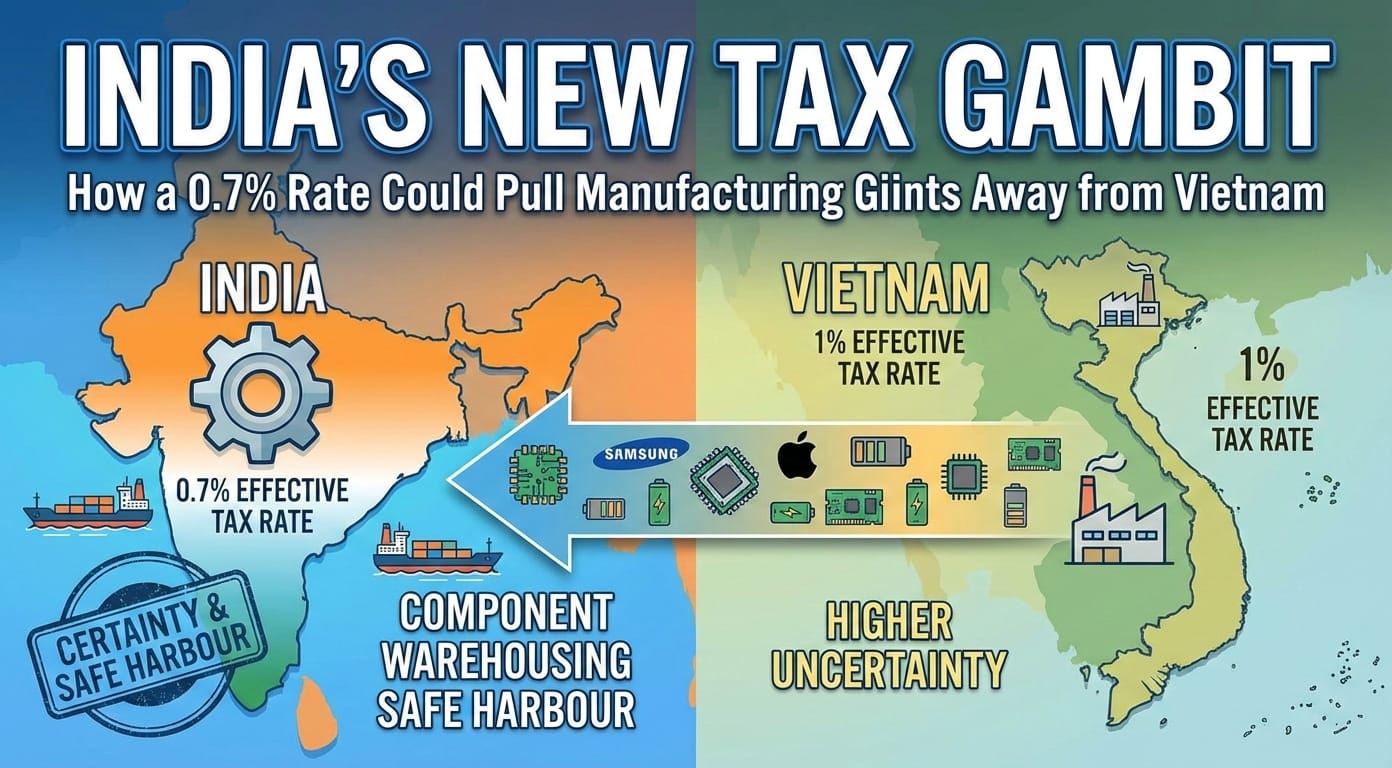
India’s new proposal sets the safe harbour margin for component warehousing at just 2 percent. Now before your eyes glaze over, here’s what that actually means in the real world. If a warehouse operation declares a profit margin of 2 percent on its activities, the government accepts it without question. Apply India’s corporate tax rate of around 35 percent to that 2 percent margin, and you get an effective tax incidence of roughly 0.7 percent on the total warehouse turnover. Compare that to Vietnam, where the effective tax rate for similar operations hovers around 1 percent. India has just undercut its biggest competitor by 30 percent.
But here’s where it gets really interesting. Vietnam’s lower tax rates often come with strings attached. You might get incentives for the first five years, but then what? You might need to maintain certain employment levels, meet local content requirements, or navigate periodic renegotiations with provincial authorities.
Every few years, the rules might change based on political winds or trade agreements. India’s safe harbour, once codified into law, provides something money often cannot buy: certainty. For a warehouse operation that handles components worth billions of dollars but operates on razor-thin margins of 2-3 percent, knowing your exact tax liability for the foreseeable future is worth more than a slightly lower headline rate that could evaporate or trigger disputes.
Finance Ministry sources emphasize this certainty angle because they understand what really drives corporate decision-making. When Samsung decides where to locate a component hub serving its Indian and Middle Eastern factories, the CFO isn’t just comparing tax rates on a spreadsheet.
They’re calculating total cost of ownership: tax plus legal fees plus audit costs plus management time wasted on disputes plus the risk of sudden policy changes. A predictable 0.7 percent effective rate with zero litigation risk can easily beat an uncertain 0.8 percent rate that might trigger three years of transfer pricing investigations.
This proposal directly addresses the “China Plus One” strategy that every major manufacturer has adopted since the pandemic and recent geopolitical tensions. Companies aren’t abandoning China entirely, but they’re desperate to have alternative production bases. Until now, Vietnam captured the lion’s share of this relocation because it offered the path of least resistance. India’s infrastructure challenges, complex regulations, and tax uncertainties made it the harder choice despite its enormous market and talent pool.
This component warehousing safe harbour removes one of the biggest friction points. It tells global manufacturers: bring your parts here, store them here, feed your Indian factories from here, and we’ll make the tax treatment simpler and cheaper than anywhere else in Asia.
The broader strategic implication is profound. Once you convince a multinational to locate its component warehouse in India, the assembly factory often follows because proximity matters enormously in modern just-in-time manufacturing. Once the factory comes, the supplier ecosystem develops, jobs multiply, and India moves up the value chain. This isn’t just about saving 0.3 percent on warehousing taxes. It’s about fundamentally repositioning India in global supply chains at exactly the moment when those chains are being redrawn.
The criticism that the Modi government missed the manufacturing bus may finally be getting answered, not with rhetoric, but with cold, hard tax math that makes India the smarter bet.