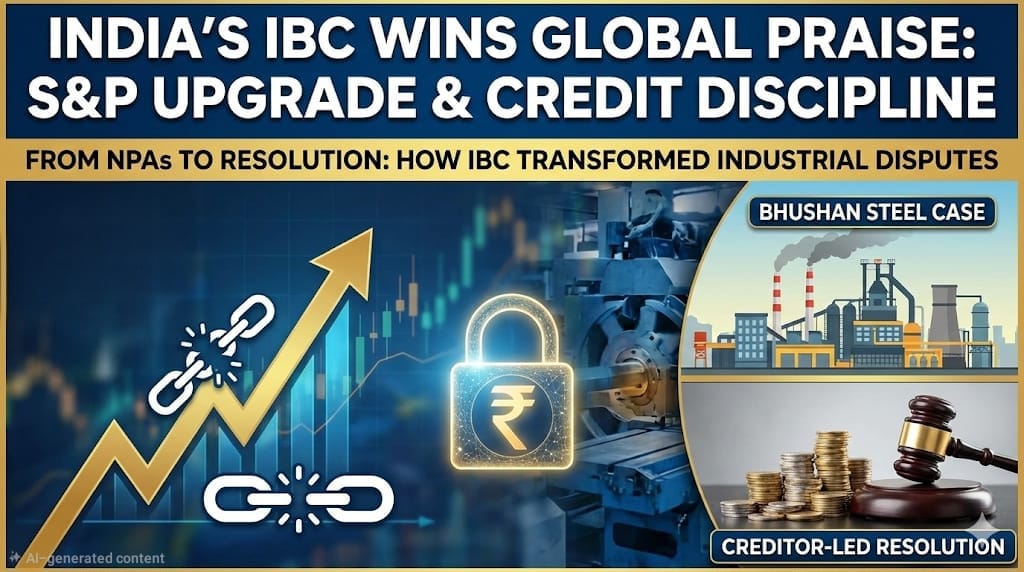
India’s insolvency framework has just earned a rare global “pat on the back”, with S&P Global Ratings upgrading India’s jurisdiction ranking for insolvency from Group C to Group B on the back of the Insolvency and Bankruptcy Code (IBC). Yet, behind this praise sits a more complex story of revolutionary law, uneven implementation, and a constant tug of war between policy ambition and judicial interpretation.
Why has S&P suddenly become more generous to India’s insolvency regime, and what exactly has changed? According to S&P, the key reason is a visible shift in “creditor-friendliness”: recoveries under IBC are now over 30 per cent on average versus roughly 15–20 per cent under the earlier patchwork of debt recovery and restructuring laws, and the average time for resolving bad loans has fallen from six–eight years to about two years as per official data.
S&P’s jurisdiction ranking assessment essentially measures how much real protection a country’s insolvency laws and practices offer to creditors and how predictable court outcomes are, and India’s move into Group B places it alongside more mature emerging markets, even though it still trails the best-in-class Group A jurisdictions.
Indian media such as The Economic Times, The Tribune and BusinessLine have highlighted these S&P findings, underscoring that creditor-led resolutions and stronger discipline for promoters have been central to this upgrade.
What makes the IBC itself so “revolutionary” in the Indian context, and why do policymakers and global rating agencies continue to defend it so strongly? Before 2016, India relied on multiple fragmented frameworks where promoters often retained control and lenders had little leverage, leading to long delays and deep haircuts on non-performing assets (NPAs).
The IBC, brought in by the Narendra Modi government in 2016, flipped that equation by introducing a creditor-in-control model, a time-bound corporate insolvency resolution process (CIRP), Section 29A to keep errant promoters out of the bidding process, and a clear waterfall for distributions—all of which have significantly strengthened credit discipline and deterrence against wilful default.
Agencies like S&P and domestic policy institutions such as the Insolvency and Bankruptcy Board of India (IBBI) often describe IBC as a well-designed and necessary law for resolving industrial disputes around distressed companies, precisely because it marries recovery, restructuring, and accountability in one integrated code.
How have landmark cases like Bhushan Steel and Star Steel shown the real-world impact of IBC on industrial disputes and takeovers? In the Bhushan Steel case, the National Company Law Tribunal (NCLT) admitted insolvency proceedings in 2017 on banks’ petitions following RBI’s directive, and Tata Steel ultimately acquired Bhushan Steel through an IBC resolution plan, enabling substantial recovery for secured lenders and preserving productive steel assets under a stronger balance sheet.
Similar creditor-driven resolutions in large steel accounts, including cases like Bhushan Power & Steel and other asset-heavy steel companies, have demonstrated that where the process has been reasonably smooth, the plants have continued to operate, jobs have largely been protected, and banks have clawed back sizeable NPAs compared with near-zero recovery scenarios under earlier regimes, as reported by business dailies such as The Economic Times and Business Standard.
These takeover-style resolutions underline why IBC is crucial for industrial disputes: it creates a credible threat that non-performing promoters can lose control, encouraging earlier settlements and better credit behaviour across the system.
If the law is so robust, why is the resolution process still not “smooth”, especially once cases reach higher courts like the Supreme Court? Despite an official average of around two years, S&P and multiple policy watchers note that timelines are unpredictable because complex matters often escalate from NCLT to the National Company Law Appellate Tribunal (NCLAT) and finally to the Supreme Court, where detailed scrutiny on issues like the rights of secured versus unsecured creditors or the role of the Committee of Creditors (CoC) can extend the process.
Landmark rulings such as the Essar Steel judgment saw the Supreme Court effectively restoring primacy to the CoC on commercial decisions while still insisting on fairness and minimum protection for operational and unsecured creditors, a balance that protects the architecture of IBC but inevitably adds layers of legal interpretation and, with it, time.
This recent judicial history explains why policy designers and global agencies may praise the law as “well made” even when practitioners and industry sometimes complain about delays: the law’s philosophy and structure are credited, while the frictions arise in implementation and in the judiciary’s attempt to refine safeguards through case law.
So what is the balanced opinion on India’s IBC today, and why should it still be appreciated rather than criticised? On the positive side, IBC has helped resolve hundreds of industrial disputes by providing a transparent, market-linked exit route for stressed companies, improving average recoveries, and cleaning up a significant chunk of the banking system’s legacy NPAs, which economists and business media frequently describe as a key contributor to India’s improved credit culture.
On the other hand, S&P and expert commentators still flag relatively low average recovery rates, the weaker position of unsecured creditors when they vote in a single class with secured lenders, and the need for more consistency in judicial timelines, showing that India’s framework, though upgraded to Group B, remains a work in progress.
Yet, given that no comparable unified insolvency code existed in India before 2016, the broad consensus from institutions such as S&P Global Ratings, Indian regulators, and business publications like The Economic Times, Business Standard and Financial Express is that IBC is a necessary, well-crafted law that deserves appreciation for its contribution to resolving industrial disputes and strengthening the financial system, even as it continues to evolve through practice and precedent.