Every January, Davos attracts two kinds of headlines: the speeches meant to define the future, and the deal announcements that critics dismiss as MoUs destined to gather dust. The scepticism is not baseless—many Davos “commitments” are non-binding, early-stage, or framed more as intent than execution, and that gap between rhetoric and reality is a recurring complaint about the Davos ecosystem.
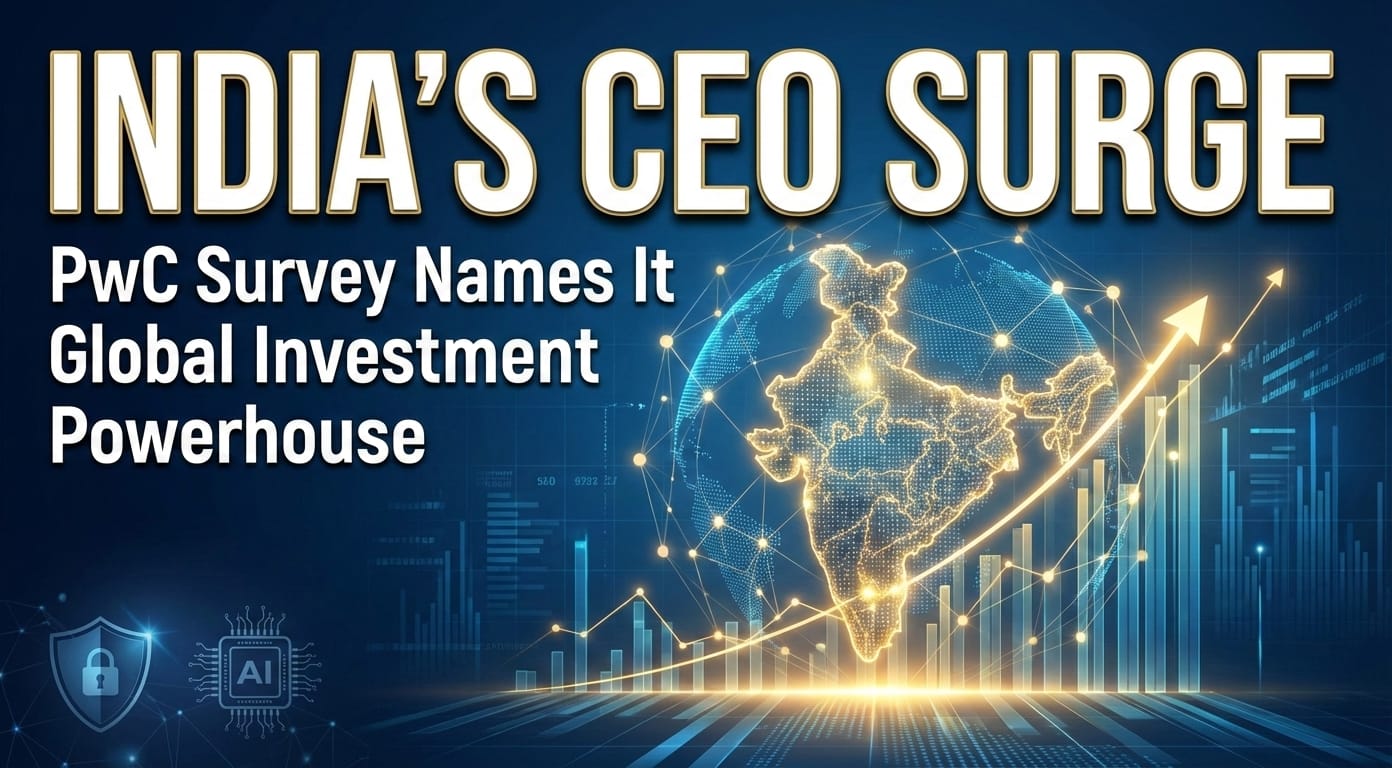
Global CEOs aren’t shy about where they’ll deploy capital next, and PwC’s 2026 survey puts India front and center. Fully 13% name it a top pick for major investments over 12 months, second only to America’s 35%, level with UK and Germany, ahead of others like UAE and France.
Yet the 2026 cycle has produced something harder to shrug off for India: not a single-state press release, not a one-off corporate pledge, but a measurable shift in how global CEOs rank India in their investment plans.
PwC’s 29th Global CEO Survey—released around the World Economic Forum’s Davos meeting—places India among the top three destinations for cross-border investment intentions over the next 12 months. The survey says that among CEOs planning to invest internationally, 35% picked the US, while 13% each selected India, the UK, and Germany, with the Chinese Mainland at 11%. That “13% for India” matters because it signals preference, not praise: CEOs are effectively telling PwC where capital is more likely to go, even when the global mood is cautious.
PwC’s India-focused report also underlines the contrast in confidence. While 55% of CEOs globally believe growth in their own territory will improve over the next 12 months, 77% of Indian CEOs say the same about India. And revenue confidence is notably stronger: 57% of Indian CEOs are “very or extremely” confident about near-term revenue growth, compared with 30% globally. In plain terms, Indian boardrooms are still leaning forward, while many global peers are leaning back.
But this optimism is no longer the wide-eyed kind. The risk list has been reshuffled. PwC records macroeconomic volatility (30%) and cyber risks (23%) as the top threats Indian CEOs feel exposed to over the next 12 months, with nearly half (48%) planning to strengthen enterprise-wide cybersecurity “to a large or very large extent.” This is a key nuance for anyone writing “India is booming” scripts: the CEOs aren’t denying growth, they are budgeting for shocks.
AI sits at the centre of both ambition and unease. PwC notes that 66% of Indian CEOs are concerned about keeping pace with technology and AI, compared with 42% globally.
Despite experimentation, only a portion of Indian CEOs report tangible AI upside so far—among those using AI at least to a moderate extent, 32% say revenues increased and 27% say costs decreased, suggesting results exist but are uneven and not yet universal. PwC also warns that foundations—not slogans—separate winners from laggards: organisations with stronger and broader AI foundations are reported to be 2.3 times more likely to see revenue growth and 1.7 times more likely to achieve cost reductions.
Another signal in the report is reinvention. PwC finds 57% of Indian CEOs say their companies have begun competing in new sectors over the past five years, higher than the 42% global figure, and the most favoured expansion areas for Indian CEOs include technology (20%), industrial manufacturing (16%), and aerospace and defence (14%). This matters because it frames India’s opportunity beyond “cheap labour” narratives—CEOs are describing a market where adjacency moves are already happening.
Now return to the Davos criticism: “agreements remain on paper.” A fair, evidence-aware way to address it in an India context is to say this: MoUs are not the same as realised investment, and many will not fully materialise; however, some Indian state delegations claim measurable conversion, which is at least a check against the idea that nothing ever happens. For example, Maharashtra’s Chief Minister Devendra Fadnavis said at Davos that the realisation rate of last year’s MoUs was 75%, while also announcing MoUs worth Rs 30 lakh crore at the 2026 meeting.
Even if such figures should be treated as claims until independently audited, they indicate that the India story at Davos is not only about signatures—it is also about follow-through being publicly tracked and politically owned.
In that sense, Davos 2026 offers India two parallel headlines that strengthen each other. One comes from the global perception layer: CEOs worldwide are increasingly willing to rank India alongside established Western destinations in their near-term cross-border investment priorities.
The other comes from the execution layer: India’s leaders and institutions are being pushed to prove delivery—especially in cybersecurity readiness, AI scaling, and the speed at which firms can turn opportunities into products and jobs.
India’s signal shines clear through PwC’s lens: global CEOs bet big because fundamentals deliver, local ones push forward with eyes wide on risks. The real test? Turning cyber shields, AI scale, and fresh sector bets into jobs, output, and edge that lasts.