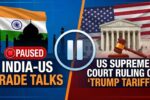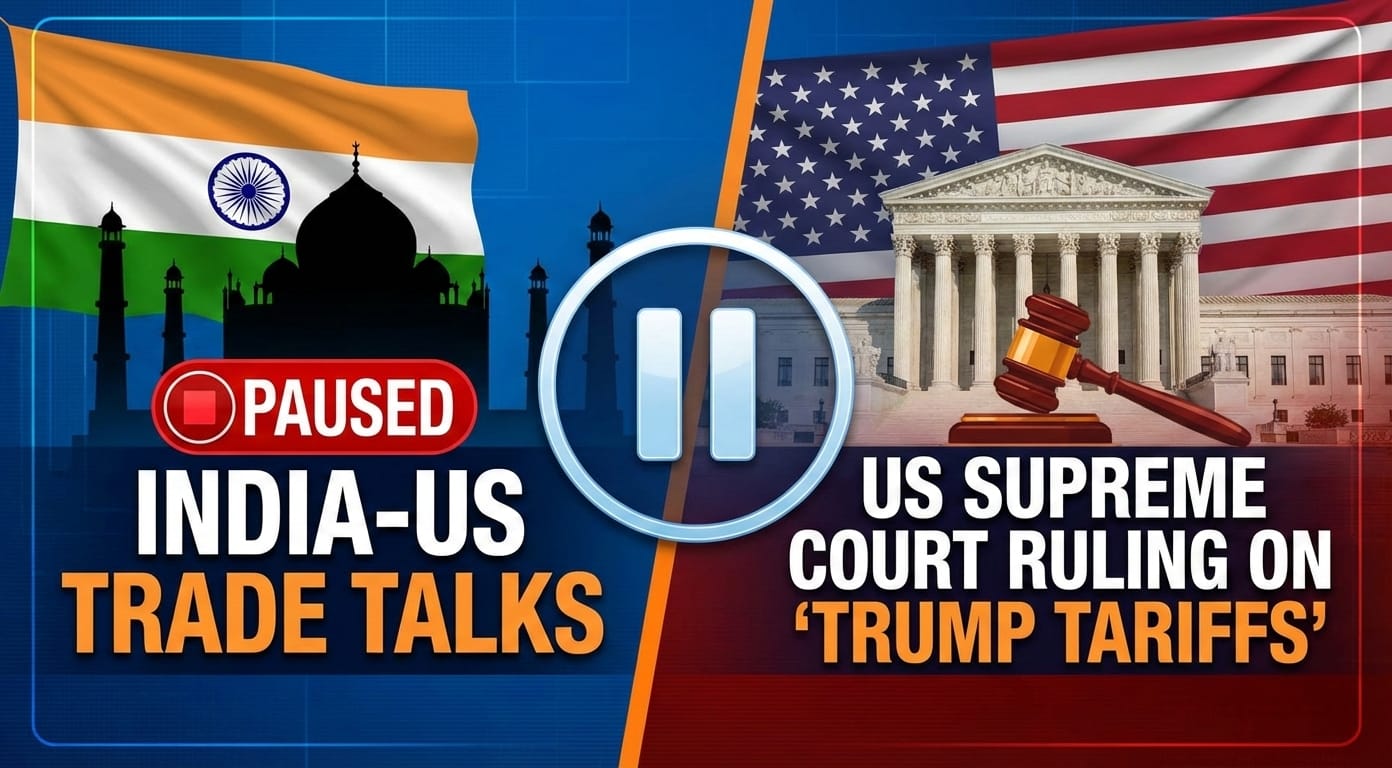
Just days before negotiators from India and the United States were set to sit across a table in Washington DC and convert a political handshake into binding legal text, a thunderclap arrived from the US Supreme Court. The three-day talks — Scheduled to begin on Monday and expected to give formal legal shape to the framework agreement struck earlier this month — have been rescheduled.
The court ruled that President Donald Trump had overstepped his executive authority by imposing sweeping tariffs under the International Emergency Economic Powers Act, better known as IEEPA. What was supposed to be the final leg of a high-stakes diplomatic sprint has now turned into an uncertain pause, one that has implications not just for trade volumes, but for the very legal architecture that underpins dozens of deals the Trump administration has rushed to conclude.
The timing of the Supreme Court’s intervention is striking. The Trump White House had been on an aggressive trade deal-making spree, inking framework agreements with nearly 20 countries in a matter of months. These arrangements, informal and swift by design, were never ratified by Congress — Procedural gap that critics had long flagged as a vulnerability.
Singapore-based trade analyst Deborah Elms of the Hinrich Foundation put it plainly, describing these as arrangements of questionable legal standing whose durability was always open to challenge. With the court now ruling against the IEEPA-based tariff authority, the scaffolding holding up these deals has visibly wobbled, and foreign governments and corporations alike are reconsidering their options.
For India, the pause is as much a strategic opportunity as it is an inconvenience. The framework agreement between the two countries had been constructed on the premise that India would extend market access to American goods — A concession that would have tangible consequences for domestic industries, from agriculture to manufacturing. Government officials had made it clear that such market access would only be unlocked after a legally signed agreement was in place.
With the talks now rescheduled and the legal basis of the American tariff regime in flux, New Delhi finds itself in a position where it does not have to immediately open its doors. President Trump declared on Friday that “nothing has changed” in the India-US deal, but the legal reality on the ground tells a more complicated story.
This is where the wisdom of cautious, process-driven diplomacy reveals itself. Governments that insist on legal finality before implementation are not being obstructionist — They are being prudent. India’s stance, that market access commitments follow only from a signed and legally sound agreement, has functionally served as a buffer.
By not rushing to execute its end of the bargain before the ink was dry on a verified framework, India has retained flexibility at a moment when the other side’s legal house is visibly in disorder. This approach of tethering concessions to legal certainty rather than political goodwill is a cornerstone of how sovereign nations protect their economic interests in negotiations where power asymmetries are real and the pressure to move fast is constant.
The broader question the Supreme Court ruling raises is about the architecture of American trade authority itself. After the court’s decision, the Trump administration pivoted swiftly to Section 122 of the Trade Act of 1974, which grants the President temporary tariff-raising powers, bringing the effective rate to 15 percent. But “temporary” is a word with real meaning in trade law, and the patchy legal patchwork being assembled in Washington is unlikely to inspire confidence among trade partners who need durability and predictability in their agreements.
Elms warned that foreign firms could file fresh lawsuits against the IEEPA-backed reciprocal tariff rates, and that foreign governments might choose to reopen negotiations rather than accept terms built on shaky legal ground.
Looking ahead, the trajectory of India-US trade relations is unlikely to be derailed permanently, but the road is now more complicated than either side had anticipated. The United States has signaled that new investigations into “unfair trade practices” are coming, sector by sector, covering semiconductors, electronics, drones, critical minerals, and pharmaceuticals.
These investigations, handled at the country level, can culminate in additional tariffs, and Elms assessed it as highly probable that these sectors will face higher duties in the months ahead. India’s steel and aluminium industries, which had been seeking relief and concessions under the broader trade framework, are watching these developments with particular interest. For New Delhi, the moment calls for vigilance: any future agreement must be negotiated with both eyes open to the evolving and unpredictable landscape of American trade law, where executive ambition and judicial oversight are now visibly in tension.
The rescheduled talks, when they do happen, will not simply be about translating a framework into legal text — They will be about building an agreement sturdy enough to survive the storms that the American political and judicial system has shown it is capable of generating.