India has signed a Comprehensive Economic Partnership Agreement (CEPA) with Oman, its second trade pact with a Gulf Cooperation Council country after the UAE. This reflects a clear strategic push to widen market access in West Asia as higher tariff barriers in the US market weigh on trade sentiment and investment decisions.
The agreement was signed during Prime Minister Narendra Modi’s visit to Muscat, where he framed the CEPA as a long-horizon decision intended to translate policy intent into measurable commercial outcomes, particularly through trade expansion, investment confidence, and sectoral opportunity creation.
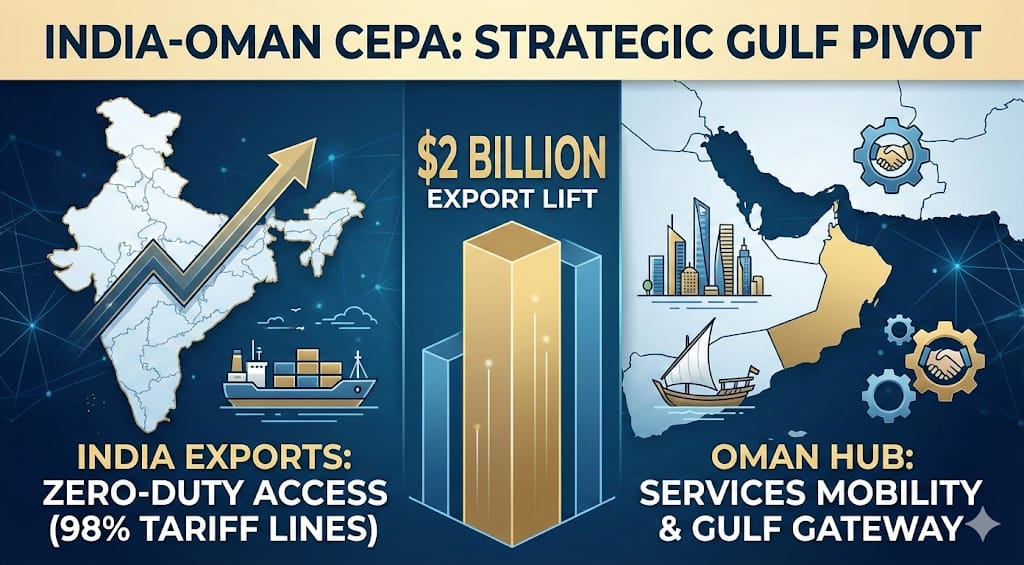
From India’s export perspective, the most significant lever is Oman’s offer of zero-duty access on 98% of its tariff lines, which the Indian side estimates could translate into roughly $2 billion of additional exports in the near term.
The likely winners are labour-intensive and MSME-heavy segments such as gems and jewellery, textiles, leather, footwear, sports goods, plastics, furniture, agricultural products and engineering goods. These categories where even moderate tariff cuts can quickly improve landed-price competitiveness.
This matters because, while a large share of Indian goods already enter Oman at an average tariff of around 5%, some tariff peaks reportedly go up to 100%, and removing these outliers can change purchasing decisions in price-sensitive product lines and institutional procurement.
India’s own tariff liberalisation is calibrated rather than across-the-board, with concessions on 77.79% of total tariff lines while ring-fencing sensitive areas. The protection list—dairy and several key agricultural commodities such as tea, coffee, rubber and tobacco, alongside gold and silver bullion and jewellery—signals a negotiating approach that prioritises export upside while containing domestic adjustment pressures. In practice, this structure also suggests India expects net gains not only from direct exports to Oman, but from using Oman as a regional logistics and re-export base, given its positioning and connectivity across the Gulf and into parts of Africa.
On the services side, the CEPA is designed to reduce frictions that typically restrict Indian firms even after goods tariffs fall. Oman has offered what India describes as unusually wide commitments under Mode 4, notably raising the quota for Intra-Corporate Transferees from 20% to 50%. It has also expanded the permitted stay for Contractual Service Suppliers from 90 days to two years, with the possibility of a further two-year extension. These provisions are commercially relevant because they lower compliance uncertainty for Indian IT, professional services, project engineering and healthcare-linked service providers that depend on predictable staff deployment timelines to deliver contracts.
Investment clauses add another layer to the economic logic of the pact. The Commerce Ministry has indicated the CEPA provides for 100% FDI by Indian companies in major services sectors in Oman, which could encourage Indian firms to shift from pure export models to “presence in market” strategies, including regional headquarters, warehousing, after-sales support, and project delivery units. Both countries have also agreed to discuss social security coordination in the future once Oman’s contributory system is implemented, a step that—if concluded—could lower the cost of deploying Indian skilled workers and improve long-term talent mobility.
The trade baseline suggests meaningful room for expansion, but with realistic ceilings. Oman’s annual imports are about $40 billion, and nearly two-thirds are machinery goods, a category where India has increased capabilities and scale. Indian exports to Oman have doubled in five years from about $2 billion to $6 billion, led by machinery and parts, aircraft-related items, rice, iron and steel articles, personal care products and ceramics. On the import side, India bought roughly $6.6 billion from Oman in FY2025, dominated by crude oil, LNG and fertilisers, plus chemical inputs such as methanol and ammonia—indicating that Oman’s gains will be concentrated in energy and industrial feedstocks, while India’s gains depend on export penetration and services execution.
The broader bilateral platform is already investment-linked, with over 6,000 India–Oman joint ventures in Oman and institutional vehicles such as the Oman-India Joint Investment Fund, which has fully deployed $320 million and is implementing a third tranche of $300 million. Large legacy projects like OMIFCO at Sur, a $969 million JV involving Omani and Indian partners, show the relationship’s industrial depth, while the two sides also signed additional agreements spanning maritime heritage, agriculture, higher education, food innovation and maritime cooperation—signals of a wider partnership architecture beyond tariff schedules. In political terms, the visit also carried symbolic weight as Sultan Haitham bin Tarik conferred the Order of Oman on Modi, reinforcing top-level commitment that often determines how quickly FTAs move from signature to utilisation.