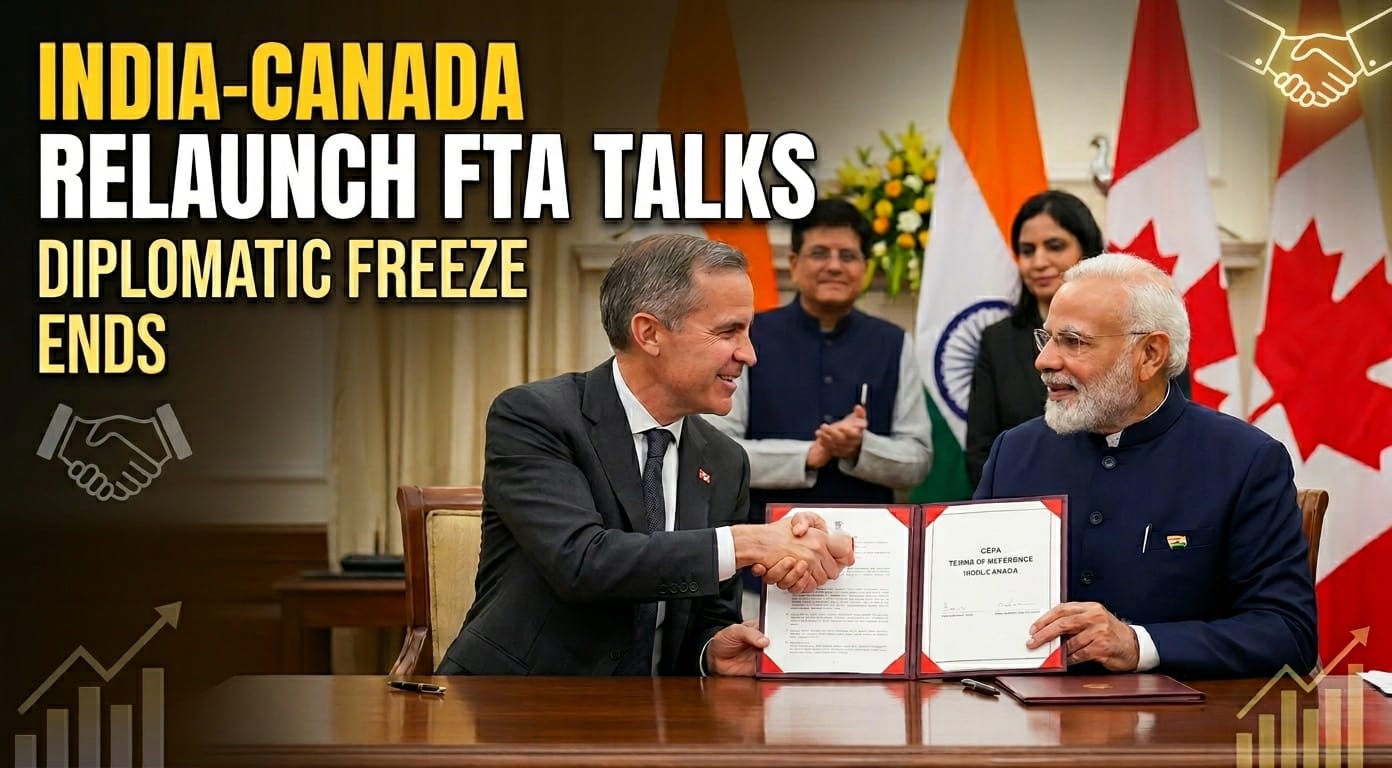
India and Canada on Monday formally revived their long-stalled trade negotiations by signing fresh Terms of Reference (ToR) for a Free Trade Agreement (FTA), officially known as the Comprehensive Economic Partnership Agreement (CEPA). The breakthrough comes two and a half years after former Canadian Prime Minister Justin Trudeau’s unsubstantiated allegation that Indian agents were involved in the killing of Khalistani terrorist Hardeep Singh Nijjar in Canada — a claim that plunged bilateral relations to their lowest point in decades.
The newly-agreed ToR, signed in New Delhi by Commerce Minister Piyush Goyal and Canada’s Minister for International Trade Maninder Sidhu, in the presence of Prime Minister Narendra Modi and Canadian Prime Minister Mark Carney, lays down the framework, frequency, and objectives for the CEPA negotiations. Both countries have pledged to move swiftly toward finalising a balanced and mutually beneficial deal. The meeting, held at Hyderabad House, symbolised not only a new diplomatic chapter but also India’s growing economic assertiveness on the global stage.
Prime Minister Modi, highlighting the renewed momentum, stated that both nations are determined to elevate bilateral trade to USD 50 billion by 2030. At present, trade between the two countries stands at USD 8.66 billion, with India’s exports at USD 4.22 billion and imports from Canada at USD 4.44 billion. Canada’s Prime Minister Mark Carney described the development as “the expansion of a valued partnership with new ambition, focus, and foresight,” calling it an effort by “two confident nations determined to deliver prosperity through partnership.”
This major diplomatic development marks another step in the normalisation of India-Canada ties, which had deteriorated sharply under Trudeau’s leadership. Trudeau’s political rhetoric, influenced by domestic pressures from Khalistani elements in Canada, pushed relations into deep freeze. His unwarranted public accusation in 2023 against India over Nijjar’s killing — without presenting any credible evidence — ruptured trust and caused India to suspend trade talks. Trudeau’s open courting of Khalistani sympathisers not only embarrassed his government internationally but directly hurt Canada’s long-term strategic and trade interests in one of the fastest-growing economies in the world.
Ever since Trudeau’s exit and Mark Carney’s rise to the premiership in 2025, Ottawa has visibly shifted course, adopting a pragmatic and forward-looking foreign policy approach. Canada is now slowly cosying up to India again, rebuilding the relationship on mutual respect and economic complementarity. The resumption of FTA negotiations and the signing of a historic CAD 2.6 billion uranium supply agreement marks Canada’s strongest outreach yet — 51 years after the two countries severed nuclear cooperation following India’s Pokhran-I test in 1974. The new pact, signed between Cameco Corporation and India’s Department of Atomic Energy, will ensure a long-term uranium supply for India’s civil nuclear energy programme and facilitate cooperation on small modular reactors (SMRs).
The uranium deal and broader energy collaboration form key pillars of a renewed India–Canada Strategic Partnership. Both sides have also agreed to intensify cooperation in clean energy, critical minerals, LNG, petroleum, technology, and defence — signaling a comprehensive upgrade of bilateral engagement. The leaders further decided to expand collaboration in cybersecurity, counterterrorism, immigration enforcement, and law enforcement communication channels, addressing cross-border threats such as extremism, narcotics, financial fraud, and cybercrime.
From a trade perspective, the CEPA framework is expected to unlock significant potential for both economies. India’s major exports to Canada include pharmaceuticals, iron and steel, seafood, cotton garments, electronic goods, and chemicals, while Canada primarily exports pulses, fertilizers, coal, crude, paper, pearls, and semi-precious stones. Services like telecom, IT, and business outsourcing, already among India’s strongholds, are likely to benefit immensely once the CEPA is concluded.
The revival of these negotiations comes at a time when India is actively pursuing trade expansion globally. Over the past year, New Delhi has signed a series of strategic trade accords, including the India–Australia ECTA (now upgraded to CECA), the India–UAE CEPA, and ongoing pacts with the UK and Gulf Cooperation Council countries. In 2025, India also concluded an expansive trade and investment partnership with the European Free Trade Association (EFTA), paving the way for deeper engagement with emerging and developed markets alike.
The timing of this India–Canada rapprochement carries strong geopolitical undertones. As Western economies diversify supply chains away from China, India’s economic scale, policy stability, and global standing make it an indispensable partner. Ottawa’s renewed alignment not only rebuilds trust but repositions Canada strategically in the Indo-Pacific framework — where India continues to emerge as a principal economic and security actor.
In essence, this revival of FTA talks represents not just an economic negotiation but the reconstruction of diplomatic intent between two democracies that briefly lost their way. Mark Carney’s approach to India stands in sharp contrast to Trudeau’s foreign policy missteps that allowed separatist and ideologically driven politics to harm bilateral engagement. For India, the move adds yet another feather to its cap of expanding global partnerships, reinforcing its position as a trusted and indispensable trade ally in an increasingly fragmented world order.