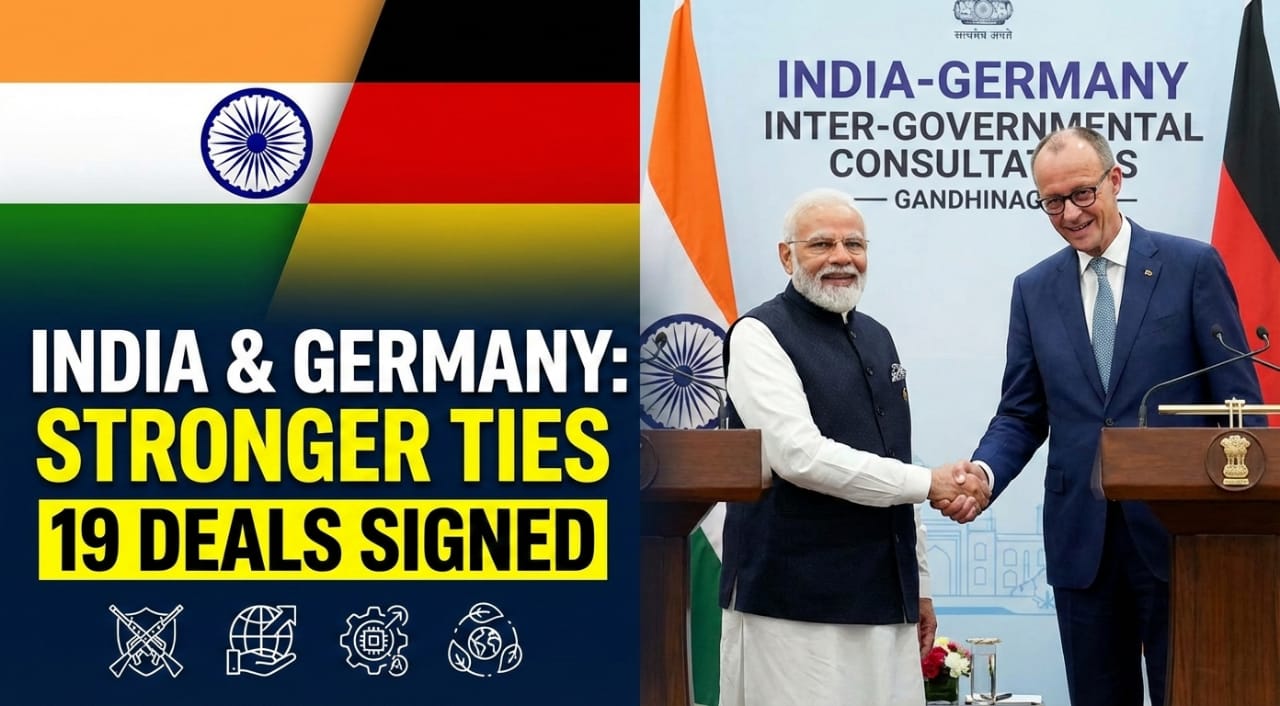
India and Germany are boosting their partnership with 19 agreements signed this Monday in Gandhinagar, Gujarat. Prime Minister Narendra Modi and German Chancellor Friedrich Merz agreed on deals about defense, trade, important minerals, tech, and visa-free airport transfers for Indian passport holders passing through Germany.
These agreements arrive as both countries aim to depend less on China for important resources and strengthen their relationship given current global tensions, turning long-time friends into key strategic partners.
Right now, over 2,000 German companies are operating in India, investing heavily and creating jobs because they see India’s fast growth as a big win. Pm Modi mentioned during the press conference that trade between the two countries recently hit a record high of over $50 billion, an increase from $29.52 billion in FY25, with Indian exports at $10.54 billion.
This is good for India because it means more factories, tech, and money flowing into areas like cars and chemicals, where Germany does well. For Germany, India’s large market of 1.4 billion people provides a safe place to increase sales. Currently, 37% of German companies view India as a key sales location, and that number is expected to rise to 53% by 2030. These deals will create a CEO group to push trade even higher, perhaps doubling it soon, and will fund green projects with €1.24 billion under their Green and Sustainable Development Partnership.
There’s also a big boost for defense, with a joint statement for making weapons and equipment together. Instead of just being buyers, India and Germany will work together on projects like building submarines with ThyssenKrupp and working on helicopter systems. This will assist India in modernizing its military without relying too much on one supplier, like Russia.
More joint military exercises, navy ship visits, and training programs are planned, in addition to a new security discussion. This creates trust – PM Modi called it a symbol of mutual trust – which is important as India faces border threats and Germany is concerned about Europe’s security. As a result, India gains advanced tech and jobs in defense factories, while Germany gains new markets for its arms companies and shares the responsibility in troubled areas like the Indo-Pacific.
A shared stand against terrorism brings them closer. Both leaders spoke out against attacks like the Pahalgam massacre on April 22, 2025, where Lashkar-e-Taiba killed 25 tourists and one local in Kashmir’s Baisaran Valley, and the Delhi car explosion on November 10, 2025, that killed 15 people near Red Fort. They promised to take down UN-listed terror groups, approved legal aid agreements, and increased counter-terrorism talks. For India, this means global support against cross-border attacks from Pakistan; for Germany, it strengthens intelligence sharing as extremism spreads.
Tech and minerals are changing the game. A new Semiconductor Ecosystem Partnership will connect research, factories, and skills within the sector. India requires chips for phones, cars, and AI, while Germany desires supply outside of China. The critical minerals deal focuses on mining, processing, and recycling rare earths for batteries and wind turbines. Germany is watching India’s reserves to avoid China’s 90% control.
Also, green hydrogen, renewable resources, and the movement of health workers make it easier for Germany to deal with labor shortages. India receives advanced knowledge, R&D centers, and recycling technology to support its electric vehicle growth and aim for net-zero emissions by 2070. Germany secures stable resources for its energy transition, creating reliable supply lines in both directions.
There are benefits for people too. Indians passing through German airports like Frankfurt can skip visa problems, saving time and money on flights to Europe. Healthcare workers will have easier entry into Germany’s hospitals. These 19 agreements bring people, businesses, and security closer. As PM Modi stated, it’s about great chances – for India, jumping to tech leadership with jobs for young people; for Germany, a trustworthy Asian ally during uncertain times.
Trade passed $50B because of trust, and 79% of German companies are thinking about investing more in India by 2030. This partnership isn’t just official papers, it means jobs, safety, and a shared future, which proves friendship can build stronger connections than anything else.